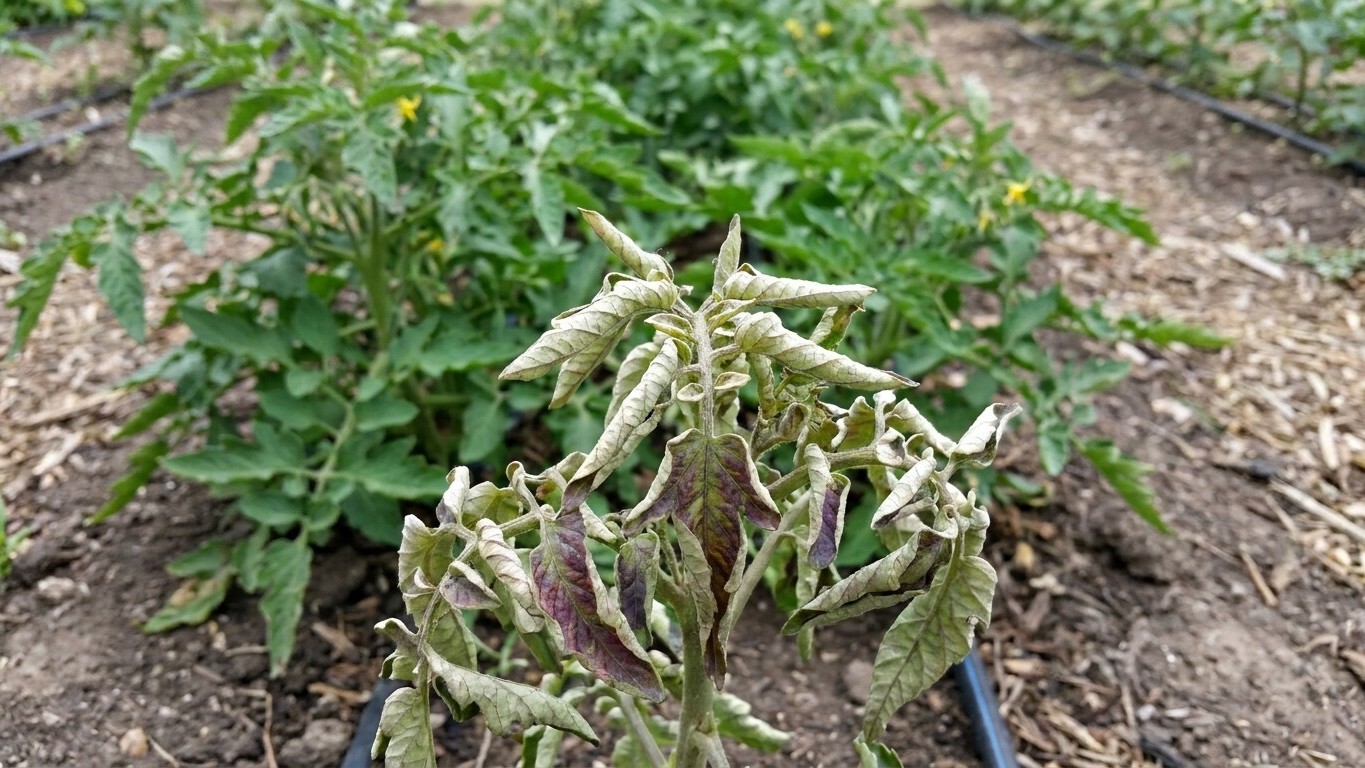

Curly Top is caused by Beet Curly Top Virus, carried by the beet leafhopper, and it does exactly what the name suggests: a tomato plant that was growing fine yesterday simply stops. Leaves curl upward and stiffen, veins turn purple, growth halts. There’s no cure. Whether it’s serious depends entirely on timing.
What you are looking at

Yes, this is serious, and it moves fast: a plant infected early can go from healthy to dead within a couple of weeks, while a plant infected later in the season simply stalls and never fills out. The tell isn’t a spot that spreads leaf by leaf the way a fungus does. It’s the whole plant, or a whole branch, changing character almost overnight.
Sudden stunting with no new growth
The clearest sign is a plant that stops adding height or new leaves while its neighbors in the same row keep growing. There’s no gradual slowdown. One week it’s tracking with the row, the next it’s frozen in place, top growth bunched and tight instead of spread out.
Upward-curling, stiff leaves
Leaves roll upward along their length, sometimes so tightly they look like narrow tubes rather than flat blades. They feel thick and leathery, almost brittle, rather than soft and pliable like a healthy leaf. This starts on younger, upper leaves and the whole plant tends to take on the same texture within days.
Purple veins on the underside
Flip a curled leaf over and look at the veins. On an infected plant they often show a distinct purple or reddish-purple discoloration, especially near the leaf base, standing out against the pale green tissue around them. This purpling is one of the more reliable visual markers, because few other tomato problems turn veins this color.
Yellowing between the veins
Between those purple veins, the leaf tissue often turns pale yellow while the veins themselves stay dark, giving the leaf a mottled, almost stained-glass look. It’s different from a uniform yellowing across the whole leaf, which points more toward a nutrient issue.
Fruit that ripens too soon on a stalled plant
Fruit already set before infection sometimes ripens prematurely, staying undersized, while the plant around it has stopped producing new blossoms or foliage. A plant loaded with small, oddly early-ripening tomatoes and no fresh growth at the top is a strong match for curly top.
What it is not
Mistaking curly top for something else costs a gardener either wasted effort (spraying fungicide on a virus, which does nothing) or wasted hope (waiting for a plant to “grow out of it” when it never will). Three conditions get confused with it most often, and each has one visual detail that settles the question.
Tomato Yellow Leaf Curl Virus
This one also curls leaves upward and stunts the plant, and it’s easy to see why the two get mixed up. The difference is the vector and the pattern of yellowing: TYLCV leaves cup upward with distinct yellow margins running along the leaf edge, rather than the purple-veined mottling of curly top, and infection tends to spread through a planting gradually as whiteflies move plant to plant, instead of appearing as isolated plants scattered across a row. Confirming which one you have matters for control, since the vector is a whitefly rather than a leafhopper, and management steps differ accordingly.
Herbicide Drift Injury
Drift from a broadleaf herbicide like 2,4-D twists and narrows new leaves into strap-like, distorted shapes, and it can look alarming fast. The giveaway is direction and recovery: drift damage usually shows up on the side of the plant facing the source, often affects several plants and even several species in the same pattern, and new growth that emerges weeks later is normal again as the chemical dissipates. Curly top doesn’t recover, doesn’t follow a directional pattern tied to a spray event, and doesn’t produce the strap-shaped, ribbon-like leaves typical of hormone herbicide injury.
Physiological Leaf Roll
Ordinary leaf roll from heat, uneven watering, or heavy pruning also curls leaves upward, and it alarms a lot of new gardeners every summer. The difference is that the plant keeps growing normally underneath the curl, fruit set continues, and there’s no purple vein discoloration or yellow mottling. The curling usually eases once watering evens out or temperatures drop, whereas a curly top plant stays stalled regardless of how well it’s watered afterward.
Where it comes from and when it strikes
Beet Curly Top Virus doesn’t travel through soil, water, or pruning tools. It moves almost entirely inside the beet leafhopper, a small, wedge-shaped insect that picks up the virus feeding on an infected plant and can pass it to a healthy one in a single brief feeding, often in under a minute. That speed is part of what makes this disease hard to stop once a leafhopper has visited.
The insect overwinters and breeds on weedy rangeland and dryland vegetation, including mustards and various winter annual weeds common across arid and semi-arid parts of the western United States. As that vegetation dries out in late spring and early summer, leafhoppers move off the range and into irrigated gardens and fields looking for green tissue, sometimes carried long distances on wind currents rather than simply hopping from one nearby plant to the next.
Warm, dry, sunny conditions favor both the leafhopper’s activity and its migration into cultivated ground, while the insect tends to avoid shaded, humid environments. This is one of the few common tomato problems where wet leaves and splashing water play essentially no role at all. A single flight of leafhoppers passing through a garden during hot, dry weather can infect scattered plants across a row in one afternoon, which is why curly top so often shows up as isolated, randomly placed sick plants rather than a patch spreading outward from one point.
What to do about it now
Once the purple veins and frozen growth show up, that plant is not coming back. There’s no spray, soil drench, or fertilizer that reverses a virus, and no treatment cures a plant already infected. The honest move is to pull it, since a stunted, non-producing plant is only tying up space and, in some cases, still hosting virus that a leafhopper could pick up and carry to a neighbor.
Removing and destroying the infected plant, rather than composting it, reduces that risk, though by the time symptoms appear the leafhopper responsible has often already moved on. Because transmission happens in seconds during a single probe, insecticides sprayed after the fact rarely prevent infection on plants the leafhopper has already visited, and shouldn’t be relied on as a rescue treatment.
What actually helps the rest of the planting is physical protection: shade cloth or floating row cover over young transplants creates both a barrier and an environment leafhoppers tend to avoid, since they favor bright, open, sunny conditions. Keeping nearby weedy areas mowed or cleared reduces the population building up next to the garden in the first place. Reflective mulch under plants has shown some ability to disrupt leafhopper landing behavior in various crops, and it’s a low-cost step worth adding.
On the food-safety question, the harvest is fine. The virus doesn’t produce any toxin and doesn’t make the fruit unsafe to eat. Fruit that had already ripened before the plant stalled is perfectly good; what’s lost is the fruit that would have formed afterward, not the safety of what’s already on the vine.
Keeping it out next season
Crop rotation, so useful against soil-borne diseases, does very little here, because the virus doesn’t persist in garden soil at all. It survives in the leafhopper itself and in the weedy plants the insect feeds on between seasons, which means the fix has to target the insect’s habitat and behavior rather than the planting bed.
Clearing or mowing weedy borders, ditches, and vacant ground near the garden before the leafhopper’s spring and early-summer migration cuts down the population moving in. Row covers or shade cloth over transplants during that migration window offer the most direct physical protection, since a leafhopper that can’t land on a leaf can’t transmit anything.
On the seed rack, resistance to curly top isn’t marked with a standard letter code the way Verticillium wilt (V), Fusarium wilt (F), or nematodes (N) are on tomato packets, and no widely recognized cultivar resistance code for this disease is published in mainstream seed catalogs. Gardeners in leafhopper-prone regions rely instead on cultural barriers rather than a resistant variety pulled off the shelf.
Sourcing transplants from a nursery rather than growing them exposed outdoors during peak leafhopper activity reduces the odds of bringing infected seedlings into the garden. Spacing plants to keep foliage from crowding, and locating the vegetable patch away from dry, weedy field edges where leafhoppers breed, both lower the chances of a repeat.
Common questions
Can one infected tomato plant infect the ones next to it directly?
Not on its own. The virus needs the beet leafhopper to move it from plant to plant; there’s no direct plant-to-plant spread through touching leaves, tools, or roots.
Will a stunted plant ever start growing normally again?
No. Once the virus takes hold, the stunting and leaf curling are permanent for that plant’s lifespan. Removing it is more useful than waiting.
Does curly top affect other garden vegetables besides tomatoes?
Yes, the beet leafhopper feeds on a wide range of hosts, including beets, peppers, beans, and various weeds, so a garden with one infected tomato may show symptoms on other crops too.
Is it worth spraying insecticide as a preventive measure?
Rarely worth relying on alone. Because transmission happens in a single quick probe, insecticide often can’t act fast enough to stop infection; physical barriers like row cover during the leafhopper’s active migration period are generally more effective.