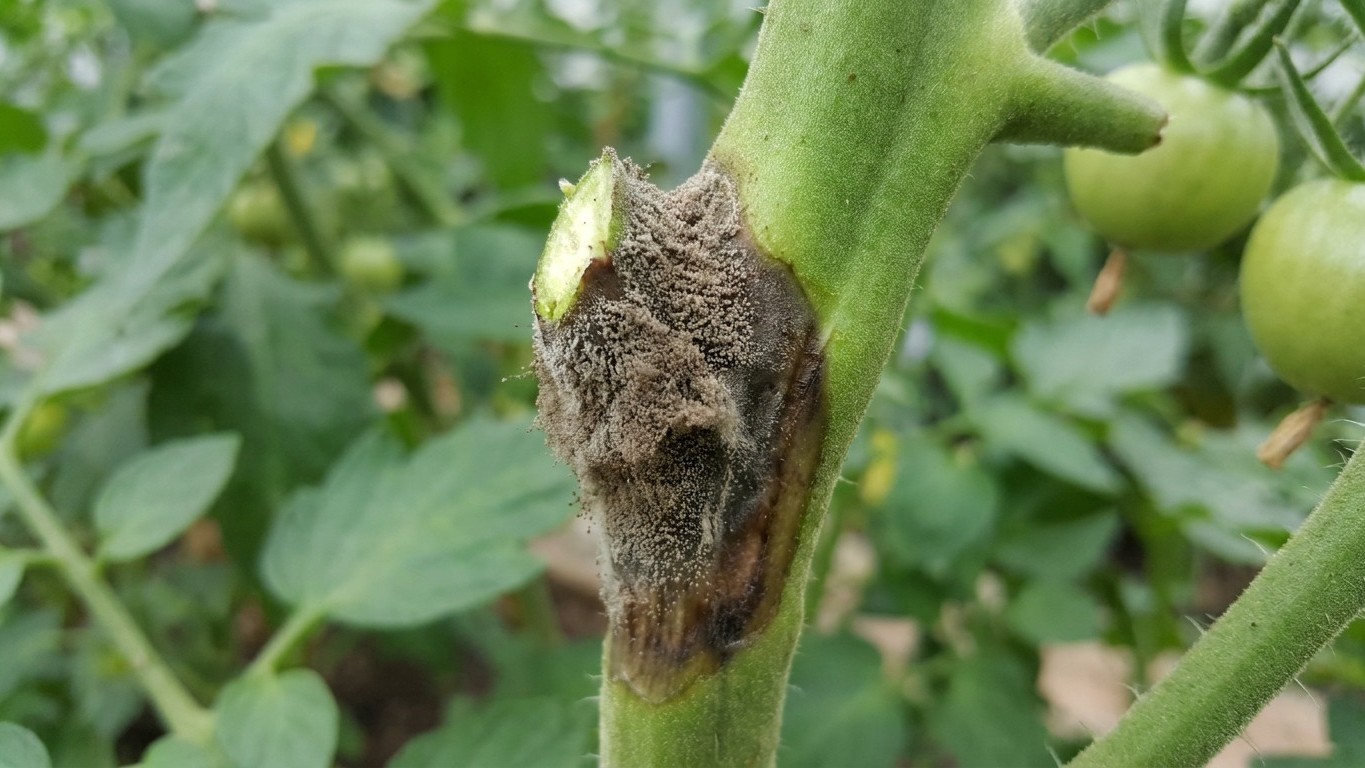

Gray fuzz clustered around a pruning cut, a broken stem, or a spent flower is almost always Botrytis cinerea, the fungus known as gray mold. It moves into the plant through wounds and dying tissue rather than healthy leaves, and once conditions turn cool and damp it can spread fast, but it rarely kills an otherwise vigorous plant outright.
What you are looking at

This is a wound pathogen, and that single fact explains almost everything else about how it behaves. It does not usually punch through intact leaf surfaces the way late blight does. It waits for an opening: a pruning scar, a hail nick, a broken side shoot, a bruise from a stake, or a flower that has finished blooming and started to die back. Once it gets a foothold in that dead or damaged tissue, it can then move into healthy stem beyond the wound margin.
Fuzzy growth at pruning wounds and stem breaks
Look first at any spot where you removed a sucker or where a stem snapped in wind. A gray-brown, felty mold forms right at the cut edge, sometimes tinged with a dusty look under a hand lens, that dust being millions of spores. The tissue beneath softens and turns tan to brown, and a sharp line often separates dead tissue from the still-firm stem above it.
Collapsing blossoms and stem cankers
Spent flower clusters are a favorite entry point. A blossom that should simply dry up and drop instead turns slimy and gray-fuzzed, and the fungus rides that dead tissue down into the stem behind it, producing a tan, sunken canker that can girdle a stem if left alone long enough to encircle it.
Ghost spots on green and ripening fruit
On fruit, gray mold rarely produces the full fuzzy coating gardeners expect. Instead it leaves small, roughly quarter-inch rings with a pale halo and a slightly darker or lighter center, sometimes called ghost spots. They mark where a spore landed and started to germinate before the fruit’s own defenses stopped it cold, leaving a cosmetic ring rather than a rot.
None of this spreads with the speed of a true blight. A gray mold outbreak generally builds over a week or more of damp weather rather than overtaking a planting overnight.
What it is not
Three other problems get mistaken for gray mold often enough that the mix-up is worth untangling, because the wrong call leads to the wrong response, and in one case a delay that costs the whole planting.
Late blight (Phytophthora infestans)
Late blight starts as water-soaked, irregular blotches on leaves, often larger than a gray mold lesion and with no wound needed to start it. The telltale sign is a ring of white, downy growth on the underside of the leaf, visible in the cool of early morning before it dries and disappears by midday. Late blight does not politely wait at a wound margin; it moves through green tissue and can collapse a planting within a week in the right weather. This is the one disease on this list worth reporting to a local extension office, because it also threatens nearby potato fields and neighboring gardens through wind-carried spores.
Septoria leaf spot
Septoria produces small, circular spots, often under a quarter inch, with a dark brown border and a tan or gray center that, under a hand lens, shows tiny black specks (the fungus’s fruiting bodies, called pycnidia). It starts on the oldest, lowest leaves and works upward slowly over weeks, not days. There is no fuzzy mold at all, gray or otherwise. It is a nuisance disease you manage, not an emergency you scramble to contain.
White mold (Sclerotinia sclerotiorum)
White mold produces a cottony, bright white growth on stems, thicker and more distinctly white than the gray-brown fuzz of Botrytis, and it eventually forms hard, black, irregular structures called sclerotia embedded in the rotted tissue, roughly the size and shape of a mouse dropping. Gray mold never produces those black sclerotia; that single detail is the fastest way to separate the two when a stem lesion looks ambiguous.
The stakes of confusing these matter. Treat gray mold like late blight and you will pull and destroy plants that could have been saved with simple pruning. Treat late blight like gray mold and wait it out, and you risk losing the whole row before you realize the mistake.
Where it comes from and when it strikes
Botrytis cinerea is a generalist fungus that survives between seasons as tough resting structures (sclerotia) or as fungal threads in old plant debris left in the soil or on stakes and cages. It is not fussy about its host either, infecting hundreds of plant species, which is part of why it is so widespread in gardens and greenhouses alike.
Spores form in enormous numbers on infected tissue and travel on air currents, splashing rain, and even on hands and pruning tools moving from plant to plant. They land constantly on tomato foliage and mostly do nothing, because intact healthy tissue resists them. The infection only takes hold once a spore finds a wound, a dying flower, or senescent leaf tissue to colonize first.
The weather that favors it is cool and humid with extended periods of leaf wetness, conditions common in early spring and late fall, in shaded or crowded plantings, and inside greenhouses and high tunnels where humidity lingers overnight. Dense foliage that traps moisture and blocks airflow is the single biggest risk factor a gardener controls directly.
What to do about it now
Start with removal. Cut out infected stems and blossom clusters several inches below any visible lesion, using clean, sharp shears, and do this on a dry day rather than right after rain or morning dew, since wet conditions help the fungus sporulate on the very cuts you are making. Bag and discard the debris rather than composting it in a home pile that may not reach temperatures high enough to kill the sclerotia.
Pull mulch or debris away from the base of affected stems and let the crown dry out. Stop overhead watering if you are still using it and switch to soaker hoses or drip irrigation at the soil line, since wet foliage overnight is exactly what this fungus needs. Thin dense foliage and space plants for airflow going forward.
A wilt or a stem canker that has already girdled a stem cannot be reversed; the tissue beyond that point is finished, and the honest move is to prune below it or remove the plant rather than treat and hope. As for the harvest, fruit with ghost spots is safe to eat; the ring is cosmetic scarring, not active rot, though badly affected or sporulating fruit should be composted or discarded rather than eaten. Fungicide sprays labeled for Botrytis can slow new infections on high-value plantings, but they work best as prevention before symptoms appear, not as a cure for tissue already collapsed.
Keeping it out next season
Because Botrytis survives broadly in soil debris and on a wide range of hosts, a short rotation offers limited protection compared to more host-specific tomato pathogens; even so, avoiding the same bed for tomatoes and other susceptible crops for a couple of seasons reduces the local spore load along with other soil-borne problems.
Unlike Verticillium wilt or Fusarium wilt, which have well-known resistance codes (V and F) printed on seed packets, gray mold resistance is not a standard trait bred into commercial tomato varieties, so no letter code exists to shop by here. Sanitation and airflow do the heavy lifting instead.
- Disinfect stakes, cages, and pruning shears between seasons and between plants if disease was present
- Lay mulch to stop soil splash from carrying spores and debris up onto lower leaves
- Space plants generously and prune suckers regularly to keep the canopy open to light and moving air
- Remove spent blossoms and any dropped petals caught in leaf axils, since they are prime infection sites
- Buy transplants from a supplier with clean, well-spaced greenhouse stock rather than crowded flats showing any gray fuzz
Greenhouse and high tunnel growers get the most consistent payoff from venting to cut overnight humidity, since that single change addresses the exact condition this fungus depends on.
Common questions
Is gray mold on tomatoes dangerous to people?
No. Botrytis cinerea is a plant pathogen and does not infect humans. Fruit showing only cosmetic ghost spots is fine to eat once trimmed and washed as normal.
Can gray mold spread from tomatoes to other garden plants?
Yes, more easily than most tomato diseases. Botrytis infects a very wide range of species, including strawberries, peppers, roses, and many ornamentals, so infected debris left in a garden bed can seed problems well beyond the tomato patch.
Will removing infected stems save the rest of the plant?
Usually, yes, if you cut well below the visible lesion in dry weather and disinfect your tool afterward. The plant can continue producing from healthy growth above and around the removed section.
Does gray mold ruin the whole tomato fruit?
Not typically. The ghost spot pattern common on fruit is a surface ring, not a full rot, and affected fruit is generally still usable after trimming. A fruit that is fully soft, sunken, and sporulating with visible fuzz should be discarded rather than eaten.