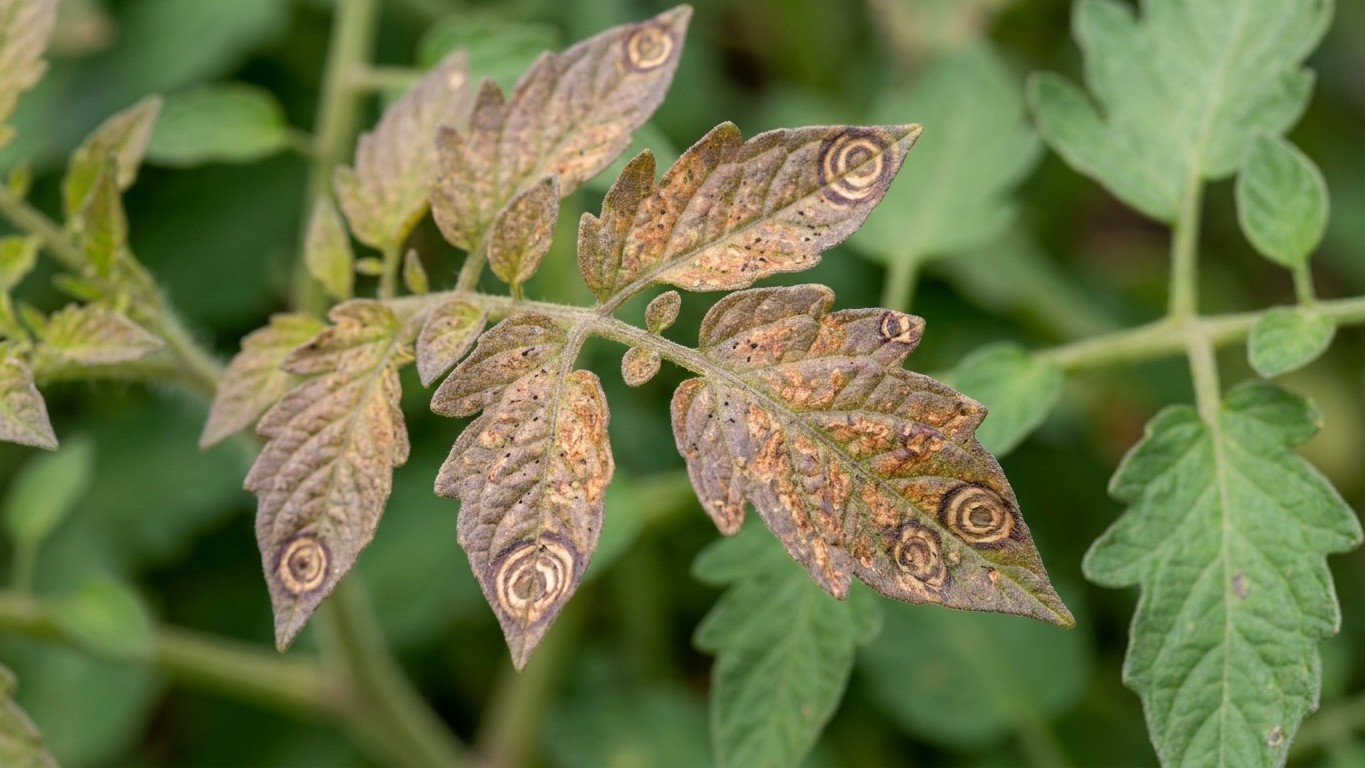

Bronze, ring-marked leaves on the upper growth and target-like rings on the fruit itself point to tomato spotted wilt virus, a disease carried by thrips rather than spread through soil or water. It moves fast once thrips populations build, and there is no cure. Removing infected plants is the only real response.
What you are looking at

Tomato spotted wilt shows up first on the youngest leaves, not the old ones near the ground, and that single detail rules out most fungal leaf spots before you even look closer. Yes, it is serious: a plant that tests positive will not recover, and the virus can spread to neighboring plants as long as thrips are active. It moves over days to a couple of weeks, faster in warm weather when thrips are reproducing quickly.
Bronze discoloration on young upper leaves
The newest growth at the top of the plant takes on a dull bronze or purplish-brown cast, sometimes with small dark flecks scattered across the leaf surface. The leaf doesn’t yellow uniformly the way a nutrient problem would; the bronzing has a slightly mottled, uneven look, as if someone had dusted the leaf with rust-colored powder.
Concentric ring spots on leaves
As the disease advances, distinct dark rings appear on the bronzed tissue, alternating light and dark bands that form a bullseye pattern. These rings are smaller and more tightly spaced than the target lesions of fungal blights, and they tend to cluster near the leaf tip and margins rather than spreading from a single center point.
Ringspots on green and ripening fruit
Fruit is where the disease becomes unmistakable. Green fruit develops raised or faintly sunken rings, and as the fruit ripens those rings turn into yellow and red bullseye patterns on the skin, sometimes several concentric circles deep. This fruit symptom doesn’t occur with the common fungal diseases, which makes it the single most reliable confirmation.
One-sided stunting and purple stem streaking
Growth often stalls on one side of the plant while the other side continues more normally, giving the whole plant a lopsided, stunted silhouette. Stems and petioles can show dark purple or brown streaking, and the growing tip may die back entirely while lower foliage still looks reasonably green.
What it is not
Three conditions get confused with tomato spotted wilt often enough that a gardener treating the wrong one wastes a season, and in the case of an actual virus, wastes fungicide on a problem no fungicide touches.
Early blight
Early blight (caused by the fungus Alternaria solani) also produces concentric ring lesions, which is exactly why it gets mixed up with spotted wilt. The difference is location and company: early blight starts on the oldest, lowest leaves, each ring lesion surrounded by a distinct yellow halo, and it never produces the bullseye pattern on fruit that spotted wilt does. Treating early blight as a virus means skipping the fungicide and sanitation that would actually slow it down; treating spotted wilt as early blight means spraying a fungicide that does nothing while the virus keeps spreading through thrips.
Septoria leaf spot
Septoria produces small, circular spots with dark margins and tan or gray centers, each center dotted with tiny black specks visible with a hand lens. It starts low on the plant like early blight, spreads upward, and never touches the fruit. There’s no bronzing, no bullseye rings, and no one-sided stunting, which makes it the easiest of the three to rule out once you know to check the fruit.
Curly top virus
Curly top is also insect-vectored, but by leafhoppers rather than thrips, and the symptoms diverge quickly: leaves curl upward and thicken, veins turn purple, and stunting is uniform across the whole plant rather than one-sided. Curly top does not produce the ring-spot pattern on leaves or fruit that defines spotted wilt.
| Condition | Where it starts | Lesion appearance | Fruit affected? |
|---|---|---|---|
| Tomato spotted wilt | Young upper leaves | Bronze color with dark concentric rings | Yes, bullseye ringspots |
| Early blight | Old lower leaves | Rings with yellow halo | Leathery spots at stem end |
| Septoria leaf spot | Old lower leaves | Small tan spots with black specks | No |
| Curly top virus | Whole plant, uniformly | Curled, thickened, purple veins | No ringspots |
Where it comes from and when it strikes
Tomato spotted wilt virus is a tospovirus, and it doesn’t travel the way fungal spores or bacteria do. It survives between seasons inside its insect vector, mainly western flower thrips, and in a wide range of perennial weeds and ornamental plants that host the virus without always showing obvious symptoms. A thrips larva that feeds on an infected plant carries the virus for the rest of its life, and the adult that emerges can transmit it to every tomato plant it feeds on afterward.
Arrival usually happens one of two ways: infected transplants brought in from a greenhouse where thrips were already present, or adult thrips blown in on wind currents from nearby infected weeds and ornamentals. Once thrips are established in a planting, they don’t need wet leaves or high humidity to spread the virus the way many fungal pathogens do. Warm, dry stretches that let thrips populations build quickly are what favor an outbreak, the opposite of the cool, damp conditions that favor most fungal tomato diseases. That distinction is worth remembering: overhead watering and poor airflow, the usual culprits behind fungal leaf spots, do little to explain a spotted wilt outbreak.
What to do about it now
There’s no treatment that cures a plant once it’s infected, and saying otherwise would be selling false hope. The virus is systemic, meaning it’s already moved through the plant’s vascular tissue by the time symptoms show on the leaves.
The most useful action is removal. Pull the infected plant, roots and all, and dispose of it away from the rest of the garden rather than composting it, since thrips can still feed on the discarded tissue and carry the virus to neighboring plants. Don’t wait for the plant to decline further; every day it stays in the ground is another day thrips can pick up virus from it and spread it.
Beyond removal, focus on the vector rather than the plant. Reflective mulch (aluminum-colored plastic) disrupts thrips’ ability to land on foliage and has shown real value in reducing new infections in a planting. Insecticides aimed at adult thrips have limited effectiveness against spotted wilt specifically, because transmission can happen in the brief time a thrips feeds before an insecticide takes effect; they’re worth using as one part of a broader approach, not a standalone fix.
Fruit that already shows ringspots is disfigured but not unsafe. The virus doesn’t produce anything toxic to humans, so fruit that’s otherwise ripe and sound can still be eaten; it just won’t look as appealing sliced or on the vine.
Keeping it out next season
Crop rotation, the usual advice for soil-borne tomato problems, does little here since the virus doesn’t persist in soil the way fungal spores do. It survives in weeds, ornamentals, and thrips populations instead, so managing those overwintering hosts matters more than rotating tomato beds.
Resistant cultivars exist and are worth seeking out. Seed packets and catalog listings that carry the code TSWV in their disease resistance letter string indicate a variety bred with tolerance to the virus, often built around a gene identified as Sw-5. Choosing one of these varieties is the single most reliable step available to a home gardener, since it removes the guesswork around vector control entirely.
Beyond variety selection, a few habits reduce risk meaningfully:
- Clear nearby weeds and volunteer plants that can host both the virus and its thrips vector over winter
- Source transplants from growers who screen greenhouses against thrips, since infected transplants are a common entry point
- Use reflective mulch at planting time to make it harder for thrips to locate and settle on young plants
- Space plants for good airflow and avoid crowding tomatoes next to ornamentals known to host thrips
None of these steps guarantees a thrips-free season, but combined with a resistant cultivar, they lower the odds considerably compared to planting a susceptible variety and hoping the thrips stay away.
Common questions
Can tomato spotted wilt spread from plant to plant without thrips?
No. Unlike some tomato viruses that spread through hand contact or contaminated tools, spotted wilt needs a thrips to acquire the virus from one plant and feed on another to transmit it. Controlling human-to-plant contact won’t slow this disease the way it would with a mechanically transmitted virus.
Is it safe to eat tomatoes with ringspot patterns?
Yes, ripe fruit affected by the virus is safe to eat. The ring pattern is cosmetic damage to the skin and flesh coloring, not a toxin or pathogen that affects humans.
Should I report a suspected outbreak to my extension office?
It’s worth a call, especially if multiple plants show symptoms at once, since local extension offices can confirm the diagnosis and may track thrips activity in the area. This is different advice from a fast-moving fungal disease that demands immediate reporting; spotted wilt spreads on the timeline of a thrips population, not overnight.
Will removing one infected plant stop the spread to the rest of my garden?
Removing the plant reduces the amount of virus available for thrips to pick up, but it won’t stop spread on its own if thrips are already present and feeding on other plants nearby. Pair removal with reflective mulch or resistant varieties for a real chance at limiting further infections.