
Georgia’s growing season is long enough for nearly any pepper to finish, but the state’s own temperature pattern decides which attempts actually set fruit. The reference station’s 35.8 days a year at or above 90°F is the number that matters most, because pepper flowers abort in that heat regardless of how much season is left on the calendar. Variety choice matters less than timing the transplant around that heat and around your own local nights.
The short answer

Start with the heat. Atlanta’s reference station averages 35.8 days a year at or above 90°F, based on the 1991-2020 NOAA NCEI Climate Normals. That’s not a handful of scorching afternoons scattered across summer, it’s more than a month of days when pepper blossoms are likely to drop before they ever set fruit. Pepper flowers are sensitive to heat stress at the moment of pollination, and a run of 90°F-plus days during flowering can shut down fruit set on an otherwise healthy plant for a week or more, even if the plant itself looks fine. This is why a garden can carry dozens of blooms in July and still show a stalled cluster of green fruit that never grows.
That heat number is a real measurement from a fixed weather station, and it tells you what the middle of a Georgia summer does to fruit set. It doesn’t tell you what a single backyard experiences on any given week, and it says nothing about the other threshold that governs peppers just as strictly.
The other end of fruit set failure is cold, not heat. Nights below 55°F cause the same kind of blossom drop as nights that are too hot, just through a different mechanism: pollen becomes less viable and flowers abort. This matters at both edges of the Georgia season, in the cool nights of a late spring before summer settles in, and again in early fall as nights start dropping back down. The problem is that this site does not carry summer night minimum data for Georgia or any other territory. There’s no reference figure here for how many nights in a typical Georgia summer dip below 55°F, and giving one without a source would be a guess dressed up as fact.
What that means practically: you have to watch your own nights, not assume anything from the state’s latitude or from how warm the coldest month of the year runs. A mountain garden in the north Georgia foothills and a coastal plain garden near the Florida line can differ by weeks in when their nights reliably clear 55°F, even though both are in the same state and both share the same 35.8-day heat count from the reference station. Track your own overnight lows through a thermometer or a local weather station reading rather than inferring them from a map. The heat number is measured and published. The night-temperature threshold is real biology, but the specific count of qualifying nights in your yard is something only your own observation can answer.
When to start seed here
Working out a seed-starting date for peppers in Georgia is a backward calculation, not a lookup. You start from the frost date, adjust for soil temperature, and then subtract the weeks a pepper seedling needs indoors before it’s ready for the ground.
- Find your last spring frost window. NOAA NCEI’s 1991-2020 Climate Normals, using freeze probabilities at the 30-70% band for reference station USW00013874, place Georgia’s last spring frost between March 11 and March 29. That’s a range, not a single date, and it comes with a real caveat: the reference station sits at an urban airport, which runs warmer than the surrounding countryside. North Georgia and the mountains typically freeze weeks earlier in fall and can run behind this window in spring, while the coastal plain tends to stay milder. Pin down where your county falls within or outside that March 11 to March 29 band before doing anything else.
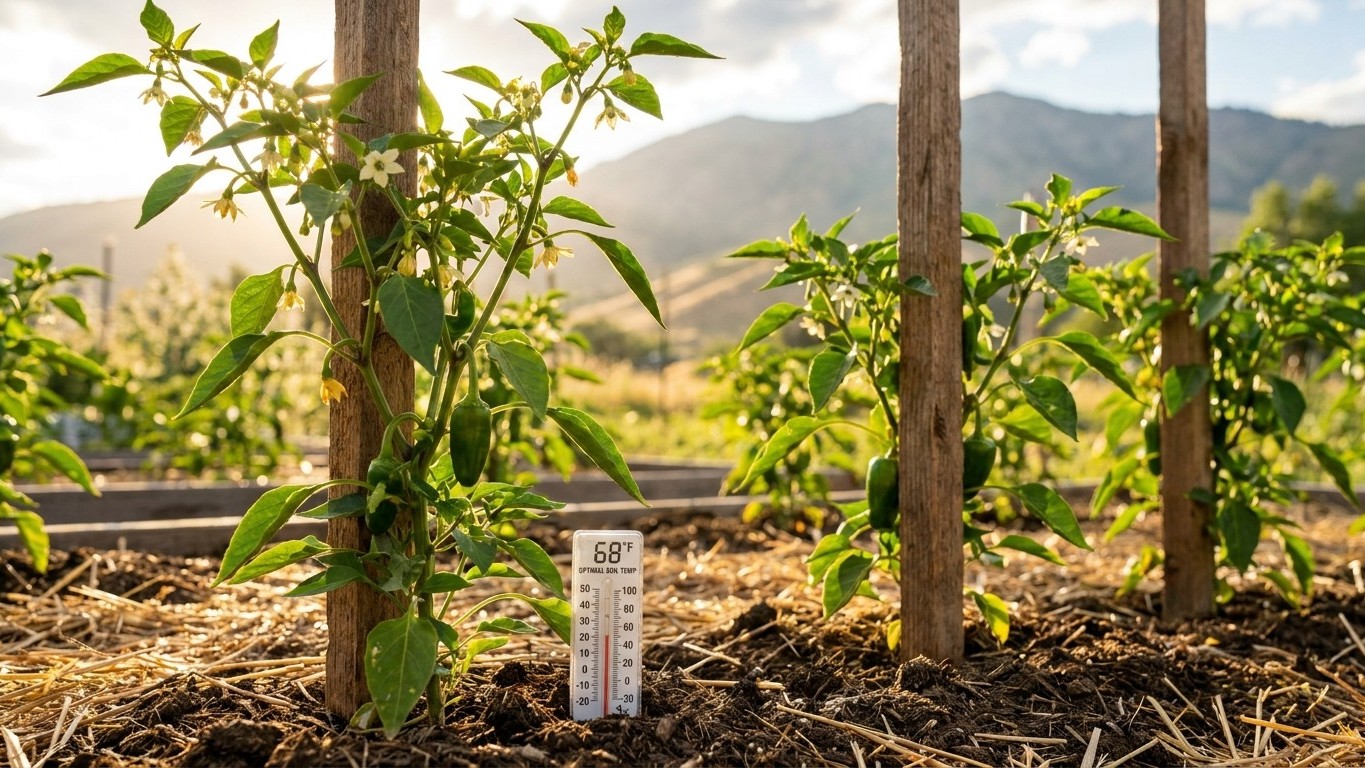
- Add the soil temperature condition. Frost date alone isn’t enough. Utah State University Extension’s guidance on peppers is specific: transplant only after frost has passed and only once soil temperature has reached 60°F. Soil often lags behind air temperature by a couple of weeks in early spring, so even if your calendar clears the frost window, cold soil can still stall a transplant. Check soil temperature directly with a probe thermometer a few inches down rather than guessing from the air.
- Subtract 8 to 10 weeks for indoor growing. Once you know your realistic transplant date, count backward 8 to 10 weeks, the window Utah State University Extension gives for how long pepper seedlings need indoors before they’re ready to go into the ground. If your soil clears 60°F in mid-April, for example, that backward count lands seed-starting somewhere in mid-to-late February, depending on whether you use the 8-week or 10-week end of the range.
- Recheck against your own microclimate before committing. The state-level frost window is a starting point, not a guarantee for your specific yard. A garden in a low spot that collects cold air, or one shaded by trees that delays soil warming, may need extra buffer beyond the published range.
Run the same arithmetic for your own county rather than borrowing Atlanta’s exact dates. The mechanism, frost date first, soil temperature second, indoor weeks subtracted last, holds everywhere in the state even though the actual calendar dates shift with elevation and distance from the coast.
What goes wrong here
Georgia’s particular mix of a long season with a hard heat spike in the middle produces a specific set of failures. Most of them trace back to the two-sided fruit set problem and to how strong the summer sun runs at this latitude.
- Blossom drop from a heat spell. When days push past 90°F, especially in a multi-day stretch, flowers open and fall without setting fruit. This lines up directly with the reference station’s 35.8-day average, which means most Georgia summers include enough hot days to interrupt fruit set at least once. The remedy isn’t a product, it’s timing and shade. Get plants established and flowering before the hottest stretch of summer arrives if your county’s transplant window allows it, and use light shade cloth over the plants during the worst heat waves to blunt the temperature spike hitting the blossoms.
- Blossom drop from a cool night. The same failure shows up at the other end, when overnight temperatures fall below 55°F, whether that’s a late cold snap in spring or an early cool front in fall. Since this site doesn’t carry night minimum data for Georgia, the fix starts with watching your own thermometer. If a cold night is forecast during flowering, floating row cover overnight can hold enough heat to keep blossoms from aborting.
- Sunscald on exposed fruit. Georgia’s summer sun is intense enough that fruit exposed after heavy pruning, or on plants that lost leaves to disease, develops pale, papery patches on the side facing direct sun. Leave enough foliage on the plant to shade developing fruit, and avoid removing large amounts of leaf cover during the hottest weeks.
- Blossom-end rot from uneven watering. Peppers develop sunken, leathery patches on the fruit’s blossom end when soil moisture swings between too dry and too wet, which interferes with calcium uptake even when soil calcium levels are adequate. Consistent watering on a schedule, along with mulch to hold soil moisture steady through Georgia’s hot, drying afternoons, addresses this more reliably than adding calcium products.
Common questions
Can I extend the Georgia pepper season past the first fall frost?
Row cover or a cold frame can buy some extra weeks once nights start dropping, but once temperatures fall consistently below the 55°F threshold that governs fruit set, new flowers won’t produce fruit regardless of protection. Fruit already set and sizing up is what benefits most from season-extension covers.
Does the 35.8 days above 90°F average mean every summer is the same?
No. That figure is a 1991-2020 average across many years at one reference station, so individual summers can run hotter or milder than the norm. Treat it as a planning baseline for how often you should expect a heat-driven blossom drop, not a guarantee of exactly 36 hot days every year.
Should I start seed earlier if I live in north Georgia versus the coastal plain?
Generally later in the mountains and earlier on the coastal plain, since the published frost window skews later at higher elevation and milder near the coast. Use your own county’s frost data rather than the Atlanta-based range if you’re outside the metro area.
Is there a published second frost threshold, like a light-frost date separate from a hard freeze?
Not in the data available for this article. The only frost figure sourced here is the 32°F freeze probability window from NOAA NCEI, March 11 to March 29. No separate light-frost or hard-freeze threshold is published in the sources used for this piece.