
Georgia’s pepper problem isn’t really the heat, it’s the two-sided squeeze: plants stall when nights turn cool in spring, then stall again when summer afternoons climb past the point where pollen stops working. Get the transplant date right, watch both ends of the thermometer, and choose from the Pepper Varieties That Ripen in a Georgia Season, and fruit set follows. Miss either window and you get tall green plants with almost nothing on them.
The short answer

The reference station in Atlanta averages 35.8 days a year at or above 90 F, according to NOAA NCEI Climate Normals covering 1991 through 2020. That’s not a handful of hot afternoons scattered through July. It’s more than a month’s worth of days, most of them clustered from mid-June into September, when pepper flowers are trying to set fruit in the middle of the growing season rather than at the edges of it.
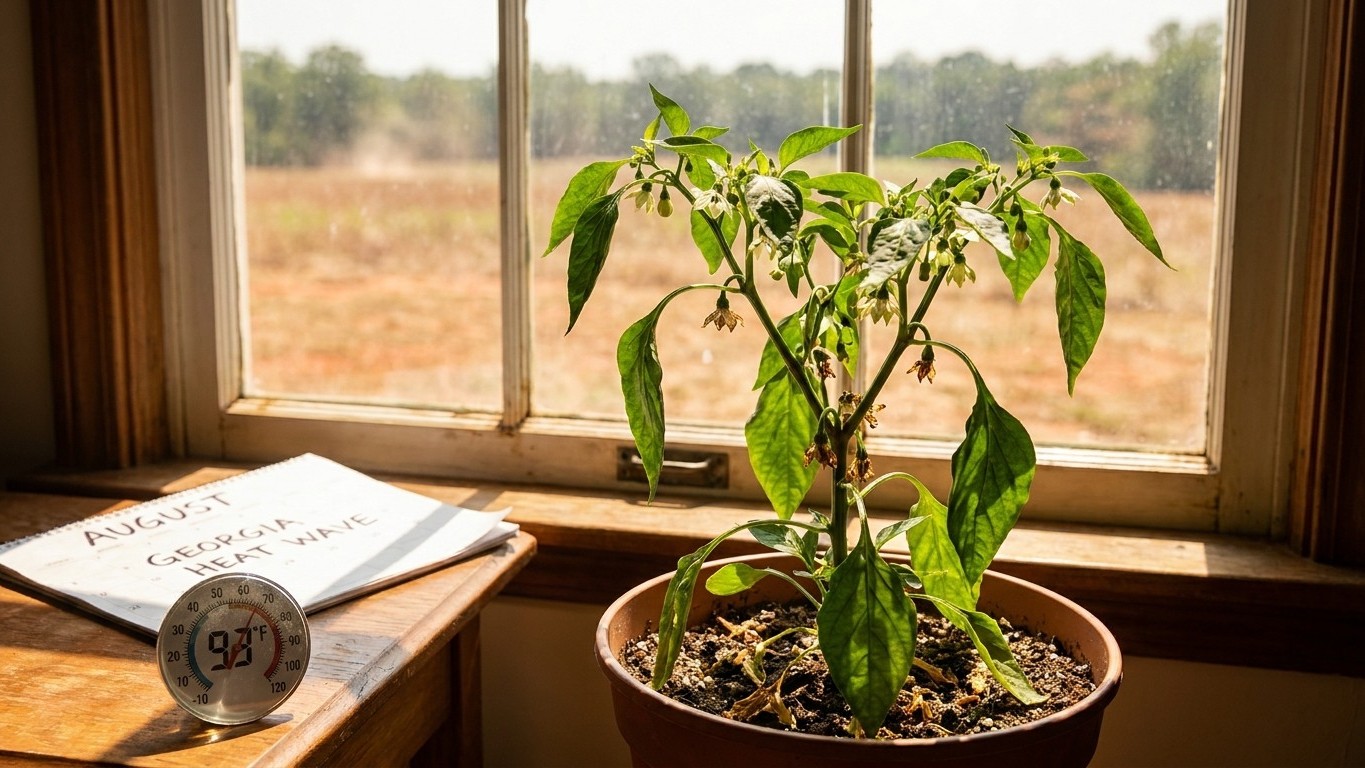
Pepper flowers don’t tolerate that kind of heat well. Pollen becomes less viable as daytime temperatures push past 90 F, and the plant responds by dropping blossoms rather than wasting energy on fruit that won’t finish. Understanding Why Peppers Fail to Set Fruit in Georgia helps explain why a grower who plants early enough to dodge frost, then watches the crop stop producing through the hottest stretch of summer, isn’t doing anything wrong. That’s the plant reacting to conditions the reference data already describes: over a month of 90-plus days baked into a typical Georgia summer.
The other end of the failure window matters just as much, and it’s the one gardeners tend to overlook because they’re focused on frost, not on chilly nights well after the frost has passed. Peppers also drop blossoms when nighttime temperatures fall below 55 F, according to Utah State University Extension. A cool snap in late spring, even one that never comes close to frost, can knock a young plant back the same way a heat wave does later in the season.
This is where the data most gardeners rely on runs out. This site carries the days-above-90 count for Georgia because that figure is tracked and published at the reference station. It does not carry summer night minimum temperatures for individual counties, and no reliable shortcut exists to estimate them. A county’s latitude tells you nothing reliable about how cool its nights run in May or June, and the coldest month of the year is a different measurement entirely from a random cool night in late spring. Elevation, tree cover, whether a garden sits in a low spot that collects cold air overnight, none of that shows up in a statewide average.
The practical move is to track your own nights for a couple of weeks around your intended transplant date. If lows are consistently sitting above 55 F, you’re clear on that end. If they’re bouncing below it, holding transplants under cover a little longer costs far less than losing a first flush of blossoms to a cold night nobody was watching for.
When to start seed here
Utah State University Extension puts pepper transplants at 8 to 10 weeks of indoor growing before they go in the ground, and says the move outdoors should happen after frost has passed and once soil temperature reaches 60 F. In Georgia, the frost end of that equation has a wide range, and the arithmetic works differently depending on where in the state a garden sits.
- Find your last spring frost window. NOAA NCEI’s 1991-2020 Climate Normals put the 32 F freeze probability window (the band where frost risk runs from 30 to 70 percent) between March 11 and March 29 for the reference station. That’s a range, not a single date, and it applies to one station. North Georgia and the mountains typically carry frost risk for weeks longer into spring than that window suggests, while the coastal plain tends to clear earlier. Atlanta itself sits in an urban heat island, so even the reference station’s own numbers run a bit warmer than the rural county next door.
- Add time for soil to warm past frost. Soil temperature lags behind air temperature, sometimes by several weeks, especially in spring when nights are still cool even after the last frost has passed. A garden that clears frost risk in mid-March may not see 60 F soil until well into April. There’s no substitute for checking soil temperature directly with a probe thermometer rather than guessing from the calendar.
- Count backward 8 to 10 weeks from that soil-ready date. If soil in your county typically reaches 60 F in mid-April, seed starting indoors should begin roughly 8 to 10 weeks earlier, which lands somewhere in mid-February. Push the transplant date later and the seed-starting date moves later with it, week for week.
- Recheck before the move outdoors, not just before starting seed. Soil temperature and overnight lows can run behind or ahead of a typical year. Confirming both right before transplant, rather than relying on the backward count alone, catches years that don’t follow the average.
None of this arithmetic is fixed to a single date for the whole state. A gardener in the mountains and a gardener on the coastal plain are working from different frost windows even though both are technically in Georgia, so the count-back has to start from local conditions, not from a statewide figure.
What goes wrong here
- Blossom drop from a hot spell. When daytime temperatures push past 90 F, a stretch this state sees roughly 35.8 days a year at the reference station, pollen viability drops and flowers fall without setting fruit. There’s no fix that changes the weather, but light afternoon shade cloth over the hottest week or two, and keeping soil moisture even so the plant isn’t fighting drought stress on top of heat stress, both reduce how many blossoms are lost.
- Blossom drop from a cool night. The same failure shows up at the other end, when nighttime temperatures fall below 55 F. Because this site doesn’t track summer night minimums by county, the only reliable check is watching your own thermometer through late spring. If a cold night is forecast right as plants are flowering, row cover overnight can hold enough warmth to protect that flush of blossoms.
- Sunscald on exposed fruit. Strong Georgia sun can scald pepper fruit that loses its leaf cover, whether from disease, pruning, or just an open plant habit. The fruit develops a pale, papery patch that eventually turns to rot. Keeping foliage full through the fruiting period, rather than aggressively pruning for airflow, is the more reliable guard, along with light shade cloth during the most intense stretch of summer.
- Blossom-end rot. This shows up as a sunken, leathery brown patch on the bottom of the fruit and traces back to inconsistent watering rather than a soil calcium shortage in most home gardens. Peppers that dry out between waterings and then get soaked can’t move calcium to the fruit evenly. Steady, even soil moisture, especially through the hot stretch when the days above 90 F pile up, matters more here than any soil amendment.
Checking this against your own county
Every figure here comes from a statewide reference station or a national dataset, and Georgia is too varied for either to describe every backyard. Mountain counties, the coastal plain, and the urban core around Atlanta each run on a different frost calendar, and soil warms at different rates depending on drainage and sun exposure.
The University of Georgia Cooperative Extension (extension.uga.edu) keeps county-level staff who track local frost history, soil conditions, and pepper variety performance specific to their area. Before locking in a transplant date from the arithmetic above, a call or visit to your county’s extension office is the fastest way to confirm whether your local frost window and soil warm-up match the statewide averages, or run meaningfully earlier or later.
Common questions
Why do my pepper plants flower but never set fruit in midsummer?
That’s almost always heat, not disease. Once daytime temperatures push past 90 F, a stretch Georgia sees close to 36 days a year at the reference station, pollen viability drops and blossoms fall without setting fruit. Production typically picks back up once the hottest stretch of summer passes.
Can I start pepper seeds outdoors instead of indoors?
Utah State University Extension’s guidance assumes an 8 to 10 week indoor start before transplanting once soil hits 60 F, after frost has passed. Direct-seeding outdoors in Georgia generally shortens the productive window too much, since peppers need that indoor head start to reach flowering before summer heat sets in.
Does the Atlanta frost date apply to my county?
Not directly. The March 11 to March 29 window comes from one reference station, and Atlanta itself runs warmer than surrounding areas due to its urban heat island. Mountain counties typically clear frost risk later, and the coastal plain earlier. Your county extension office can confirm the local pattern.
How do I know if my nighttime temperatures are too cool for fruit set?
There’s no statewide figure to check this against, since summer night minimums aren’t tracked at the county level here. The only reliable method is watching your own outdoor thermometer through late spring and early summer, and using row cover if a night below 55 F is forecast while plants are flowering.