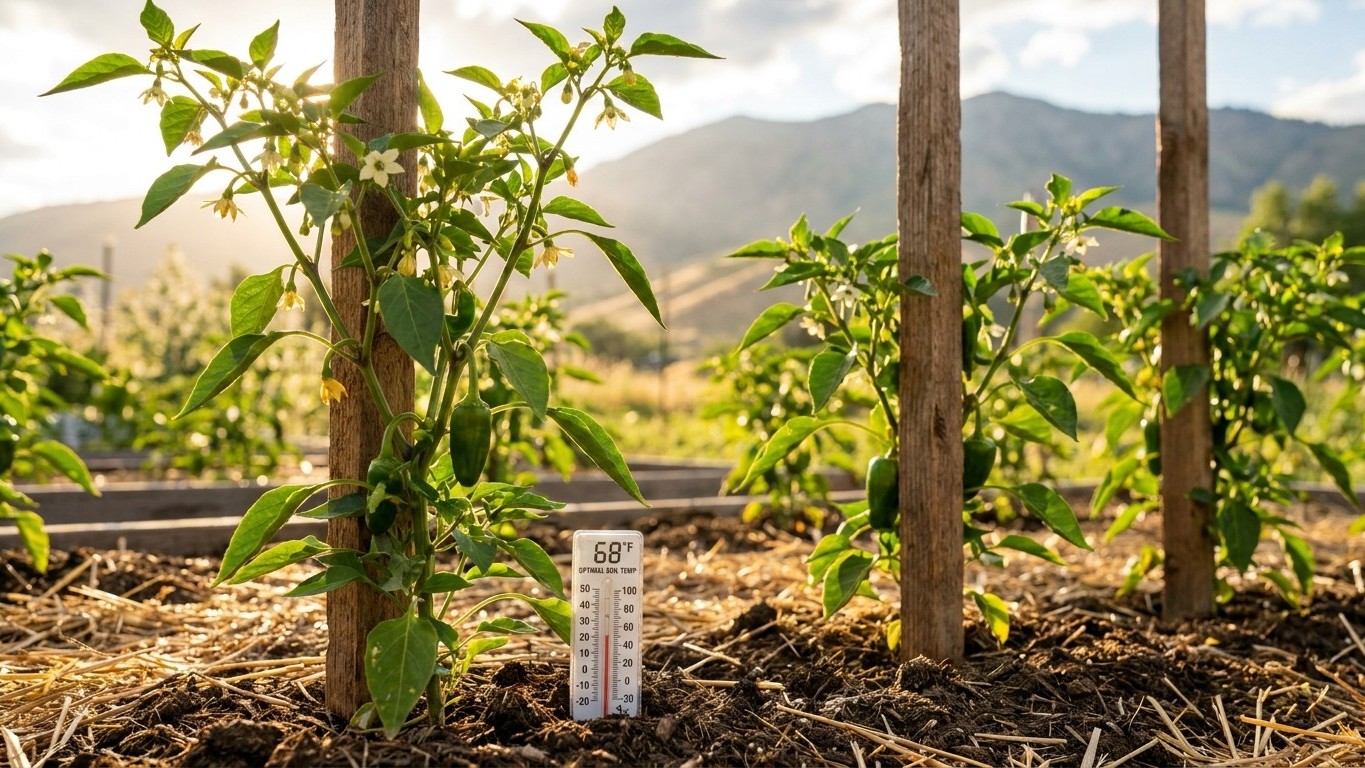

Most pepper varieties, from sweet bells to hot jalapeños, can ripen fully within an Indiana growing season if the transplant goes into warm soil after the last frost and gets an 8 to 10 week head start indoors. The limiting factor isn’t the calendar so much as two temperature thresholds that pepper flowers can’t tolerate: too hot, and too cold at night. Indiana crosses one of those lines regularly. The other one depends on where you garden.
The short answer

Indianapolis averages 14.6 days a year at 90 F or hotter, based on NOAA’s 1991-2020 Climate Normals. That’s not a brutal number compared to states farther south, but it’s enough to matter during the exact weeks when pepper plants are trying to set fruit. Pepper flowers drop instead of forming fruit once daytime highs push consistently above 90 F, a physiological response that has nothing to do with watering or fertilizer. The plant simply won’t hold the bloom. In a typical Indiana summer, that means a handful of days, usually clustered in a July or August heat spell, where flowering stalls even on a healthy, well-tended plant. Growers who see blossoms appear and vanish without fruit often assume disease or a pest. More often it’s just heat.
The other failure point sits at the opposite end of the thermometer. Pepper fruit set also fails when nighttime temperatures drop below 55 F, according to Utah State University Extension. Cool nights in spring or a stretch of unseasonably chilly weather in early fall can shut down flowering just as effectively as a heat wave, and this is the threshold gardeners tend to overlook because they’re focused on frost, not on the 55-degree mark specifically. A night can stay well above freezing and still be too cold for a pepper flower to hold.
Here’s the catch for Indiana growers: this site tracks days at or above 90 F for the state, but it does not carry summer night minimum data. That gap matters, because whether your peppers hit the cool-end failure threshold depends heavily on your specific location, elevation, and how close you are to a body of water or urban heat pooling, none of which can be reliably guessed from latitude or from how cold your winters run. A river bottom in southern Indiana can drop into the mid-50s on a clear August night while a spot ten miles away, closer to Lake Michigan’s moderating effect, doesn’t. The practical move is to track your own overnight lows with a simple min-max thermometer during the flowering weeks, rather than assume the state average tells you anything useful about your yard specifically.
When to start seed here
The timing math for pepper seed starting is straightforward once you know your local numbers, and it works backward from two fixed points: your last spring frost date and the soil temperature peppers actually need to grow.
- Find your last frost window. NOAA’s 1991-2020 Climate Normals put Indianapolis at April 9 to April 21 for the 30-70% probability band of a 32 F freeze. Southern Indiana tends to clear frost about two weeks earlier than that range, and northern counties run about two weeks later, so adjust from the Indianapolis anchor point rather than using it directly if you’re well north or south of the city.
- Add the soil temperature requirement. Peppers don’t just need frost gone; they need soil at 60 F before transplanting does any good. Cold soil stalls root growth even if the air feels warm enough, so check soil temperature with a probe thermometer rather than guessing from the calendar. In many Indiana springs, soil lags a week or two behind the air warming up.
- Count back 8 to 10 weeks for indoor seed starting. Utah State University Extension recommends starting pepper seed indoors 8 to 10 weeks before that transplant date. If your realistic transplant date lands around the last week of April, that puts seed starting somewhere in the last half of February to the first week of March, depending on which end of the 8-to-10-week window you use.
- Build in a buffer for the 10% chance of a late freeze. Purdue’s extension guidance notes there’s roughly a 10% probability of a 32 F event even after the published spring frost date clears. If you transplant on the early edge of your window, keep row cover or another frost protection method within reach for the first couple of weeks outdoors.
Redo this math with your own county’s frost data rather than Indianapolis’s, especially if you garden well north toward the Michigan line or well south along the Ohio River. The arithmetic stays the same; only the starting date shifts.
What goes wrong here
Indiana’s climate creates a specific set of pepper failures, and most of them trace back to the same two temperature thresholds rather than to soil quality or disease pressure.
- Blossom drop during a hot spell. When daytime highs climb past 90 F, even for a few consecutive days, pepper flowers abort and fall off without setting fruit. There’s no cure once the heat hits; the remedy is preventive shade cloth over the plants during the hottest stretch of summer, along with consistent watering so the plant isn’t also fighting drought stress on top of heat stress.
- Blossom drop during a cool night. The same failure happens in reverse when nights fall below 55 F, which can occur in a cool early-summer stretch or a chilly snap in early autumn before the season fully ends. Since this varies by exact location and isn’t tracked at the state level here, the remedy is to monitor your own overnight lows during flowering weeks and use row cover or cold frames to buffer a cool night if you see one coming.
- Sunscald on exposed fruit. Strong summer sun can scorch pepper fruit that’s left uncovered by foliage, especially on plants that have been pruned hard or that lost leaves to disease. The fix is maintaining full, healthy foliage cover through the growing season and avoiding aggressive pruning that exposes developing fruit directly to midday sun.
- Blossom-end rot. This shows up as a dark, sunken patch on the bottom of the fruit and comes from inconsistent water delivery interrupting calcium uptake, not from a lack of calcium in the soil itself. Even watering, on a regular schedule rather than a feast-or-famine pattern during hot or dry stretches, prevents most cases.
Common questions
Can I still get a full pepper harvest if I transplant late in Indiana?
A late transplant, combined with a stretch of days above 90 F later in summer, narrows the window when flowering can actually set fruit. Starting seed 8 to 10 weeks before your local frost-clear date, rather than pushing transplanting later, gives peppers the best shot at ripening before fall temperatures shift.
Does Indiana’s number of 90-degree days make hot peppers harder to grow than sweet bells?
The 55 F and 90 F fruit-set thresholds apply to peppers broadly, not to hot varieties specifically. The published source doesn’t break out heat tolerance by variety, so there’s no verified figure here distinguishing how bells and hot types respond to Indiana’s 14.6 annual days above 90 F.
Should I trust the Indianapolis frost date for my whole county?
Not directly. NOAA’s normals for Indianapolis are the reference point, but southern Indiana clears frost earlier and northern Indiana later, by roughly two weeks or more in either direction. Use the Indianapolis window as a midpoint and adjust based on your position in the state.
What if I don’t know my summer overnight lows?
This site doesn’t carry summer night minimum data for Indiana, and that figure shouldn’t be estimated from latitude or from winter cold. A simple outdoor min-max thermometer placed near the pepper bed during flowering weeks gives you the real number for your specific yard, which is the only reliable way to catch a cool-night fruit-set failure before it costs you a harvest.