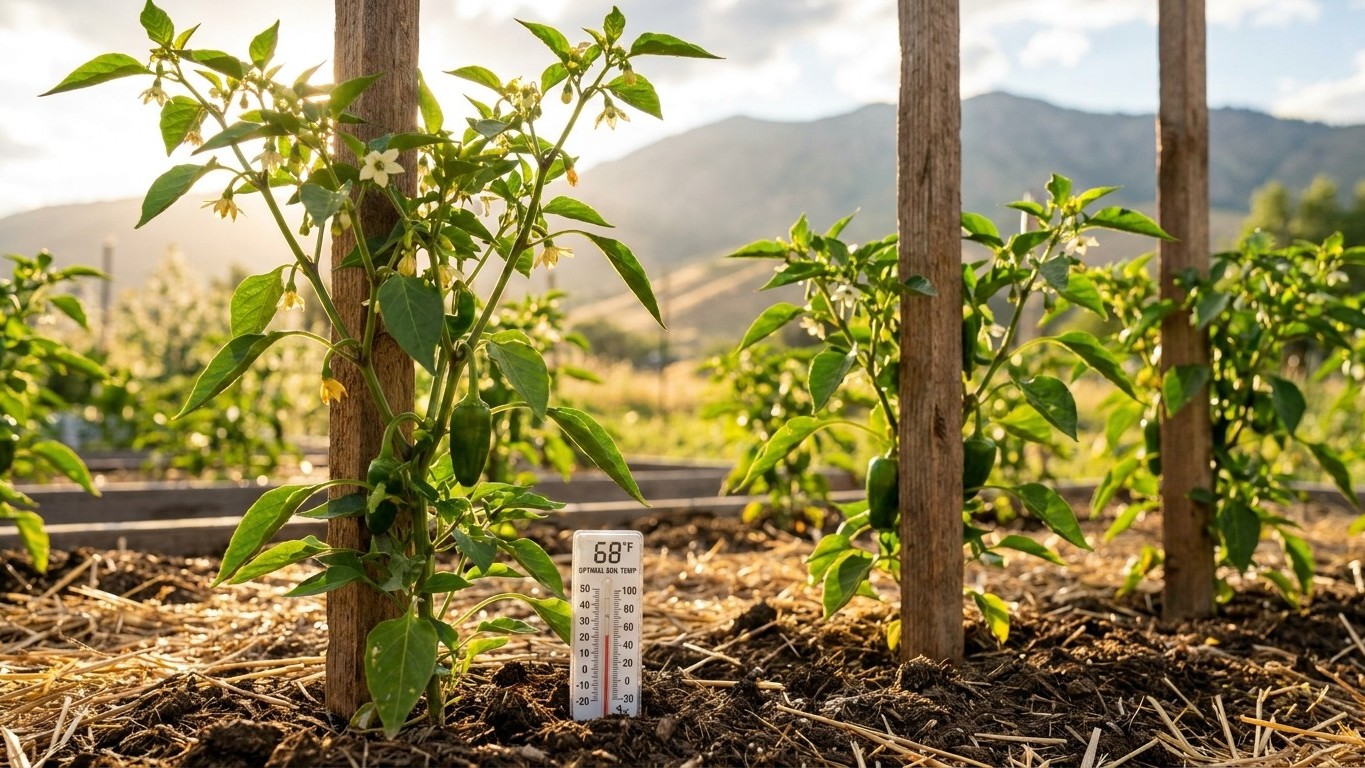

Peppers can ripen fully in Oklahoma, but only if the transplant date, the soil temperature, and the state’s heat load line up first. The Oklahoma City reference station averages 70.7 days a year at or above 90°F, and pepper fruit set stops in that kind of heat just as surely as it stops during a cold snap. Get the transplant timing right, indoors 8 to 10 weeks before soil hits 60°F after the last frost, and most varieties have enough season left to set fruit and ripen before fall.
The short answer

Start with the number that actually shapes the pepper season here: 70.7 days a year at or above 90°F, measured at the Oklahoma City reference station over the 1991-2020 normals period. That’s not an average summer temperature. It’s a count of how many individual days cross the threshold where pepper flowers stop setting fruit at all. According to Utah State University Extension, pepper fruit set fails once daytime temperatures climb above 90°F, because the plant redirects its energy into surviving heat stress instead of finishing pollination. With over 70 such days typical in a single year, an Oklahoma pepper patch can go through long stretches, sometimes back to back, where blossoms open, drop, and never become fruit.
That’s the hot end of the problem. The cold end is just as strict, and it works in the opposite direction. The same Utah State University Extension guidance says fruit set also fails when nighttime temperatures drop below 55°F, regardless of how warm the days are. A pepper plant can be perfectly healthy, full of blossoms, sitting in ideal daytime warmth, and still fail to set a single fruit if the mercury dips too low after dark.
Here’s where a gardener has to do some of their own homework: this site tracks days at or above 90°F for Oklahoma, but it does not carry summer night minima. That gap matters. Oklahoma is a large state stretching from the humid southeast to the drier panhandle, and nighttime lows in July and August can differ meaningfully from one county to the next, and even from one yard to another depending on whether it sits in a low spot that collects cool air or on a breezy rise that doesn’t. There is no shortcut here. Don’t assume a cooler night just because a location sits farther north or at a higher latitude. Latitude alone doesn’t tell you what the thermometer reads at 2 a.m. in a river valley versus 2 a.m. on an open plain twenty miles away.
The practical move is to keep a thermometer in the pepper bed itself, or check a nearby weather station’s overnight lows through midsummer, and treat any stretch of nights below 55°F the same way you’d treat a heat wave: as a pause button on fruit set, not a plant failure. Peppers usually resume setting fruit once temperatures settle back into their comfort range on both ends. The season isn’t lost, it’s just paused, and knowing which end is causing the pause changes what you do about it.
When to start seed here
Working out a starting date for pepper seed isn’t guesswork if you build it backward from the transplant date, and the transplant date itself depends on two things lining up at once: the last frost has passed, and the soil has actually warmed to 60°F. Here’s how the arithmetic works, step by step, so it can be redone for any specific county rather than treated as a fixed calendar date.
- Start with the frost window for the reference station. NOAA’s 1991-2020 climate normals put the last spring freeze at the Oklahoma City airport station somewhere between March 28 and April 10, based on the 30 to 70 percent freeze probability band. That’s an airport reading, not a backyard reading.
- Add a margin for a home garden. Suburban and rural yards typically see their last frost later, and their first fall frost earlier, than an airport weather station by a week or two, sometimes more if the site sits at higher elevation or in a low-lying cold pocket. A gardener in a valley or a shaded lot should push the working frost date later rather than trust the airport figure directly.
- Wait for the soil, not just the calendar. Utah State University Extension is specific that pepper transplants go into the ground only after frost risk has passed and once soil temperature reaches 60°F, since cold soil stalls root growth even if the air feels warm enough. A soil thermometer pushed a few inches into the bed, checked over several mornings, tells you more than any date on a seed packet.
- Count backward 8 to 10 weeks for the seed-starting date. Once the likely transplant date is set, indoors seed-starting needs to begin 8 to 10 weeks earlier, per Utah State University Extension guidance, to produce a transplant sturdy enough to handle the move outside.
- Recheck the window before committing. If the working transplant date lands, say, in mid-April for a particular county once the local frost margin is added, counting back 8 to 10 weeks puts the indoor seed-starting date in mid-to-late February. Every gardener should run this same backward count using their own county’s frost pattern rather than borrowing the Oklahoma City airport figure outright.
The point of doing the math this way, rather than picking a date off a generic chart, is that it forces the two real variables (frost risk and soil temperature) to actually govern the schedule, instead of a fixed weekend on the calendar that may or may not match what’s happening in a specific yard.
What goes wrong here
Most pepper failures in Oklahoma trace back to one of three patterns, and each one has a fix that doesn’t require replacing the plant.
- Blossom drop during a heat spell or a cool night. Flowers open, then fall off without ever becoming fruit. This happens on the hot end when days push past 90°F, a threshold Oklahoma City crosses an average of 70.7 days a year, and on the cold end when nights fall below 55°F. The remedy is patience rather than intervention: keep the plant watered and mulched through the hot stretch or covered lightly through an unseasonable cool snap, and let fruit set resume once temperatures move back into range on both ends.
- Sunscald on exposed fruit. Peppers that lose their leaf cover to pruning, wind damage, or disease end up with pale, blistered patches on the side facing direct sun, especially during the state’s long run of 90°F-plus afternoons. The fix is keeping the plant’s own foliage intact as natural shade for the fruit; avoid heavy pruning during the hottest weeks, since a fuller canopy protects the peppers underneath it better than any external cover.
- Blossom-end rot on developing fruit. A sunken, leathery brown patch forms on the bottom of the pepper, usually tied to inconsistent watering that disrupts calcium movement into the fruit rather than a soil nutrient shortage by itself. Even watering, a soaking that reaches the root zone on a steady schedule rather than a quick daily sprinkle, keeps the plant from swinging between drought stress and sudden saturation, which is what triggers the rot in the first place.
None of these three problems mean the plant is dying. They’re symptoms of the specific stress Oklahoma’s climate applies to peppers: heavy heat load on one side, an unpredictable spring and fall on the other, and the gardener’s job is reading which one is active before reaching for a fix.
Common questions
Can peppers still ripen if a heat wave hits mid-summer?
Yes, in most cases. Fruit set pauses above 90°F rather than stopping for good, according to Utah State University Extension. Once temperatures drop back under that threshold, blossoms that open afterward can still set fruit, so a hot stretch in July doesn’t necessarily cost the whole season, just the fruit that would have set during it.
Should I track nighttime lows myself instead of relying on a published figure?
Yes. This site carries days at or above 90°F for Oklahoma, but it does not carry summer night minima, and no reliable figure for a specific yard’s overnight lows can be inferred from latitude or from how cold the winter gets. A backyard thermometer or a nearby weather station’s overnight readings through midsummer is the only way to know if nights are dropping below the 55°F threshold that also stops fruit set.
Does the last frost date mean it’s safe to transplant peppers?
Not by itself. The March 28 to April 10 window comes from the Oklahoma City airport station’s 1991-2020 climate normals, and home gardens typically see frost risk linger later than that, by a week or two in many cases. Utah State University Extension also requires soil to reach 60°F before transplanting, so both conditions, frost passed and soil warm, need to be checked together rather than going by the calendar date alone.
How long after flowering should I expect fruit to ripen?
Utah State University Extension notes a 35 to 45 day window, but that count starts from flowering, not from when the seed was sown or the transplant went into the ground. A plant that flowers in early July, for example, is generally still 35 to 45 days out from ripe fruit at that point, regardless of how early it was started indoors.