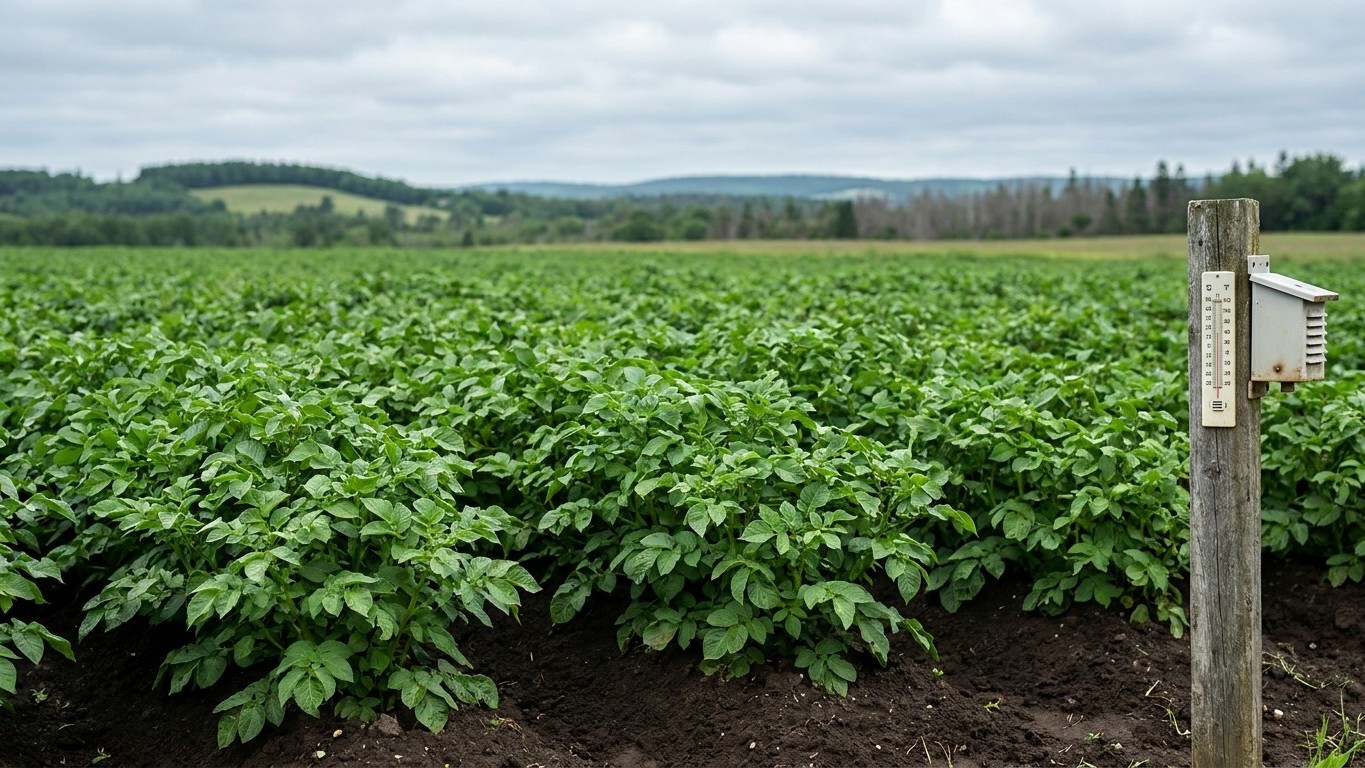

New Brunswick almost never breaks 90°F. The Moncton climate record shows zero days a year at that mark, so potato foliage keeps working right through summer instead of shutting down. The variable that actually matters here is the frost window: an average last-frost date of May 23 means soil temperature, not the calendar, decides your planting day. Growers in this province can run a full-season crop of any maturity class without the tuber-stopping heat stress that hits warmer states.
The short answer

Two numbers decide whether a potato patch succeeds in this province, and neither of them is the one most gardeners check first. The first is heat load: the Moncton reference station, drawing on Environment and Climate Change Canada’s Canadian Climate Normals for 1981 to 2010, records a mean of 0.0 days a year at 90°F or above. That is the figure Utah State University Extension flags as the ceiling for potatoes, the point where tuber set and fill are inhibited in the soil. New Brunswick, on average, simply doesn’t get there.
That single fact reorders everything else about how you grow potatoes here. In states where dozens of days cross 90°F, the whole strategy bends around escaping the heat, get a crop in early, dig it before soil temperatures climb, treat anything past midsummer as a loss. New Brunswick doesn’t need that workaround. A full-season variety planted at the right soil temperature can bulk up tubers from spring through late summer without the crop hitting a wall of heat stress, because the wall essentially isn’t there in most years.
The frost date is the real limiter
The second number is the average last spring frost, May 23, taken from the Moncton station (climate ID 8103100). That date is a mean, not a guarantee. In roughly half the years on record, frost has arrived later than May 23. Treat it as the midpoint of a window you plan around, not a date you circle and trust blindly. It’s also worth remembering that this reading comes from a single station. A province isn’t one climate, and anyone gardening away from the Moncton area, especially at higher elevation or farther north, should expect the real frost window to run later.
Put the two figures together and the picture is straightforward. Summer heat is not the constraint in New Brunswick, at least not in a typical year measured against the Moncton normals. The frost calendar and soil temperature are what set your schedule, and getting those right matters more here than managing heat ever will. With that schedule in mind, choosing Potato Varieties That Suit New Brunswick becomes the next logical step, and planning ahead for Harvesting and Storing Potatoes in New Brunswick will help you make the most of that full growing season.
When to plant here
Knowing When to Plant Potatoes in New Brunswick isn’t a fixed day on a calendar, it’s the outcome of a small piece of arithmetic that starts with your local frost date and ends with a soil thermometer reading. Here’s how to work it out, using the Moncton normal as the starting reference.
- Start with your last spring frost date. For the Moncton area, that’s an average of May 23. Remember it’s a mean: in about half of years, frost lands later, so build in a margin rather than planting the moment the date passes.
- Count backward 14 to 21 days. Both Utah State University Extension and the University of Maine Cooperative Extension describe planting potatoes two to three weeks ahead of the last frost, because the crop goes into the ground before the danger of frost has fully cleared. Counting back from May 23 puts that window in the first half of May for a Moncton-area garden, though the exact days will shift with your own local frost record.
- Check soil temperature, not air temperature. The trigger for planting is soil reaching 50°F, measured a few inches down, ideally at the same time of day over a couple of readings rather than a single check after a warm afternoon.
- Plant once the soil holds at 50°F. If a cold snap follows, seed potatoes tolerate it better than emerged sprouts do, which is part of why the earlier planting window works even with frost still a possibility.
- Reset the count if a cold spring pushes the frost date later. The 14-to-21-day rule is relative to your actual local frost pattern that year, not to the long-term average alone.
The arithmetic scales to any county. Pull your own area’s last-frost normal, subtract two to three weeks, then confirm with a soil thermometer before you trust the calculation over what the ground is actually telling you.
What the heat does to the crop
The mechanism behind all of this is simple, and it’s the one fact that should shape how any gardener plans a potato season regardless of where they live. Above 90°F in the soil, tuber set and fill are inhibited. That’s not a slowdown you can water your way past. Once soil temperature crosses that line, the plant’s energy stops going into building tubers, and no amount of extra irrigation reverses it. Watering keeps the plant alive and reduces some stress, but it does not restart tuber development once heat has shut it down.
In New Brunswick, that mechanism rarely gets triggered. With a mean of 0.0 days a year at 90°F or above at the Moncton reference station, most gardens here simply don’t encounter the soil temperatures that stop tuber growth. That changes the whole framing of the season compared to a hot-climate state. There’s no need to treat this as a race to dig before a heat wave arrives, and no need to write off a summer crop the way a grower further south might.
What that means practically is that New Brunswick gardeners can plan for a full growing season rather than rushing to harvest a spring crop ahead of summer heat. Early varieties, mid-season varieties, and late varieties (season class is what both Utah State and the University of Maine publish, not a specific number of days) can all be grown through to their natural finish here without the risk that defines potato-growing in warmer regions. The frost calendar sets the boundaries on both ends of the season; the heat ceiling, in most years, doesn’t come into play at all.
What goes wrong here
- Planting uncertified seed potatoes. Seed saved from a grocery-store potato or an unverified source can carry virus that never shows up as an obvious symptom but quietly reduces yield year after year. Buy certified seed potatoes, which have been inspected specifically to be free of that risk.
- Planting into cold, wet soil because the calendar says it’s time. A frost date passing doesn’t mean the ground is ready. Cold, waterlogged soil rots seed pieces before they sprout. Wait for the soil itself to reach 50°F, checked with a thermometer, rather than planting off the date alone.
- Skipping the hilling. Tubers that form near the surface and get exposed to light turn green and develop solanine, which makes them unfit to eat. Hill soil up around the stems as the plants grow to keep developing tubers covered.
- Digging too early. Pulling potatoes before the plant has finished its season means smaller tubers and skins that haven’t set, which makes them bruise and spoil faster in storage. Let the foliage die back naturally before harvesting for storage, rather than digging on a fixed date.
Checking this against your own county
A single reference station can’t stand in for an entire province. The Moncton normals are a starting point, not a final answer for a garden in the Saint John River valley, up toward the Restigouche, or at higher elevation inland. Frost arrives later at altitude and later moving north, sometimes by weeks rather than days, which shifts both the planting window and how much margin you should build in before trusting a frost-free stretch.
Before finalizing a planting date, check conditions against your own area rather than assuming the provincial average applies directly. Agriculture and Agri-Food Canada, at agriculture.canada.ca, is a reliable federal resource for regional growing information when a provincial site isn’t accessible. Local knowledge, and a soil thermometer, will always beat a province-wide date.
Common questions
Does New Brunswick’s summer heat ever stop potatoes from sizing?
Rarely, based on the Moncton normals. With a mean of 0.0 days a year reaching 90°F, the soil temperature that inhibits tuber set and fill, per Utah State University Extension, is not something most New Brunswick gardens experience in a typical year.
Can I plant before the average last frost date?
The 14-to-21-day planting rule from Utah State University Extension and the University of Maine Cooperative Extension already puts you ahead of the last frost date by design. Just make sure soil has reached 50°F first, since that threshold matters more than the calendar.
Should I choose an early, mid-season, or late variety?
All three season classes can work in New Brunswick, since summer heat isn’t the limiting factor here the way it is in hotter states. Neither Utah State nor the University of Maine publishes a specific days-to-maturity number, so choose based on the published season class and how it fits your kitchen use, baking or boiling, rather than a maturity count.
Where should I check my own frost dates instead of relying on the Moncton figure?
Start with Agriculture and Agri-Food Canada at agriculture.canada.ca, and cross-check against any local records for your specific county or elevation, since a single reference station rarely reflects conditions province-wide.