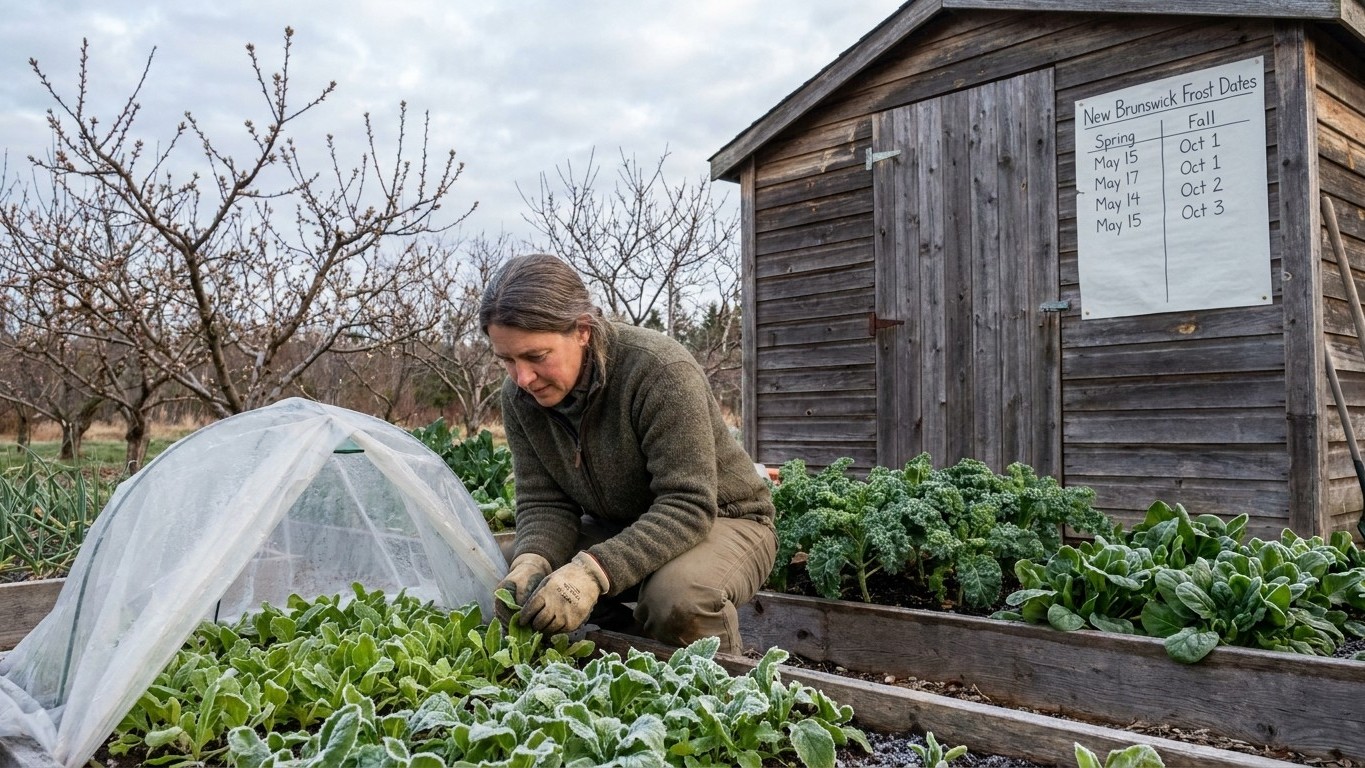

New Brunswick gives you roughly four and a half months of frost-free growing, bookended by a cool spring and a firm autumn cutoff. That single number, more than any zone map, tells you what’s realistic to plant here and what’s better left to a greenhouse or a warmer neighbor’s garden.
How long your season really is

Natural Resources Canada places the reference city for this region, Moncton, in Canadian hardiness zone 5a. That’s worth pausing on: the Canadian plant hardiness zone system is based on seven climate variables, not the single-variable model you might know from American seed packets. It’s built from seven climate variables instead of one, and NRCan itself warns there’s no clean conversion between the two scales. A Canadian plant hardiness zone, such as 4a, is calculated from seven climate variables rather than the single minimum-temperature measure used elsewhere. So when you see “5a” attached to a New Brunswick garden, treat it as a Canadian-only label, not a stand-in for a US zone number.
The more useful figures for planning are the frost dates. Environment and Climate Change Canada’s 1981-2010 normals for the Moncton station put the average last spring frost at May 23 and the average first fall frost at October 2, which also lines up closely with the traditional window for fall harvest activities like When to Carve a Pumpkin in New Brunswick. Subtract one from the other and you get a frost-free window of about 132 days, call it four and a half months.
That window rules things out before it lets anything in. Crops that need 90 to 100-plus frost-free days just to reach maturity, think full-size watermelons, dry beans grown to full dry-down, or the longest-season winter squash varieties, are working with almost no margin here, which is also why Growing Pumpkins in New Brunswick means picking early-maturing varieties rather than the giant, long-season types. Push a 100-day tomato into a 132-day window and a cool, late spring or an early September frost can wipe out the harvest before it ripens. The same logic applies to heat-loving, slow-to-mature crops like sweet peppers, which is why anyone Growing Peppers in New Brunswick usually starts them indoors well ahead of the last frost date, and it’s also why anyone attempting Growing Sweet Corn in New Brunswick needs to stick to shorter-season varieties bred for cooler climates. By contrast, shorter-season, cold-tolerant crops like those covered in Growing Potatoes in New Brunswick, Growing Carrots in New Brunswick, Growing Beets in New Brunswick, Growing Parsnips in New Brunswick, or hardy perennials profiled in Growing Asparagus in New Brunswick, or Growing Spinach in New Brunswick fit comfortably within the 132-day window with room to spare. That’s not a reason to avoid ambitious crops entirely, but it’s a reason to treat them as an experiment, not the backbone of a plan.
The date itself deserves a second look, too. May 23 and October 2 are averages, not guarantees. By definition, half of all years see frost arrive later in spring or earlier in fall than those dates suggest. A gardener who plants tender starts on May 24 assuming the danger has passed is gambling on the better half of the historical record, not a sure thing. Building in a buffer, a week or two on either end, costs nothing and saves a lot of replanting.
What the summer does to a garden here
Heat is often treated as an unqualified good for a vegetable garden, but it has a ceiling. Once daytime temperatures push past roughly 90F, tomato plants start dropping their flowers instead of setting fruit, lettuce and other cool-season greens bolt to seed, and anything that prefers mild conditions effectively shuts down for the duration. In much of the US, that means a garden splits into two productive shoulder seasons with a rough, unproductive stretch in the middle of summer.
New Brunswick doesn’t really have that problem. The Moncton normals show an average of 0.0 days per year reaching 90F. Practically speaking, the kind of extreme heat that stalls tomato fruit set or forces lettuce to bolt almost never shows up here as a climate norm. That changes the shape of the growing year: instead of a spring run, a dead midsummer lull, and a fall run, New Brunswick gardens tend to get one continuous season from late spring through early fall, with cool-season crops like lettuce, spinach, and peas often holding on through much of the summer rather than being forced out by heat.
The other side of that same coin is winter. The coldest month’s average daily minimum sits at 6.9F. That figure, not the average summer temperature and not a record low, is what actually decides whether a perennial, a shrub, or a fruit tree survives the cold season here. It’s a reminder that the growing-season math (frost dates, heat days) only covers half the story; the other half is whether whatever you plant can still be alive come April.
What tends to go wrong in New Brunswick
No Canadian provincial service publishes an equivalent home-garden pest list for this region, so the closest documented reference comes from the University of Maine Cooperative Extension, just across the border. The biology of these insects doesn’t respect the border even if the reporting does, so treat this as a strong indicator of what you’ll meet, not a provincial guarantee.
Early in the season, as cucurbit seedlings emerge, the striped cucumber beetle shows up to chew on young leaves and can spread bacterial wilt in the process, a disease that wilts and eventually kills the vine outright. Around the same time, the Colorado potato beetle appears on potato and eggplant foliage, and its larvae can strip a planting of leaves fast enough to cut yields significantly if left unchecked. A bit later, once squash vines are running, the squash vine borer‘s larvae tunnel into the base of the stem, and the first sign is often a healthy-looking plant that wilts and collapses within days. Later still, as soft fruit like raspberries and blueberries ripen in late summer, spotted wing drosophila lays eggs in the ripening fruit itself, something older fruit fly species couldn’t do, leaving berries that look fine outside and are already compromised inside.
That’s four insects, not twenty, and each one arrives at a different point in the calendar. Knowing the timing matters more than memorizing a full pest roster: a gardener who knows cucumber beetles show up at seedling stage can watch for them at the right moment instead of scanning for every possible problem all season long.
Where to check before you plant
Everything above is anchored to one weather station, Moncton, and one reference point in the Canadian hardiness system. New Brunswick spans several degrees of latitude, coastal and inland climates, and more than one hardiness zone in practice. A planting calendar built around the provincial capital or a single coastal city can run two or three weeks off for a garden further north or further inland, especially at higher elevation.
For anything specific to your own address, county-level or regional agricultural offices are the better source, since they work from local frost records and local pest reports rather than a single provincial average. Canada’s federal agriculture department maintains a working entry point at agriculture.canada.ca, useful as a starting reference when the provincial department’s own site is harder to reach directly. Pair that with your regional extension or agricultural office for pest identification and localized planting windows, since a single weather station cannot substitute for someone looking at your actual soil and your actual microclimate.
What to Grow, Given All That
Once you’ve made peace with the frost dates and the long cold stretch that defines a New Brunswick season, the next question is what actually earns a spot in the ground. That same cold winter that shapes the whole growing calendar happens to be an asset for one crop in particular: growing garlic in New Brunswick covers why the province’s deep-freeze winters help split a single clove into a full head, along with planting dates and variety choices suited to that climate.
If it’s the lawn rather than the vegetable bed you’re thinking about, the same climate data points to a different answer than gardeners in warmer states are used to. New Brunswick lawn care explains why a cool-season grass is the only sensible choice here, and what that means for planting and feeding schedules through the year.
For the vegetable garden itself, timing is everything, and nothing tests that more than a crop that needs the whole frost-free window to ripen. Growing tomatoes in New Brunswick works through the planting dates, varieties, and the race to get fruit off the vine before that first October frost closes things out.