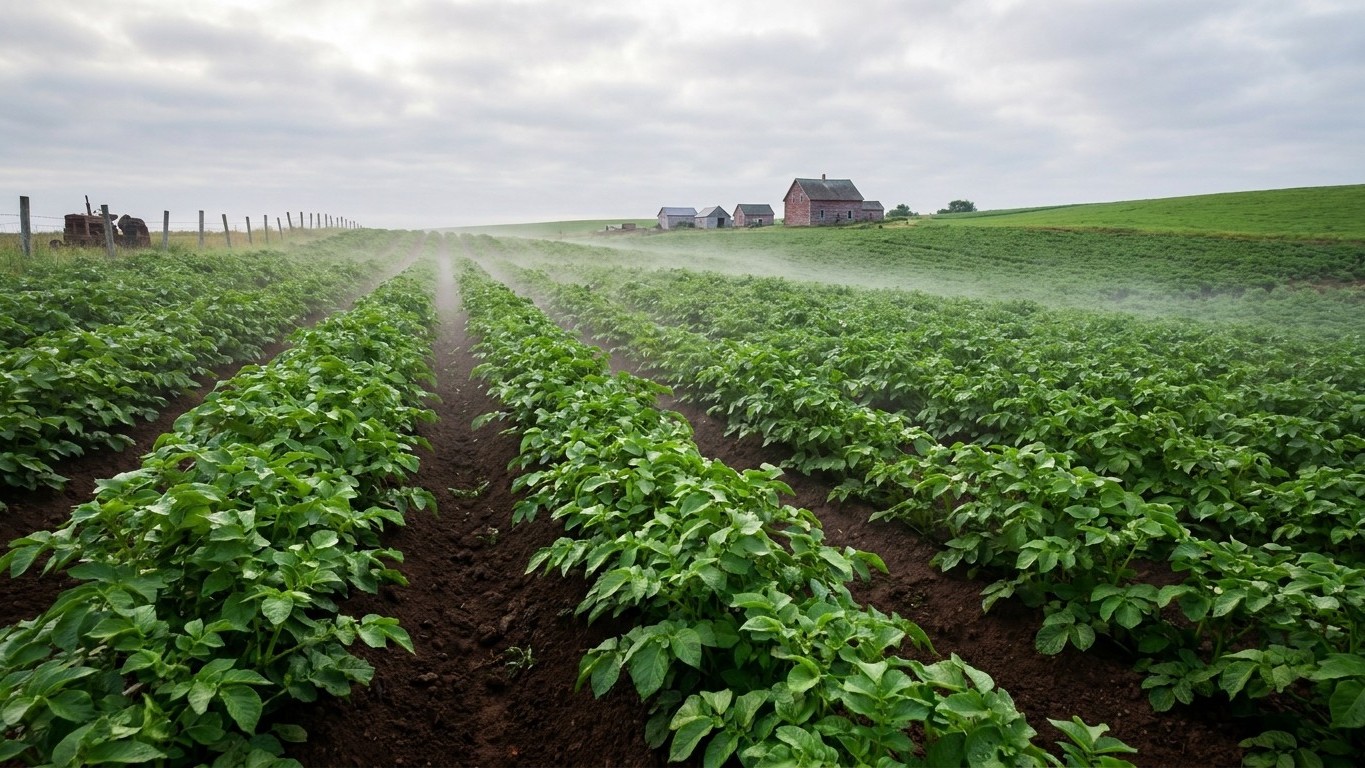

Prince Edward Island’s summer never gets hot enough to stop a potato crop from sizing up. The reference station in Charlottetown averages zero days a year at 90 F or above, and the last spring frost falls around May 16. That combination means growers here can run a full-season crop rather than racing to beat summer heat, as long as planting timing and seed quality are handled right.
The short answer

Two numbers decide whether a potato season works in any given place: how many days the soil and air spend above 90 F, and when the last spring frost typically falls. In Prince Edward Island, the Charlottetown reference station records a mean of 0.0 days a year at 90 F or higher, according to Environment and Climate Change Canada’s Canadian Climate Normals covering 1981 to 2010. The average last spring frost at the same station, Charlottetown A, lands on May 16.
That zero is the headline. Utah State University Extension identifies 90 F soil temperature as the ceiling above which tuber set and fill shut down, a threshold that governs potato growing everywhere the crop is planted. Prince Edward Island essentially never crosses it. Growers in Georgia or inland Texas plan around dozens of days above that line every summer and often have to dig a spring crop before the heat arrives. Here, that pressure doesn’t exist. The growing window stays cool enough, start to finish, that a single planting can run through the whole season without the tubers stalling out from heat stress.
This doesn’t mean the season is unlimited or that timing stops mattering. Frost is still the constraint on the front end, and Prince Edward Island’s frost-free window, while workable, isn’t the longest in North America. The May 16 average frost date is a midpoint, not a guarantee: in roughly half of all years, frost arrives later than that. Growers who plant too early into cold, wet soil risk seed rot before a single true leaf appears, and that’s a much more common failure on this island than anything related to summer heat. Working out When to Plant Potatoes in Prince Edward Island is the best way to avoid that risk, and choosing from the Potato Varieties That Suit Prince Edward Island can reduce it further, since some varieties tolerate cool, damp spring soil far better than others.
What this means practically: don’t manage this crop the way a Deep South garden manages potatoes, worrying about beating a heat wave. Manage it the way a cool, maritime climate demands, watching soil temperature and frost risk on the front end, trusting the long, mild season to finish the job, and following sound practices for Harvesting and Storing Potatoes in Prince Edward Island once the vines start to die back.at summer here won’t punish a tuber that’s sizing up in July or August. The zero-day heat count is the reason PEI is one of the more forgiving places in North America to grow a full-season potato crop, and it’s also why the island supports the scale of potato production it’s known for.
When to plant here
Planting date isn’t picked from a calendar page; it’s counted backward from two things: the local frost window and the point where soil temperature hits 50 F. Utah State University Extension and the University of Maine Cooperative Extension both peg the planting window at 14 to 21 days before the last frost date, once soil has warmed to that 50 F mark. Here’s how that arithmetic runs for Prince Edward Island.
- Start from the average last frost date. At the Charlottetown A station, that’s May 16. Treat it as a midpoint, not a safe date, since frost lands later than that in about half of all years on record.
- Count back 14 to 21 days. From May 16, that puts the planting window somewhere between roughly April 25 and May 2, depending on how much frost risk a grower is willing to accept and how quickly soil is warming that particular spring.
- Confirm soil temperature before committing seed to the ground. The 14-to-21-day rule assumes soil has actually reached 50 F. A cold, wet spring can push that date later regardless of what the calendar window suggests. A simple soil thermometer, checked at a 4-inch depth in the morning, is a more reliable guide than the date alone.
- Adjust for local conditions before finalizing. Low-lying fields, heavy clay soils, and areas near the coast can all warm more slowly than the reference station’s numbers suggest. If soil is still cold and wet at the calculated date, waiting a few extra days costs far less than losing seed to rot.
The same math works for any county or district: find the local last-frost average, count back 14 to 21 days, and confirm with a soil thermometer rather than the calendar alone. On Prince Edward Island, that generally points to a late-April to early-May planting window, though growers closer to the water or at slightly higher elevation should expect it to run a few days to a couple weeks later.
What the heat does to the crop
The mechanism is simple and it’s the same everywhere potatoes are grown: once soil temperature climbs above 90 F, tuber set and fill are inhibited. The plant keeps photosynthesizing, but the below-ground process that turns sugars into new tuber growth slows down or stops. Utah State University Extension and the University of Maine Cooperative Extension both describe this threshold as the practical ceiling for the crop, and it’s not something extra water can undo. A gardener who responds to heat stress by watering more is treating the wrong symptom; the soil temperature itself is the limiting factor, not moisture.
In places with dozens of 90 F days each summer, that mechanism forces a choice: plant early and dig a spring crop before the heat sets in, or accept reduced yield from tubers that stopped filling out mid-season. Prince Edward Island doesn’t face that choice. With a mean of 0.0 days a year at 90 F or above at the Charlottetown reference station, the soil essentially never crosses the threshold that shuts tuber growth down. A potato crop planted in late April or early May can keep filling tubers straight through summer without hitting that ceiling.
That’s a real advantage, and it’s worth naming plainly: growers here don’t need to plan around a heat-driven early dig the way growers in hotter states do. The tradeoff is that PEI’s growing season is bounded more by frost risk and by how quickly soil warms in spring than by any summer heat concern. Extension guidance groups potato varieties by season class, early, mid-season, and late, rather than by a fixed number of days to maturity, and it also separates them by intended use, such as baking or boiling, rather than by texture terms like waxy or floury. On an island where heat isn’t the limiting factor, a longer-season variety has more room to perform than it would somewhere the clock is running against a summer heat wave.
What goes wrong here
- Uncertified seed potatoes. Seed that hasn’t been certified can carry viruses that reduce yield and spread to future crops through infected tubers. Buying certified seed potatoes each season is the single most reliable way to avoid starting the year with a problem already built into the seed piece.
- Planting into cold, wet soil. Pushing seed into the ground before soil reaches 50 F, chasing an early date on the calendar rather than an actual soil temperature reading, invites seed piece rot before the plant ever emerges. A soil thermometer costs little and prevents a lost planting.
- Skipping the hilling and ending up with green tubers. Tubers that sit too close to the surface get exposed to sunlight, turn green, and develop solanine, a compound that makes them unsafe to eat. Hilling soil up around the base of the plant as it grows keeps developing tubers covered and protected from light.
- Digging too early. Pulling the crop before the plant has finished its natural cycle sacrifices yield and can leave tubers with thin, easily damaged skins that don’t store well. Letting the plant complete its growth, rather than digging on an arbitrary date, produces a crop that holds up in storage.
Checking this against your own county
Every figure in this article comes from a single reference station, Charlottetown A, and a province is never one uniform climate. Coastal areas, inland districts, and anywhere with meaningfully different elevation can run a frost date weeks earlier or later than the island-wide average, and soil warms at different rates depending on drainage and exposure. The 0.0 days above 90 F figure is a strong signal for the island as a whole, but local microclimates near the water tend to run even cooler in summer than the reference station suggests.
Before locking in a planting date, growers should check current conditions and local guidance through Prince Edward Island’s agriculture resources, available at princeedwardisland.ca/en/topic/agriculture. A soil thermometer and a season’s worth of local observation will always beat a province-wide average for pinning down the right week to plant.
Common questions
Does Prince Edward Island ever get too hot for potatoes?
Based on the Charlottetown reference station’s average of 0.0 days a year at 90 F or above, no. The 90 F soil threshold that stops tuber set and fill, as described by Utah State University Extension, is essentially never reached on the island in a typical year.
When is the safest time to plant potatoes on Prince Edward Island?
Extension guidance from Utah State University and the University of Maine points to 14 to 21 days before the last frost date, once soil reaches 50 F. With Charlottetown’s average last frost around May 16, that generally lands in the late-April to early-May range, adjusted for actual soil temperature.
Can I dig a spring crop and a second crop in the same season here?
The facts available here don’t support a specific second-crop timeline, and neither Utah State University Extension nor the University of Maine Cooperative Extension publishes days-to-maturity figures to calculate one. Because PEI’s heat load stays essentially at zero 90 F days, a single full-season planting is the approach best supported by the climate data.
Why do my potatoes turn green, and are they safe to eat?
Green tubers form when they’re exposed to sunlight, usually because hilling wasn’t kept up as the plant grew. The green color signals solanine development, and those portions are not safe to eat. Hilling soil regularly around the base of the plant prevents the exposure that causes it.