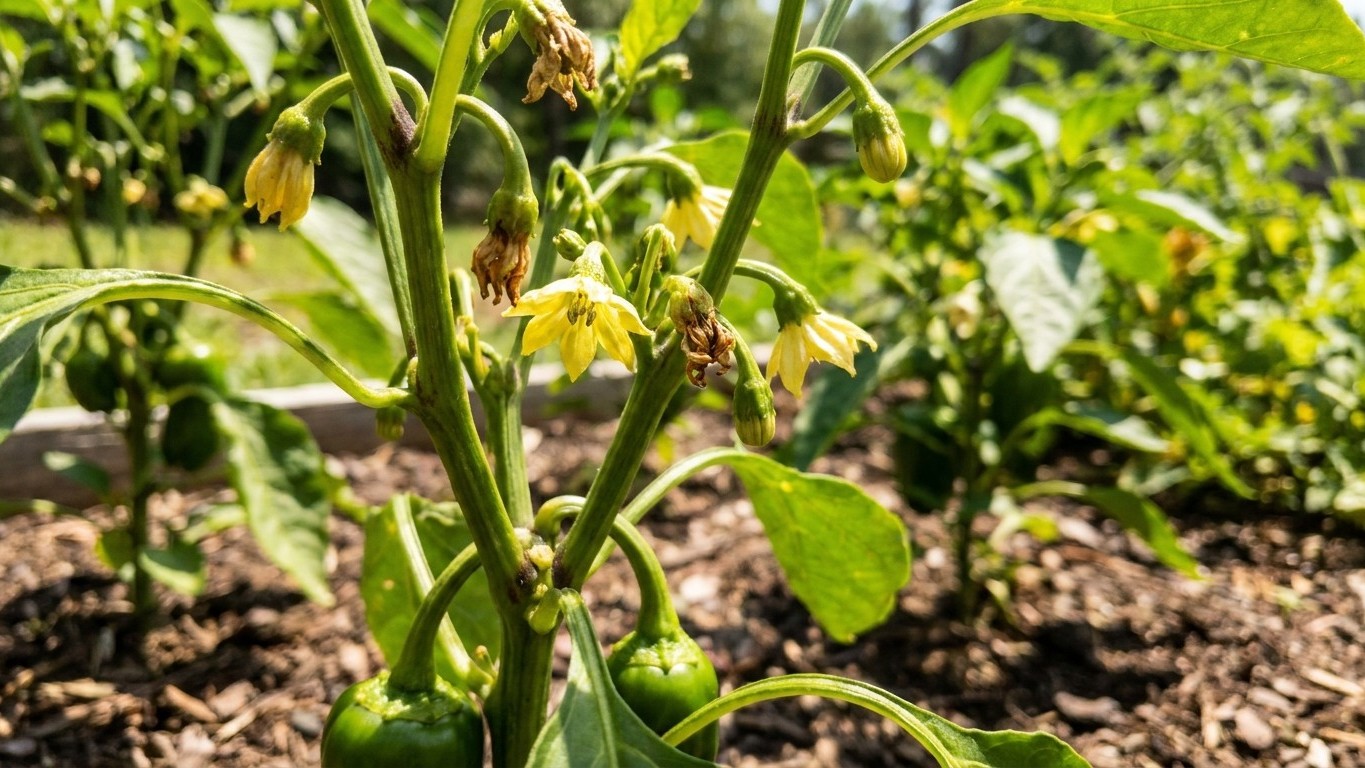

Jackson averages 71.1 days a year at or above 90 F, and pepper flowers abort when daytime heat sits in that zone for long stretches. On the other end, nights under 55 F cause the same drop, but that number depends on your specific spot, not the state average. Get the timing right on both ends and fruit set follows.
The short answer

Seventy-one days above 90 F sounds like a lot until you spread it across a Mississippi summer that runs from May into September. That’s roughly ten weeks somewhere in the calendar where pepper plants are pushing out blossoms into air too hot to let them finish the job. Pollen goes sterile, flowers yellow and drop, and a plant that looked loaded with buds in July can sit fruitless for weeks at a stretch. This isn’t a defect in the plant. It’s basic physiology: pepper pollen stops functioning well once daytime highs push consistently past 90 F, and Jackson’s climate record shows that threshold gets crossed more than seventy times a year on average.
The fix isn’t complicated, but it does require planning around the calendar rather than fighting the heat once it arrives. Knowing When to Start Pepper Seed in Mississippi is what makes this possible: get plants transplanted early enough that they set their first flush of fruit before the worst of the mid-summer heat load kicks in, then expect a lull, and count on a second flush as temperatures ease in early fall. Choosing from the Pepper Varieties That Ripen in a Mississippi Season can also make this timing window easier to work with. Gardeners who plant late and expect a single long fruiting season from June through September in Mississippi are usually disappointed by a plant that flowers heavily and sets almost nothing during the hottest stretch.
The cool end matters just as much, and it’s the one variable this site can’t hand you a number for. Nights below 55 F cause the same kind of blossom drop as excess heat, just through a different mechanism, interfering with pollen viability and fruit development in the cool direction instead of the hot one. Mississippi doesn’t see many 55 F nights in the heart of summer, but early spring transplants and late fall extensions both run into this ceiling, and the state’s terrain means the number isn’t uniform. A garden in the Delta bottomland, a hillside plot in the northeast hill country, and a low spot near a creek in the Piney Woods can all report meaningfully different overnight lows on the same date, even at similar latitude. This site tracks daytime heat loads by location, but it does not carry summer night minima, and there’s no reliable way to back into that figure from a location’s latitude or from how cold its winters run. For a fuller breakdown of both ends of this problem, see Why Peppers Fail to Set Fruit in Mississippi. If your peppers are dropping blossoms and the days haven’t been especially hot, put a min-max thermometer in the bed and check what’s actually happening after dark before assuming the problem is something else.
When to start seed here
Working out a seed-starting date for peppers is really just working backward from two conditions that have to be true before a transplant goes in the ground: the frost risk needs to have passed, and the soil needs to have warmed to 60 F. Here’s how that arithmetic runs for a Mississippi garden, using Jackson’s frost-free window as the reference point.
- Start with the frost date. NOAA’s 1991-2020 climate normals put Jackson’s last spring frost somewhere between March 6 and March 22, based on freeze probability data at the airport station. That’s a range, not a single day, and it reflects the point where 32 F freeze risk drops into the 30 to 70 percent band.
- Push it later for your actual garden. Airport stations tend to run warmer than the suburban and rural gardens around them, so real-world last frost dates in yards and gardens typically land one to two weeks after the airport figure, sometimes more at higher elevation. A garden in the Jackson area should plan on this shift; a garden further north or at higher elevation should assume an even longer lag.
- Wait on soil, not just air. Frost passing doesn’t mean the soil is ready. Pepper transplants need soil at 60 F, and cold, wet Mississippi clay in early spring can lag well behind air temperature. A soil thermometer pushed a few inches into the bed at the same time each morning for a week gives a far better answer than guessing from the calendar.
- Count back 8 to 10 weeks from your transplant date. That’s the indoor head start peppers need to be sturdy enough for the garden, per Utah State University Extension. If your realistic transplant date lands in early April once you’ve adjusted for both frost lag and soil temperature, seed indoors 8 to 10 weeks before that, which puts the start date somewhere in late January to early February.
- Rerun the math for your own county. A garden in the far south of the state will generally see both frost-free dates and warm soil arrive earlier than one near the Tennessee line, so the same 8 to 10 week rule shifts the calendar earlier or later depending on where you actually garden.
What goes wrong here
- Blossom drop during a hot spell or a cool night. This is the single most common complaint from Mississippi pepper growers, and it runs in both directions. A stretch of days above 90 F causes the same flower loss as an unseasonably cool night below 55 F, so before assuming a pest or disease problem, check both what the daytime highs have been doing and what’s happening after dark. There’s no fix for the weather itself, but staggering transplant dates, using partial afternoon shade during the hottest weeks, and keeping soil moisture even can reduce the severity of a hot-spell drop.
- Sunscald on exposed fruit. Mississippi’s summer sun is strong enough that peppers left uncovered by foliage, especially after a plant has been pruned hard or has lost leaves to disease, can develop pale, papery patches on the side facing the sun. The remedy is mostly preventive: avoid heavy pruning during the hottest months, keep the plant’s natural leaf canopy intact to shade the fruit, and if a plant has thinned out, consider light shade cloth over exposed fruit clusters during peak afternoon sun.
- Blossom-end rot. The dark, sunken patch that shows up on the blossom end of a developing pepper is a calcium delivery problem, almost always triggered by inconsistent watering rather than a true calcium shortage in the soil. Mississippi’s pattern of heavy summer downpours followed by dry stretches is close to a textbook setup for this. Even, regular watering and a layer of mulch to buffer soil moisture swings address most cases without needing a soil amendment at all.
Checking this against your own county
Everything above is built from state-level and single-station data. Jackson’s frost dates and heat-day counts are a starting point, not a guarantee for your specific yard, and the gap between airport data and your actual garden can run one to two weeks in either direction depending on terrain, elevation and how close you are to water. Mississippi State University Extension keeps county-level agents who can speak to local frost patterns, soil conditions and pepper variety performance in your specific part of the state, and that local knowledge is worth more than any statewide average once you’re deciding an actual planting date. You can find your local office and current guidance through the Mississippi State University Extension website.
Common questions
Can I get two harvests from one pepper planting in Mississippi?
Often yes, informally. Plants that set fruit in late spring before the heaviest heat, then stall during the hottest weeks, frequently resume flowering and fruiting once nights cool into early fall. It’s less a planned “second harvest” than a natural rebound once conditions fall back into the range where fruit set works.
Does shade cloth help with blossom drop from heat?
It can reduce the intensity of direct afternoon sun and lower leaf temperature slightly, which may help during the hottest weeks, but it won’t fully offset a stretch of days above 90 F. It’s a mitigation tool, not a guarantee of continued fruit set.
How do I know if my soil has actually reached 60 F?
A simple soil thermometer, pushed a few inches into the bed and checked at the same time each morning over several days, is the only reliable way. Air temperature and calendar dates are not accurate substitutes, especially in Mississippi’s heavier clay soils, which warm more slowly than sandy ground.
Is it worth transplanting earlier than the recommended frost window to beat the summer heat?
Pushing earlier than your local frost-free date risks losing the transplant altogether, and airport-based frost dates already run earlier than most home gardens experience. It’s generally safer to hold the line on frost timing and instead focus on hitting the 60 F soil mark as early as it naturally occurs, rather than gambling on an early planting.