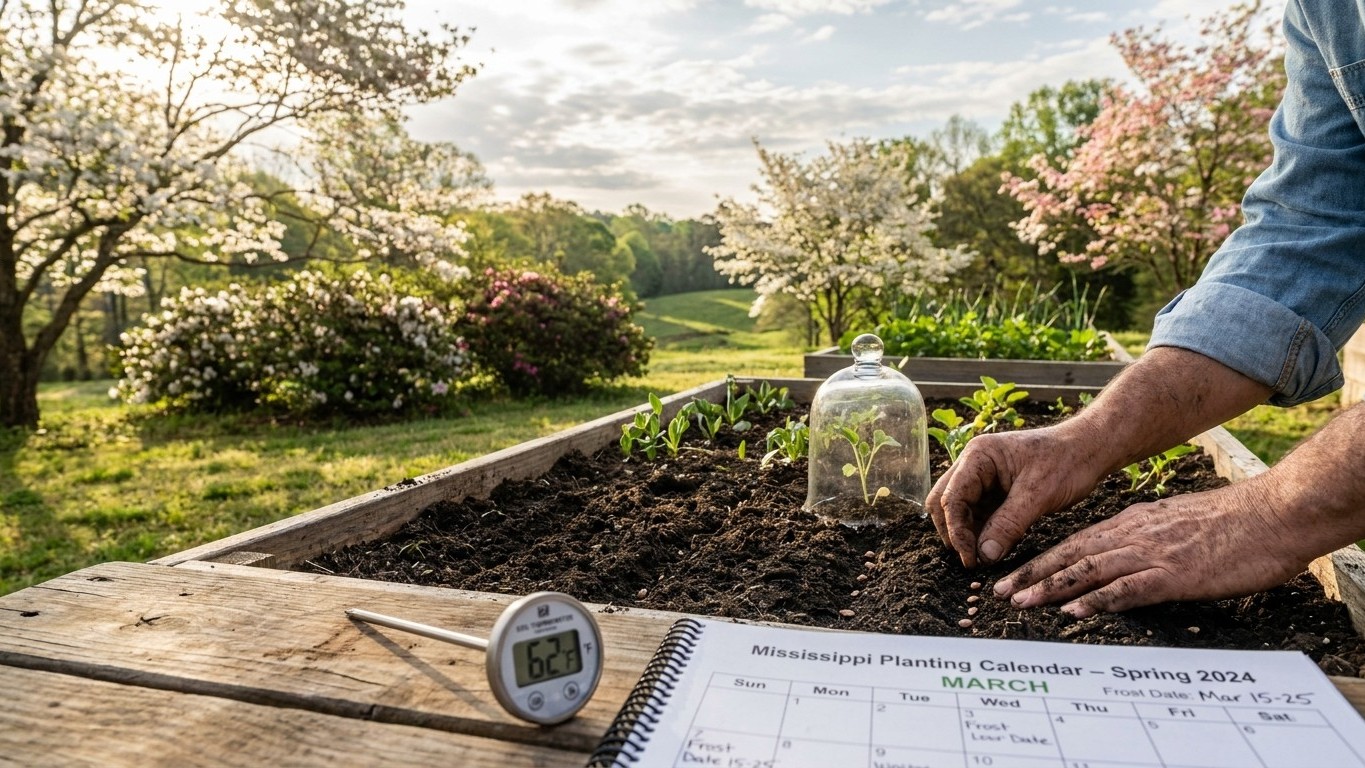

Mississippi gardens sit in USDA zones 7b through 9a, with a frost-free window that runs roughly from mid-March to mid-November at the state’s reference station. That window, not the zone number, is what actually decides what you can grow and when. Here’s how to read the season before you touch a seed packet.
How long your season really is

Three numbers define what’s possible in a Mississippi garden. The USDA hardiness zone for the state spans 7b to 9a, a range built on one variable: the average annual extreme minimum temperature. At the reference station used for these figures, the average last spring frost falls between March 6 and March 22, and the average first fall frost lands between November 7 and November 22.
Do the subtraction and you get a frost-free season that stretches roughly eight months, from mid-March through mid-November. That’s a generous window by national standards, and it’s the reason Mississippi gardeners can often get two full rounds of warm-season crops in a single year if they time things right, whether that means a second planting of beans, a long, staggered harvest from Growing Peppers in Mississippi, a spring-to-fall run at Growing Potatoes in Mississippi, a fall crop timed around Growing Carrots in Mississippi, a cool-season root like Growing Parsnips in Mississippi tucked into the shoulder seasons, another quick root crop from Growing Beets in Mississippi, or knowing When to Carve a Pumpkin in Mississippi once your fall vines come in. But a long season isn’t the same as an unlimited one, and it doesn’t mean every crop belongs here.
What it does rule out is the assumption that you can push planting dates carelessly in either direction. Long-season crops that need 100-plus frost-free days with no margin for error, things bred for shorter, cooler summers up north, can struggle here not from lack of time but from too much heat arriving before they finish. The window is wide, but it’s not infinite, and it’s not symmetrical: what kills a plant in May is frost, but what kills it in July is something else entirely, which the next section gets into.
One more thing worth saying plainly: these frost dates are averages, not guarantees. By definition, half of all years run colder or later than average on one end or the other. A frost date range of March 6 to March 22 means that in some years, the last frost lands after March 22. Planting tender crops right on the early edge of that range is a bet, not a plan, and it’s a bet you’ll lose in some years no matter how good your soil is.
What the summer does to a garden here
Heat gets treated like an unqualified blessing in gardening conversations, and in Mississippi that’s a mistake. The reference station averages 71.1 days a year at or above 90 degrees Fahrenheit. That’s not a string of a few hot weeks. That’s more than two months of the year where daytime temperatures cross a threshold that changes how plants behave.
Above roughly 90F, tomato flowers drop without setting fruit. Lettuce and other cool-season greens bolt, turning bitter and running to seed. Cool-weather crops that thrive in April simply stop being an option once summer heat load builds, and they won’t resume being viable until temperatures ease again in fall. Add the winter side of the equation, a coldest-month average minimum of 36.6 degrees Fahrenheit, and the two extremes together sketch out the real shape of a Mississippi gardening year.
That shape isn’t one continuous growing season. It’s closer to two shoulder seasons bracketing a demanding midsummer stretch. Spring planting takes advantage of the mild stretch before the 90-degree days pile up. Then comes a summer where heat-tolerant crops like okra, southern peas, and sweet potatoes carry the garden while cool-season vegetables sit out entirely. Fall brings a second planting window as temperatures ease back down before the first frost.
Treating the year as one long unbroken season, and planting cool-season crops in June because the calendar still says “growing season,” is one of the more common ways a Mississippi garden underperforms. The heat load, not the frost dates, is what carves the year into two working halves.
What tends to go wrong in Mississippi
Mississippi State University Extension keeps a running list of the insects home gardeners actually report, and a handful show up again and again. Fire ants are a near-constant presence in beds and can make hand-weeding or harvesting genuinely painful, not just a nuisance. Squash vine borers tend to arrive as squash and related vines are establishing in late spring, boring into stems and causing plants to wilt suddenly even with adequate water.
Pickleworms and melonworms move in as cucurbits mature through summer, tunneling into fruit and making it unmarketable even when the vine itself looks healthy. Armyworms, including fall, beet, yellowstriped, and Southern armyworms, tend to build up in late summer and can strip leaves off a range of crops in a matter of days once populations peak.
A few others matter depending on where in the state you garden. Harlequin bugs and yellowmargined leaf beetles target brassicas like cabbage and collards. Cowpea curculios and leaf-footed bugs go after peas and beans, damaging pods and seeds. Mole crickets are flagged specifically for the southern half of the state, particularly in sandy soils, where they tunnel through root zones and damage seedlings from below ground.
This isn’t the full list of insects present in Mississippi, and pressure from any given pest varies from one county to the next. If something is chewing through your garden and you don’t recognize the damage, your county extension office can identify it and tell you what’s actually common in your area, which is a more useful answer than guessing from a photo online.
Where to check before you plant
Everything above is a state-level average, and Mississippi is a big enough state that “state-level” hides real differences. A hardiness range of 7b to 9a means the northern hill country and the Gulf Coast are not gardening on the same calendar, even though they’re in the same state. The frost dates cited here come from one reference station, and suburban and rural gardens typically see their last spring frost later and their first fall frost earlier than a station reading, sometimes by one to two weeks, more at higher elevations.
A planting calendar built around the state capital can be three weeks off for a garden near the coast or up in the hill country. That’s not a small margin when you’re deciding whether to risk tomato transplants in early March or wait until April.
The most useful next step isn’t another article. It’s the Mississippi State University Extension service, the land-grant institution that tracks these numbers for the state and publishes county-specific guidance. Your county’s extension office can tell you your actual local frost dates, confirm which pests are active in your specific area this season, and point you toward planting calendars calibrated to where you actually garden, not to an airport weather station miles away.
Use it to understand why your garden behaves the way it does, then check with your county office before you commit seed money to a planting date.
Where to Go Next for Specific Crops
The general timing rules play out differently depending on what you’re actually putting in the ground, so it’s worth looking at the specifics before you plant. If garlic is on your list, it helps to know how garlic struggles here without enough sustained cold to form full heads, and what that means for when you plant and what varieties give you a fighting chance. Tomatoes run into the opposite problem — heat and frost windows that narrow fast — so it’s worth checking the guide on tomato planting dates and local pests before you move transplants outside. And if lawns are more your concern than vegetable beds, the breakdown of what to plant and when to feed a Mississippi lawn explains why the state’s long stretch of 90-degree days and mild winters narrows the grass choices down to a short list, regardless of what looks good elsewhere.