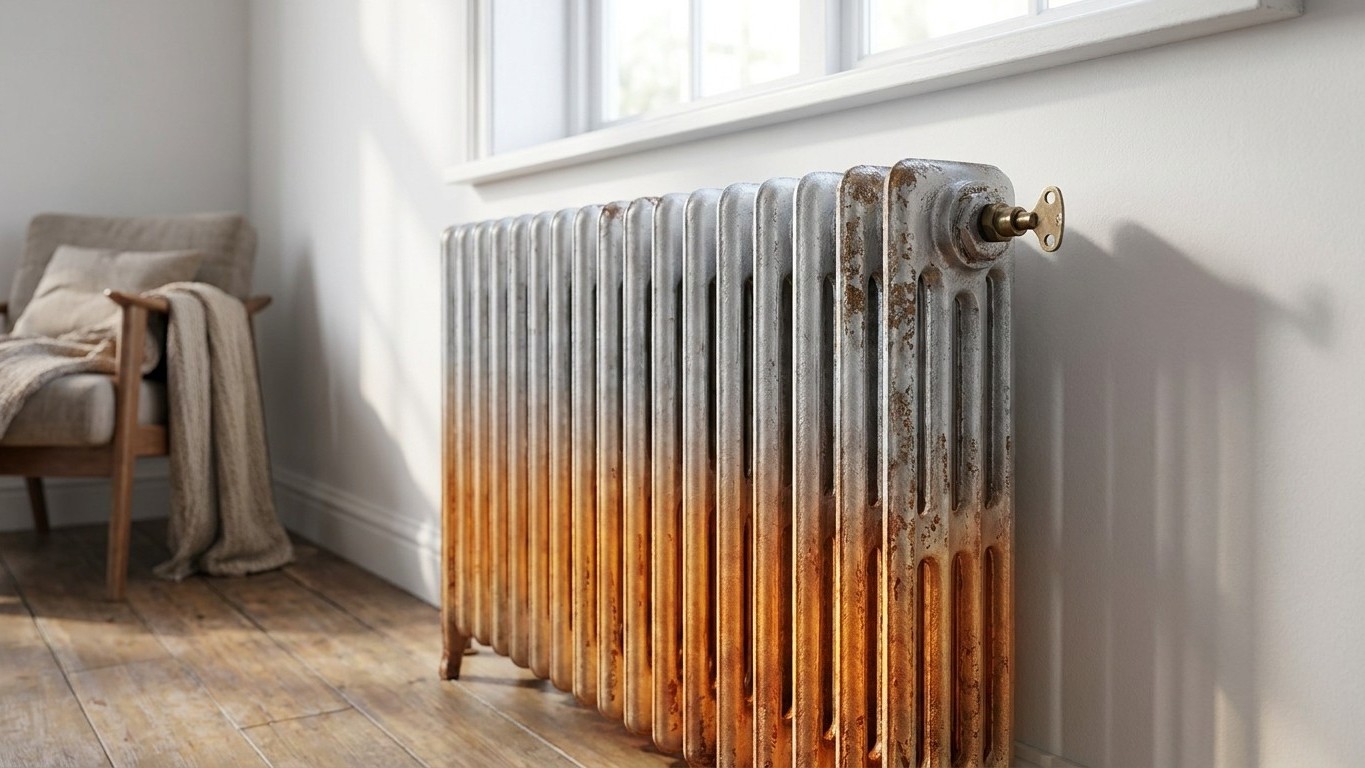

Cold at the top with a warm bottom means trapped air in a hot-water radiator, a five-minute fix with a bleed key. Cold at the bottom with a warm top means sludge settling in the loop, a different problem entirely. Banging pipes, one room that never warms up, A Leaking Radiator: each symptom points to a specific spot in the system, not a broken radiator.
Your radiator is not the machine

The radiator in your living room is not heating anything on its own. It is an emitter, the last stop for heat that started somewhere else, usually a boiler in a basement or utility closet. That boiler heats water, sometimes turning it into steam, and pushes it through a loop of pipe that runs through your walls and floors. The radiator is simply where that traveling heat gets released into the room air. Every fault covered on this page, cold spots, noise, one stubborn room, is a fault of that loop. The metal box on your wall is rarely the actual problem.
There are two families of these systems, and telling them apart takes one look. Steam systems are older, common in pre-war buildings, and run on a single pipe or two. They have an air vent, a small valve that hisses as steam pushes air out ahead of it. You will never see a bleed key on a steam radiator, and there is no pump humming anywhere near the boiler. These older setups are often paired with the heavy cast-iron units that raise the question of Keeping Old Cast-Iron Radiators, or Replacing Them, and if you keep them, Painting a Cast-Iron Radiator is often part of the upkeep, alongside choices like Radiator Covers for a cleaner look, or learning How to Hide an Ugly Radiator Without Ruining the Heat, while others eventually move on to Replacing a Radiator altogether. Hot-water systems, also called hydronic, use a circulator pump to move water continuously. They are quieter by nature, and most radiators on this type have a bleed valve near the top, a small square-headed fitting you open with a key. If your radiator has that key-operated valve, you have hot water. If it has A Hissing or Whistling Radiator as the heat comes on, you have steam.
One thing worth stating plainly, because a lot of general heating advice does not apply here: there is no duct in this system, and no filter. If someone told you to change a filter monthly or check for duct leaks, that guidance is for forced-air furnaces, a completely different setup. Radiators and boilers run on a closed loop of water or steam, not moving air, and nothing in that loop needs a filter swap. Once the loop itself is running properly, there are still Three Ways to Get More Heat Out of a Radiator You Already Have without touching the boiler at all.
Cold at the top, warm at the bottom
This is the complaint that shows up most, and it has the simplest explanation. Air has gotten into the loop and risen to the highest point it can reach, usually the top of the radiator. Water fills the rest of the radiator from below, so the bottom heats normally while the trapped air blocks the top from ever getting warm. Important distinction before anything else: this fix is for hot-water radiators only. A steam radiator has no bleed key, and opening one the way you would a hot-water unit risks releasing scalding steam or water. If you have steam heat and a cold radiator, that is a separate issue tied to the vent, not something to bleed yourself.
For a hot-water radiator, bleeding it is a short job with an ordinary bleed key, sold at most hardware stores.
- Turn off the heating system and let the radiator cool, since you will be opening a valve under some pressure.
- Hold a cloth or a small bowl under the bleed valve, because a bit of water will escape once air clears.
- Insert the key and turn it slowly, a quarter turn at a time rather than cranking it open.
- Listen for a hiss, that is trapped air escaping, and keep the valve open until the hiss stops.
- Close the valve the moment a steady trickle of water appears, no air bubbles in it.
- Check the boiler’s pressure gauge afterward, since bleeding radiators releases a small amount of system pressure each time, and low pressure needs topping up separately.
One bleed, once a year, before the heating season starts, is routine maintenance. If you find yourself bleeding the same radiator every few weeks, the air is not a one-time nuisance, it is a symptom of something feeding air into the loop continuously, whether that is a slow leak, a faulty automatic air vent, or a pressure problem at the boiler. At that point the chore is telling you to call someone who can find where the air is coming from.
Cold at the bottom, warm at the top
Flip the symptom and you flip the cause entirely. Air rises, so it collects at the top and blocks heat there. Sludge, made of rust and mineral debris that builds up inside an aging loop, sinks, so it settles at the bottom of the radiator where flow is slowest and blocks heat there instead. Knowing which end of your radiator stays cold tells you immediately which of these two you are dealing with, and that single check is the most useful diagnostic tool covered on this page.
There are a couple of things worth trying before assuming the worst. First, confirm the radiator’s valve is actually fully open, since a partially closed valve can mimic a sludge blockage by restricting flow at the bottom. Second, if some radiators in the house heat fully and others run cold at the bottom, the system may simply need balancing, adjusting the valves so water flows evenly to every radiator instead of favoring the ones closest to the boiler.
Beyond that, home fixes stop. Sludge that has built up inside pipework does not clear with a bleed key or a valve adjustment. Clearing it properly means a power flush, forcing water through the entire loop at high velocity and volume to dislodge and carry out the debris, done with equipment most households do not own and should not rent casually given the pressures involved. That is a job for a heating technician, and there is no honest DIY shortcut around it. Recognizing the symptom yourself saves you a diagnostic visit; clearing it is where the line sits.
Banging, knocking and hissing pipes
Noise from a radiator or its pipework is not just annoying, it is information, if you know how to read it. Three sounds cover almost everything homeowners report, and each points to a different cause.
A sharp bang, sometimes loud enough to startle someone in another room, is usually water hammer in a steam system: steam racing through a pipe collides with a pocket of condensate, cooled water that should have drained back toward the boiler but got trapped because the pipe or radiator has settled out of its proper slight slope. This is not cosmetic. Moving water striking metal at speed damages pipework over time, loosening joints and wearing fittings, and a pipe that bangs repeatedly should get checked rather than ignored.
A softer tick or click, especially as the heat first comes on, is almost always metal expanding as it warms and rubbing against a joist, a pipe strap, or a floorboard. It is harmless on its own, though a strap can sometimes be loosened to quiet it.
A continuous hiss from a steam radiator’s vent is the system doing its job, pushing air out ahead of the steam, and it is normal for the first minute or two of a heating cycle. A hiss that never stops, running through the whole cycle, points to a vent that has failed open and needs replacing.
| Sound | What it usually means | Needs action? |
|---|---|---|
| Sharp bang | Water hammer, trapped condensate in a steam pipe | Yes, check pipe slope and drainage |
| Soft tick or click | Metal expanding against wood framing | No, cosmetic only |
| Brief hiss at startup | Steam vent releasing trapped air, normal | No |
| Continuous hiss | Vent failed open | Yes, vent needs replacing |
One room that never gets warm
This is the diagnosis people get wrong most often, mostly because they jump straight to blaming the radiator itself, when the cause is frequently somewhere else in the room or the loop. Work through the possibilities in order, cheapest and easiest to rule out first, before assuming you need a bigger radiator or a repiping job.
- Check whether the radiator is cold at one end only, top or bottom, since that points straight back to air or sludge, both covered above.
- Confirm the valve is fully open, not partially closed by a previous adjustment or a stuck stem.
- Consider whether this radiator sits at the far end of the loop, the last stop for heat leaving the boiler, since the furthest radiator often runs coolest simply from losing heat along the way and may need the whole system balanced.
- Compare the radiator’s size to the room. A radiator sized for a small bedroom will never keep up in a room that has since been opened into a larger space or had an addition built onto it.
- Look at the room itself: drafty windows, missing insulation, or an exterior wall with no insulation behind it can lose heat faster than any reasonably sized radiator can replace it, no matter how well the loop is balanced.
Thermostat setbacks deserve a specific mention here, because the usual advice does not translate cleanly to this kind of heat. The U.S. Department of Energy states that “you can save as much as 10% a year on heating and cooling by simply turning your thermostat back 7-10°F for 8 hours a day from its normal setting.” That figure is real, but it is a yearly average across heating and cooling, not a guarantee for every type of system. A forced-air furnace can push a room back up to temperature in minutes. A hydronic system is moving a mass of water and cast iron that takes real time to heat back up, so a deep setback that works fine with ducted air can leave a radiator-heated room cold for a full hour after the thermostat calls for heat. If one room seems to lag behind the rest of the house every morning, a smaller, steadier setback may serve that room better than the deep swing that suits a furnace elsewhere in the same house.