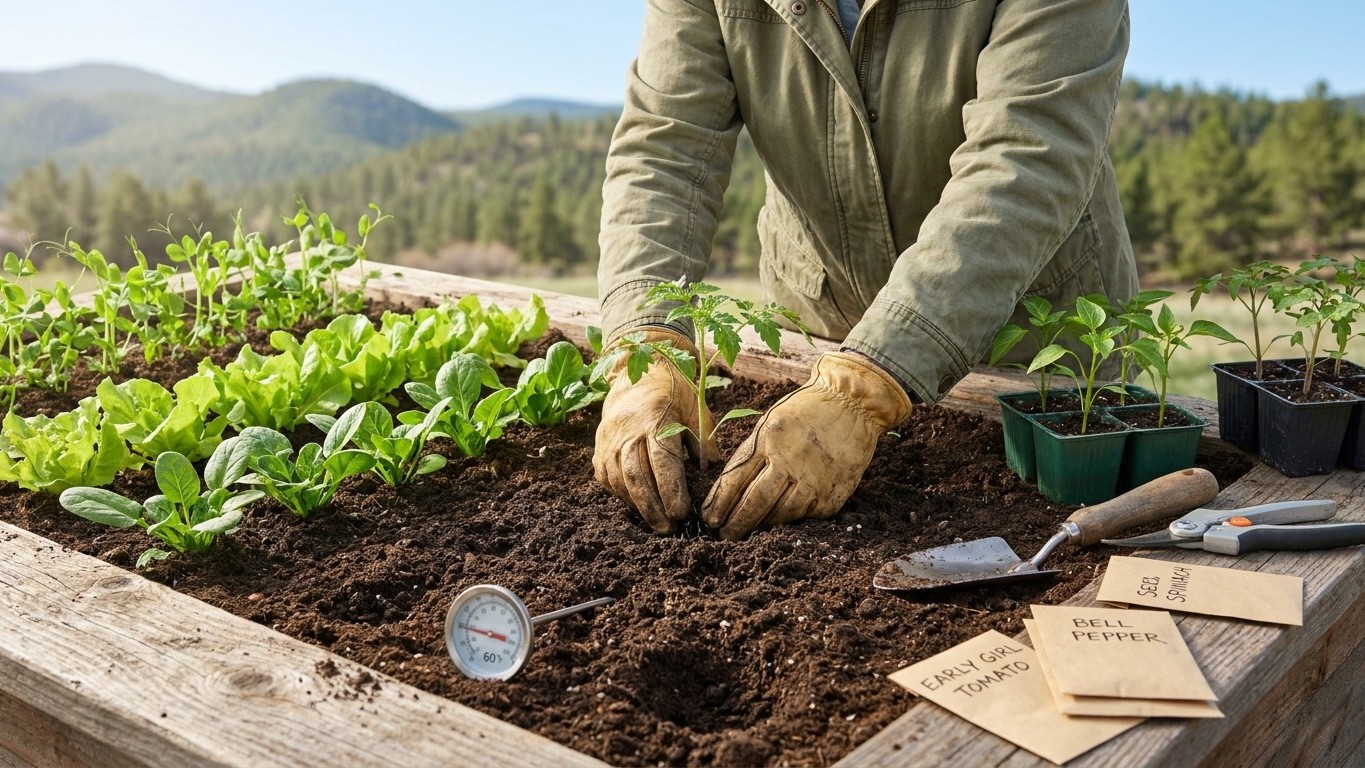

May is Colorado’s hinge month: the last spring frost lands between May 1 and May 11 in the Denver area, so early May still calls for hardy, cold-tolerant crops while the back half of the month opens the door to warm-season planting. Cool-season vegetables go in the ground directly; tomatoes, peppers and squash wait for hardened-off transplants once nights hold above the danger zone.
What goes in the ground in May

The calendar page on your fridge doesn’t know your soil temperature, and in Colorado that gap matters more than almost anywhere else. NOAA’s 1991-2020 climate normals put the last spring freeze at the Denver-area reference station somewhere between May 1 and May 11, which means the first third of the month is still inside the risk window, not past it. Soil temperature and that freeze window are what decide planting, not the date on the seed packet.
Early in the month, while frost odds are still live, stick to what shrugs off a cold night. Peas, spinach, lettuce, arugula and radishes go straight into the ground as seed. Onion sets, seed potatoes and garlic (if you missed the fall window) tolerate the swing between warm afternoons and near-freezing nights that Colorado does so well. Hardened-off transplants of broccoli, cabbage and kale can go out too, since a light frost barely slows them down.
Once the calendar clears the May 1-11 band and overnight lows settle, the ground opens up for the crops that can’t take a chill. Beans, corn and squash seed go directly into soil that has actually warmed, not soil that merely looks dry on top. Tomatoes, peppers, basil and squash transplants follow, but only after a proper hardening-off stretch outdoors in a sheltered spot for several days first.
Elevation changes everything
Denver sits at 5,280 feet on the plains, and the May 1-11 window applies there. Mountain towns run a much shorter season and can still see frost into July; treat May in those towns the way you’d treat April on the plains, and hold the warm-season crops back. The Western Slope runs on its own schedule again. If you garden above 7,000 feet, hardy greens and alliums are the safe bet all month.
What to start under cover
Most of the classic “start indoors” work for the big warm-season crops happened weeks before May, since tomatoes and peppers typically need six to eight weeks of indoor growth before they’re ready to face the garden. By May, the useful move under cover is different: it’s about filling the gaps rather than getting a head start on the season’s stars.
Cucumbers, melons and summer squash resent having their roots disturbed for long, so starting them under cover two to three weeks before you plan to transplant, rather than months ahead, actually works in your favor. Count backward from the point your soil and night temperatures clear the frost window for your elevation, not from a fixed date on a chart. A second round of broccoli or cabbage started under cover now sets up a fall harvest later, since these plants tolerate cool finishes better than hot ones.
The two ways this goes wrong are mirror images of each other. Start too early and you end up babysitting leggy, rootbound seedlings that stall the moment they hit the garden, having spent weeks fighting a container too small for them. Start too late, especially for anything that needs a long run, and you’re racing the first fall frost, which lands between September 30 and October 12 at the Denver-area reference station. Do the arithmetic backward from that fall date for slower crops like melons, and you’ll see how little slack Colorado’s season actually gives you.
What is ready to pick
May rewards anyone who got a head start earlier in spring. Established asparagus crowns, meaning beds in their third year or later, come into full harvest this month, and the rule holds regardless of what the calendar says: cut spears while they’re still tight-tipped and about pencil-thick, before they start to open and toughen. Rhubarb stalks thicken enough to pull by mid-month in most gardens, and the plant keeps producing as long as you leave a few leaves on each crown.
Lettuce, spinach and radishes sown under cover back in March or April usually reach the table sometime in May, and the test is simple: lettuce and spinach leaves at a usable size before they bolt in the day’s heat, radishes pulled as soon as the shoulders push up out of the soil rather than left to get woody underground. Chives and other perennial herbs wake up early and are ready to snip as soon as new growth reaches a few inches.
If you’re still working through stored crops from last season, this is the month to go through them one more time. Squash, potatoes and onions held in storage should get a hands-on check now: soft spots, sprouting eyes on potatoes and any give in an onion’s neck all mean use it now rather than let it sit. The ones that pass inspection can usually make it a few more weeks, but May is generally the last reliable stretch before storage crops start turning faster than you can use them.
The jobs that matter this month
Soil preparation done now sets up everything that follows, and Colorado’s clay-heavy soils in particular reward working in compost while the ground is workable rather than fighting it bone-dry in July. Get beds turned and amended before the warm-season transplants go in, since disturbing roots later to fix a soil problem costs you more than it saves.
Staking matters this month specifically because peas and early climbing crops are putting on fast growth right now, and a support installed after the vines have sprawled does real damage getting untangled. Put stakes, cages and trellises in place while the plants are still small enough to train onto them without snapping stems.
Watering rhythm needs adjusting as days lengthen and afternoon temperatures climb, even while nights stay cool. Shallow, frequent watering trains roots to stay near the surface, which then punishes plants the moment a hot, windy Colorado afternoon shows up; deeper, less frequent watering builds the root system that actually survives summer.
Succession sowing keeps a steady supply coming instead of one glut followed by a gap. Put in a new short row of lettuce or radishes every couple of weeks rather than a single big planting, so the harvest spreads out through summer instead of arriving all at once and bolting together.
Pest scouting matters early, before populations build. Aphids and flea beetles show up on tender new growth in May, and a few minutes checking the undersides of leaves now catches an infestation while a strong hose spray or row cover still handles it, rather than after it’s spread across the bed.
What not to do in May
The single most common mistake in Colorado gardens this month is planting tomatoes, peppers or squash into cold soil because the air finally felt warm on a nice afternoon. Colorado’s daily temperature swing is wide: a 70-degree afternoon can still sit over soil that hasn’t caught up, and a warm-season transplant dropped into cold ground simply stalls, sitting there stunted for weeks even if it doesn’t die outright. Check that both soil temperature and overnight lows have actually turned the corner before transplanting, not just the daytime high.
A close second is uncovering row covers or cold frames too early after a mild stretch, only to lose tender growth to a return frost. Colorado is known for late snow and cold snaps that arrive after several deceptively warm days, and the May 1-11 frost window is a range, not a guarantee that frost stops on any single date. Keep protection handy and ready to throw back over beds rather than putting it away for the season the first time a week feels warm.
Feeding nitrogen at the wrong moment causes its own damage. Heavy nitrogen applied to young transplants before they’ve hardened off pushes soft, leafy growth that’s more vulnerable to both cold snaps and pests, rather than the sturdier growth that comes from a plant allowed to establish roots first. Hold off on heavy feeding until plants are settled in and actively growing, and lean on compost worked into the soil ahead of planting instead of a quick nitrogen boost after the fact.
Checking this against your own county
A state-wide month is a starting point, not an instruction, and nowhere is that more true than Colorado. Elevation alone can shift the last-frost window by weeks between a Denver-area garden and a mountain town a couple hours away, and the Western Slope runs on a different pattern again from the Front Range. The USDA hardiness zone map puts Colorado anywhere from 3b to 7b, and that spread alone tells you how little a single statewide date can promise.
For a planting window built around your actual county, the Colorado State University Extension service publishes local guidance and a state planting calendar worth checking before you put anything warm-season in the ground.
Common questions
Is it safe to plant tomatoes in Colorado in May?
Only once the frost window has passed for your elevation. At the Denver-area reference station, the last spring frost falls between May 1 and May 11, so tomatoes go out toward the back half of the month there, after hardening off, and later still at higher elevations.
What vegetables can I direct sow in Colorado in May?
Peas, spinach, lettuce, arugula, radishes and onion sets can go straight into the ground early in the month. Beans, corn and squash seed can follow once the soil has actually warmed and the frost window has cleared.
When is the last frost date in Denver, Colorado?
NOAA’s 1991-2020 climate normals put the last spring freeze at the Denver-area reference station between May 1 and May 11. That’s a range built on freeze probability, not a single guaranteed date, and mountain towns and the Western Slope run on different schedules entirely.
Can I plant grass seed in Colorado in May?
Cool-season lawn grasses common on the Front Range generally establish well once soil has warmed past the frost window and before summer heat sets in, which makes May a workable window in most Denver-area yards, though local Extension guidance is the better check for your specific elevation and grass type.