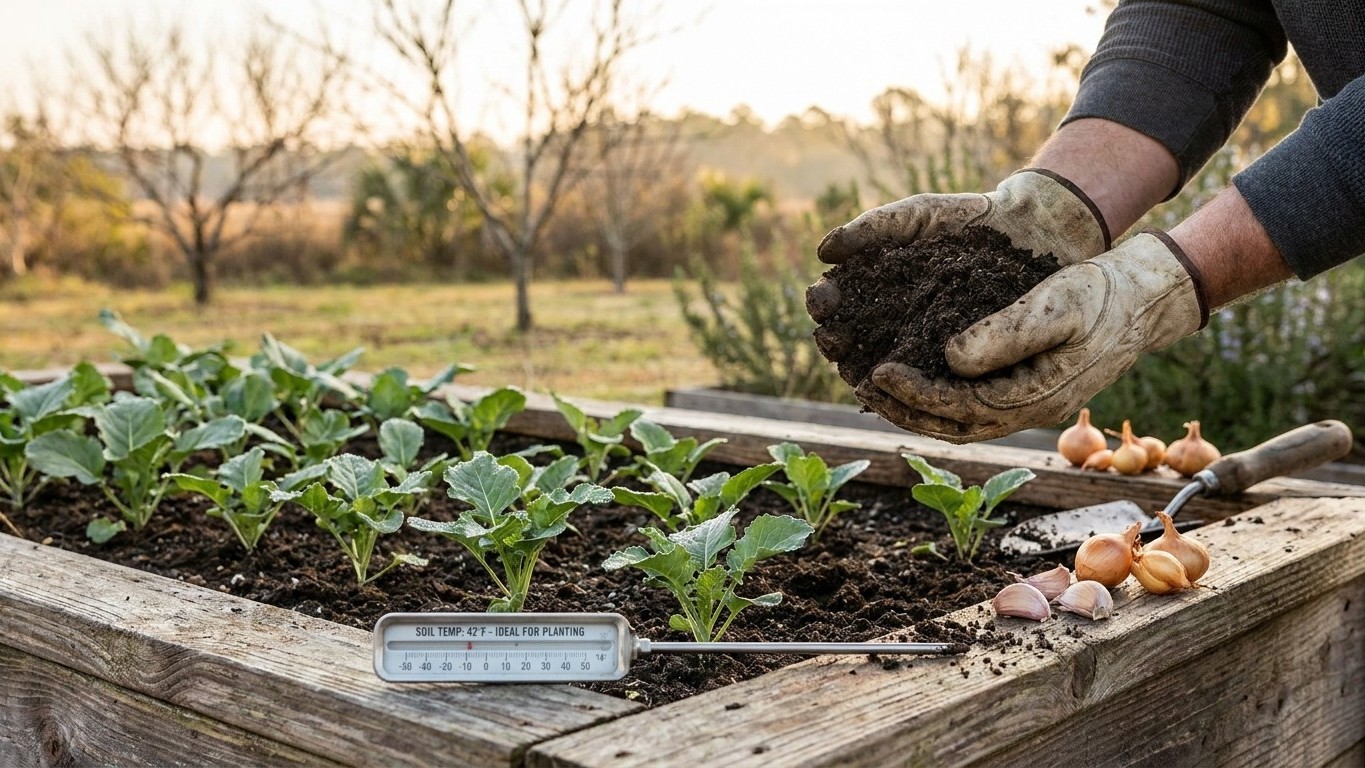

February in Georgia splits the state in two. In the coastal plain and south Georgia, cold-hardy greens, onions, garlic and English peas can go into open ground right now. In north Georgia and the mountains, the soil is still too cold and wet to work, and the safer bet is starting seeds under cover, pruning dormant fruit trees, and getting beds ready for a spring that’s still weeks away.
What goes in the ground in February

The decision here isn’t the calendar. It’s soil temperature and where you sit relative to the average last frost window. For the Atlanta area, NOAA’s 1991-2020 climate data puts that window between March 11 and March 29, which means February sits anywhere from two to eight weeks before the ground is reliably safe for tender crops. That number comes from a single weather station at an urban airport, so treat it as a reference point, not a rule for every county.
South Georgia and the coastal plain, sitting in USDA hardiness zones 8b and 9b, typically thaw out and warm up faster than that Atlanta reference suggests. If your soil crumbles rather than clumps when you squeeze it, and a soil thermometer reads above 40°F, you can direct-sow English peas, and set out onion sets, shallots and garlic cloves where they weren’t already in from fall. Hardy greens including kale, collards, spinach, mustard and lettuce can go in too, especially under a cold frame or low tunnel that buys another 5 to 10 degrees of protection on cold nights.
North Georgia and the mountains, closer to zones 6a and 7a, are a different story. The ground there is often still frozen solid or waterlogged, and working it now just compacts the soil and undoes months of structure. If that’s your situation, the honest move is to leave the open ground alone and focus on what still works: bare-root fruit trees and cane fruits like blackberries and blueberries can be planted while they’re dormant, and it’s a good window to force rhubarb crowns or chicory roots indoors for an early harvest that has nothing to do with outdoor soil temperature at all.
What doesn’t belong outside anywhere in Georgia this month: tomatoes, peppers, squash, beans, corn, cucumbers. A warm afternoon doesn’t mean the soil has caught up, and a hard freeze arriving in the following week will take out anything tender that got planted on optimism alone.
What to start under cover
Seed starting indoors runs on its own math, and it’s worth doing the arithmetic yourself rather than trusting a generic date. Take your local expected last frost window (again, March 11 to March 29 for the Atlanta reference, earlier for the coastal plain, later for the mountains) and count backward by the number of weeks each crop needs before it’s ready to transplant.
Tomatoes generally need 6 to 8 weeks indoors before they go outside, which puts an indoor start sometime in late January to early February for most of the state. Peppers run longer, closer to 8 to 10 weeks, so if you haven’t started them yet, this month is close to the deadline. Cool-season transplants like broccoli, cabbage and cauliflower can also start indoors now for setting out once the coldest nights have passed, since they tolerate a light frost far better than the summer crops do.
Two mistakes show up every year with this timing. Start too early, and by the time the ground is finally warm enough, the seedlings are rootbound, leggy and stressed, with weak stems that never quite recover even after transplanting. Start too late, and the plant never builds the root mass it needs before the heat of summer arrives, which shortens the harvest window on the back end. Both mistakes come from the same source: using a fixed date instead of counting backward from the actual frost window for your part of the state.
A heat mat and a south-facing window, or a simple grow light setup, matter more than the exact brand of seed tray. Consistent bottom heat around 70°F speeds germination on tomatoes and peppers noticeably compared to a cold windowsill.
What is ready to pick
Outdoors, February harvests in Georgia depend heavily on how the winter treated your garden and which part of the state you’re in. In the south, overwintered collards, kale and leeks often keep producing right through the month, especially if they were mulched heavily going into the coldest stretch. A hard freeze sweetens the flavor of kale and collards rather than ruining them, so don’t rush to pull them the morning after a cold night.
Cold frames and low tunnels, if you set them up in fall, are likely holding lettuce, spinach and mustard greens that have kept growing slowly all winter. Check them on mild days, since even a cold frame can overheat and bolt greens if the lid stays closed on a sunny 55°F afternoon.
Indoors, sprouts and microgreens are the most reliable harvest this month, ready in as little as 5 to 10 days from seed with no dependence on outdoor weather at all.
This is also the month to walk through stored crops. Winter squash, sweet potatoes and stored onions should get a hands-on check: soft spots, a sweet fermented smell, or sprouting onions mean it’s time to use or toss that item before it spreads to the rest of the bin. One soft squash left in a box of a dozen can take down the whole batch within a couple of weeks.
The jobs that matter this month
February carries more weight than its short harvest list suggests, mostly because the work done now sets up everything that follows.
Dormant pruning tops the list for fruit growers. Peach and apple trees, along with blackberry and blueberry canes, should be pruned while they’re still dormant and before buds break, since cutting into active growth stresses the plant and can cut yield for the season. Georgia’s peach growers time this closely, and home gardeners with even one or two trees benefit from the same discipline: remove dead, crossing and inward-growing branches, and open up the center of the tree for air movement and light later in the season.
Seed ordering has a real deadline too, even if it doesn’t feel like one. Popular varieties, especially disease-resistant tomatoes and regionally adapted okra and pepper types, sell out from seed companies by late winter most years. Waiting until spring often means settling for whatever’s left.
A soil test is worth doing now, before the planting rush. The results take a couple of weeks to come back, and knowing your pH and nutrient levels ahead of spring means you can amend with lime or compost while there’s still time for it to work into the soil before anything goes in.
Beyond that: turn the compost pile to keep it breaking down through the cold, clean and sharpen pruning shears and hoes so they’re ready when the workload picks up, and check raised beds and fencing for winter damage while repairs are still easy to make without disturbing new growth.
What not to do in February
The most common mistake in Georgia this month is trusting a warm afternoon over the calendar of averages. A stretch of 70°F days in February happens most years and fools people into setting out tomato or pepper transplants, only for a freeze to arrive a week or two later and kill them outright. The average last frost window running to March 29 for the Atlanta reference means a warm week in February guarantees nothing about what comes after it.
A related error: uncovering row covers, cold frames or mulch too early after a mild spell, then getting caught when temperatures drop back down. Hardy greens can shrug off a light freeze, but young transplants that were hardening off under a warm cover for a week lose that protection fast once exposed.
Nitrogen fertilizer is another trap. Feeding dormant fruit trees, canes or overwintered greens with a nitrogen-heavy fertilizer this early can push soft, tender new growth right before a freeze, and that new growth is exactly what cold damage targets. Wait until active growth is clearly underway before feeding.
Last one: don’t prune spring-flowering shrubs like azaleas or forsythia now. They set their flower buds on last season’s wood, and a February pruning cuts off the very blooms you’re waiting for. Save that pruning for right after they flower.
Checking this against your own county
Everything above is a statewide starting point, and Georgia is too large and too varied for one answer to fit every yard. The state spans USDA hardiness zones 6a to 9b, and that range alone shifts planting windows by several weeks between the mountains and the coast. Elevation in north Georgia pushes frost dates earlier in fall and later in spring than the Atlanta reference station used here, while the coastal plain runs consistently milder in both directions.
For a planting calendar built around your specific county, the University of Georgia Cooperative Extension is the right next stop, with local offices that track soil temperature and frost data closer to home than any statewide average can.
Common questions
Can you plant tomatoes in Georgia in February?
No, not outdoors. The average last frost for the Atlanta reference station runs from March 11 to March 29, and most of the state is still inside that risk window in February. Start tomato seeds indoors instead, timed 6 to 8 weeks before your local last frost date.
Is it too early to start a vegetable garden in Georgia in February?
Not for cool-season crops. Garlic, shallots, onions, English peas and hardy greens can go into workable soil in south Georgia this month. It is too early for warm-season crops like tomatoes, peppers and squash almost everywhere in the state.
What vegetables are cold-hardy enough for Georgia gardens in February?
Kale, collards, spinach, lettuce, mustard greens, English peas, garlic and onions all tolerate the cold well and can survive light freezes without protection, and heavier freezes under a cold frame or row cover.
When should fruit trees be pruned in Georgia?
While they’re dormant and before buds break, which for most of the state falls in the winter months including February. Pruning after growth resumes stresses the tree and can reduce that season’s fruit.