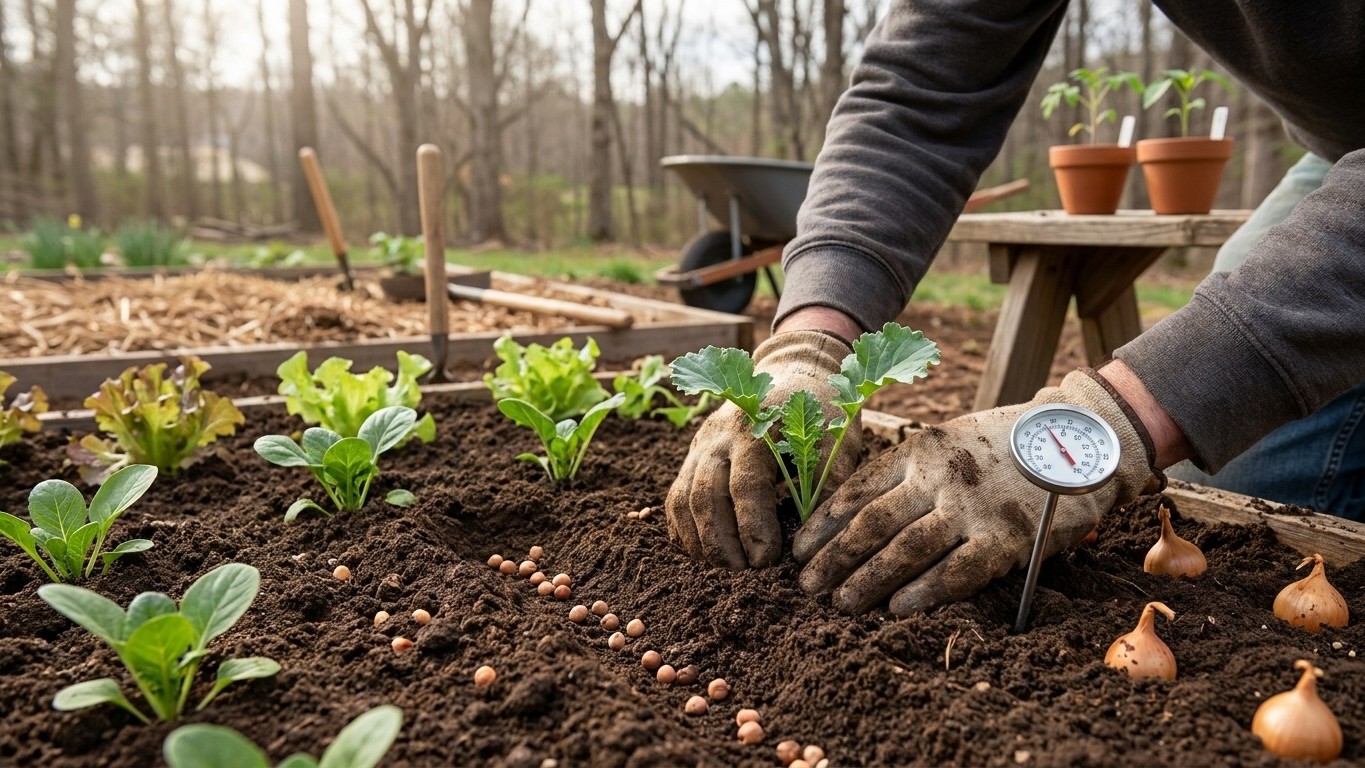

Hardy crops win in Georgia in March: lettuce, spinach, kale, onions, garlic, and peas can all go into the ground now with little risk. Tomatoes, peppers, beans, and squash are a different story. For the Atlanta area, NOAA’s 1991-2020 climate normals put the last spring freeze anywhere between March 11 and March 29, so tender transplants set out on March 1 are gambling against three more weeks of freeze risk, while ones set out on March 30 are usually clear.
What goes in the ground in March

The decision isn’t the calendar date. It’s soil temperature and where you sit relative to that freeze window. Seeds germinate on soil warmth, not air warmth, and a 55°F afternoon over 40°F dirt will still leave beans and squash rotting instead of sprouting. That’s the trap March sets: the air feels like spring weeks before the ground agrees.
Crops that tolerate frost outright don’t need to wait for any of this. Lettuce, spinach, arugula, kale, collards, and other hardy greens can be direct-sown or transplanted through the entire month. So can the alliums: onion sets, shallots, and garlic (garlic ideally already in from fall, but a late planting in workable soil still has time to size up). English peas belong in this same category. All of these shrug off a light freeze that would flatten a pepper seedling overnight.
Root crops split the difference. Carrots, beets, radishes, and turnips can go in as soon as soil is workable and not waterlogged, since they germinate at cooler temperatures than warm-season crops but still want the ground to have lost its winter chill.
Warm-season crops are where March turns into a bet. Because the last-frost window for the Atlanta reference station runs from March 11 to March 29, anything tender put in the ground during the first half of the month is exposed to real freeze odds. The coastal plain in south Georgia typically clears frost earlier than that window and can often direct-sow beans or set out squash transplants with more confidence by mid-month. North Georgia and the mountains run the opposite direction: freezes linger later into spring there than the Atlanta-based window suggests, so tender plantings should wait longer, not less. If you’re gardening in zone 6a country in the far north versus zone 9b near the coast, per the USDA Plant Hardiness Zone Map, treat “March” as two very different months.
What to start under cover
Seed-starting math runs backward from the frost window, not forward from today’s date. Tomatoes and peppers generally want six to eight weeks indoors before transplant, so counting back from a last-frost target anywhere in the March 11 to March 29 range puts their start date in mid-to-late January for most of the state. If those trays aren’t already growing, starting them now still works for a slightly later transplant date, especially in north Georgia where frost lingers longer anyway.
Squash, cucumbers, and melons need far less lead time, usually three to four weeks, which makes March the right start window for a transplant that goes out once soil has warmed past the frost risk. Starting too early with these fast growers is its own failure mode: they get rootbound and leggy in small trays long before the garden is ready, and a stressed, overgrown seedling often performs worse than one started two weeks later and planted at the right size.
The opposite mistake shows up with slow growers like peppers and eggplant. Start those too late in March and you’re pushing transplant date into early summer, cutting into the harvest window before the first fall frost arrives sometime between November 13 and December 1. Under cover in a cold frame or unheated hoop house, hardy greens can also be started now for an earlier, more protected crop than direct-sowing in open beds.
What is ready to pick
March harvests lean heavily on what survived winter rather than anything newly planted. Overwintered kale, collards, and leeks that made it through the cold months are often at their sweetest right now, since cold exposure converts starches to sugars in these crops. Spinach and lettuce planted in late winter or carried through under a cold frame or low tunnel are usually ready to start cutting.
Cold-frame greens deserve a daily check as the month warms, because the same protection that kept them alive in February can cook them by late March on a sunny 70°F afternoon if the frame isn’t vented. Bolting is the other risk: as day length stretches, overwintered greens that lingered too long can send up a flower stalk and turn bitter fast, so harvest generously rather than letting them sit.
Indoors, sprouts and microgreens fill the gap for households wanting fresh greens with zero outdoor risk, ready in one to two weeks from seed regardless of what’s happening in the yard.
Stored crops need a walk-through this month too. Squash, potatoes, and onions held over winter should get pulled and checked, since soft spots, sprouting eyes, or a sweet fermented smell mean that item needs to be used or composted before it spreads rot to the rest of the bin.
The jobs that matter this month
March is the last real window for dormant pruning on fruit trees and berry canes before buds break open. Prune after that point and you’re cutting into new growth, wasting the tree’s stored energy and inviting disease into fresh wounds. Apples, pears, blueberries, and grapes all benefit from a final look now, cutting out dead wood, crossing branches, and anything growing straight up through the canopy.
Soil preparation pays off disproportionately this month because it’s the last calm stretch before planting season fills every weekend. A soil test now, through the county extension office, gives results back in time to correct pH or add amendments before warm-season crops go in. Turning finished compost into beds and topping off mulch on garlic and overwintered greens both matter here too, since mulch that’s thinned out over winter leaves roots exposed just as temperature swings get sharper.
Seed ordering has a real deadline hiding in it: popular varieties of tomatoes, peppers, and heirloom vegetables sell out from seed companies earlier every season, so March orders often mean settling for whatever’s left rather than a first choice.
Tool maintenance and bed repair belong on this list too, not as busywork but as prevention. A dull pruning saw tears bark instead of cutting clean, and a fence panel that’s been sagging since fall will fail exactly when spring growth needs the support most. Staking for peas and any early climbers should go in now, before vines are six inches tall and impossible to train without damage. Pest scouting starts here as well: aphids and early cabbage worms show up on the first warm greens well before most gardeners think to look.
What not to do in March
The single most common mistake is planting tomatoes, peppers, or squash into the ground because the air finally feels like spring, while soil temperature hasn’t caught up. A 75°F afternoon can sit over soil still in the 50s, and warm-season seeds planted into that cold ground simply rot instead of germinating. Check soil temperature directly with a simple soil thermometer rather than trusting how the day feels on skin.
Uncovering cold frames, low tunnels, or mulched beds too early after a mild stretch is the second trap. A run of 70°F days in the middle of the frost window (March 11 to March 29 for the Atlanta reference point) can lull gardeners into stripping off protection, right before a cold snap drops back through. Keep covers on standby even after a warm week until you’re clearly past the local frost date, not just past a good few days.
Nitrogen timing trips people up too. Heavy nitrogen feeding on greens that are about to bolt just pushes more leafy growth into a plant that’s already shifting toward flowering, wasting fertilizer instead of extending harvest. Save the nitrogen push for crops that are staying vegetative, like new transplants, rather than greens on their way out.
Skipping the final dormant pruning window because it’s “basically spring already” costs a full season of tree shape and fruit yield if buds have already broken by the time you get to it.
Checking this against your own county
A state-wide frost window is a starting point, not an instruction for a specific yard. The March 11 to March 29 range comes from one Atlanta-area station, and it shifts by weeks depending on elevation, local cold pockets, and how far north or south of that station a garden sits. North Georgia’s mountain counties routinely freeze later into spring than this window suggests, while the coastal plain in the south often clears frost well ahead of it.
The University of Georgia Cooperative Extension (extension.uga.edu) publishes county-level planting guidance and can connect a gardener to local frost data that accounts for elevation and regional differences the statewide number can’t capture.
Common questions
Is it safe to plant tomatoes in Georgia in March?
Only in the far south of the state, and even there it’s a calculated risk. For the Atlanta-area reference window, last frost falls between March 11 and March 29, so tomatoes set out in early or mid-March are still exposed. Waiting until after that window closes, or holding transplants under row cover, is the safer path.
Can I still plant garlic in March in Georgia?
Garlic does best planted in fall, but a late planting in workable, well-drained soil in early March can still size up into usable bulbs, just smaller than a fall-planted crop.
Why is my soil still too cold to plant even on a warm March day?
Soil holds cold longer than air. A 70°F afternoon doesn’t undo weeks of cold ground, which is why a soil thermometer is a more reliable planting guide than the day’s forecast high.
Does March frost risk differ much across Georgia?
Yes, considerably. The published window of March 11 to March 29 reflects one Atlanta-area station. North Georgia and the mountains tend to stay in frost risk later into spring, while the coastal plain typically clears frost earlier than that window.