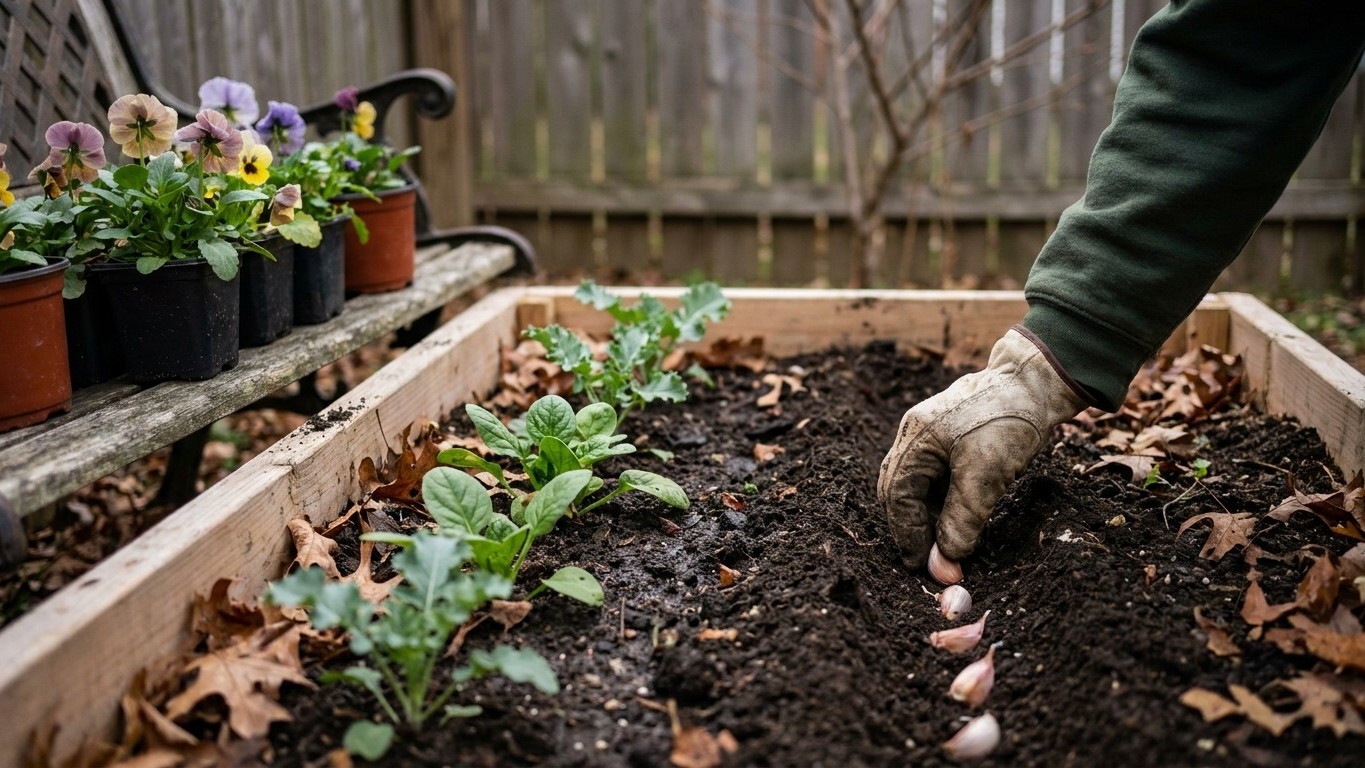

October in Missouri means garlic goes in the ground, hardy greens get one more sowing window, and the season’s last tender crops need to come off the vine before the frost window arrives. The state’s first fall frost lands anywhere from October 18 to October 29, so the first half of the month still works like a mild fall day and the back half works like the start of winter. Plan around that split, not around the date on the calendar.
What goes in the ground in October

Soil temperature and the frost window decide what survives this month, not the fact that it’s still technically fall. Missouri’s first frost falls in the October 18 to October 29 range, which means a crop planted on October 1 gets roughly three workable weeks before the air turns hostile, while anything planted after the 20th is racing a clock that’s already running out. That gap is the whole story for this month.
Garlic and shallots are the anchor crop right now. Cloves planted through mid-to-late October have time to root before the ground locks up, and they’ll sit dormant through winter and push up in spring well ahead of anything started later. This is close to the only bulb crop worth planting for a harvest, as opposed to spring bulbs planted purely for bloom.
Spring-flowering bulbs, tulips, daffodils, crocus, also go in now, and they’re forgiving of a light frost since they’re not trying to grow top growth before winter. On the vegetable side, spinach, mache, and cold-hardy lettuce varieties can still be direct-sown in the first half of the month in the milder parts of the state; they germinate slower as soil cools but tolerate the frost that follows.
What doesn’t belong in this list: beans, squash, tomatoes, peppers, anything warm-season. A stretch of 70-degree afternoons in early October doesn’t change the fact that the ground is cooling and the frost window is close. Skip them entirely rather than gamble a few weeks of growing time on a crop that dies at the first freeze.
Row covers, cold frames, and low tunnels stretch this window meaningfully. A simple hoop of plastic sheeting over a bed can buy two to three extra weeks for greens that would otherwise stop at first frost, and it’s the cheapest season-extension tool available to a home gardener.
What to start under cover
Counting backward from the frost window is the only method that holds up here. With first frost landing between October 18 and October 29, anything started indoors this month isn’t headed for an outdoor transplant before winter, it’s headed for a cold frame, a hoop house, or a windowsill through the cold months.
Microgreens are the most reliable indoor crop to start now. Radish, pea shoots, and brassica mixes are ready in one to three weeks on a sunny sill or under a basic grow light, and they don’t care that the calendar says fall is ending. Sprouting jars work the same way for households that want fresh greens without any soil at all.
For gardeners running a cold frame or unheated hoop house, this is also the window to start a second round of lettuce and spinach seedlings indoors for transplant under cover, since the protected structure buys enough extra warmth to let transplants establish even after the open-ground frost date passes.
The two failure modes to watch: starting seedlings too early leaves them leggy and rootbound with nowhere to go, since there’s no outdoor bed left to receive them once the ground freezes. Starting too late means microgreens or cold-frame lettuce won’t size up before the shortest, dimmest days of the year slow growth to a crawl. Aim for the first half of the month for anything meant to reach harvest size before the light drops off.
What is ready to pick
This is peak harvest month for anything that needed a full season to mature. Winter squash and pumpkins should already be cured or coming off the vine before that first frost hits; a fully cured winter squash has a hard rind that doesn’t dent under a thumbnail and a dry, corky stem. Sweet potatoes need to be dug before soil temperatures drop much further, since cold soil damages the roots even without a hard freeze.
Root crops, carrots, beets, turnips, can stay in the ground longer than most people assume. A light frost actually sweetens them, so there’s no rush to pull them the moment temperatures dip, as long as they’re mulched to keep the ground workable for digging.
Brussels sprouts follow the same rule, tasting noticeably better after a frost or two rather than worse. The last tomatoes and peppers, on the other hand, need to come off before the first freeze regardless of ripeness; green tomatoes picked ahead of frost and ripened indoors on a windowsill beat any tomato left on a frost-killed vine.
For stored crops from earlier in the season, this is also the month to start checking curing squash, stored onions, and early potatoes for soft spots or sprouting. One rotting squash in a storage bin spreads decay to its neighbors fast, so a quick weekly check saves the rest of the batch.
The jobs that matter this month
October is one of the busiest maintenance months of the year precisely because the frost window forces a deadline. Every task below has a real cutoff, not a vague “sometime this fall” timeline.
Harvest before frost tops the list, since tender crops left out past the frost window are simply lost. Right behind it is cleanup: pulling spent tomato, squash, and bean plants once they’re done producing removes overwintering sites for pests and disease before the garden goes dormant for winter.
Mulching perennial beds, garlic rows, and any newly planted bulbs matters more this month than any other, since a two-to-three-inch layer applied now insulates roots through the freeze-thaw cycles of early winter. Waiting until after the ground freezes to mulch defeats the purpose entirely.
Soil testing and amending is worth doing now rather than in spring, since amendments like lime or compost need months to integrate into the soil, and a fall test gives that time before spring planting starts. Turning finished compost into beds now, ahead of winter, accomplishes the same thing.
Tool cleaning and sharpening belongs on this month’s list too: a season’s worth of dirt and sap left on pruners and hoes causes rust over winter storage, and dull blades make spring pruning cuts ragged. Seed ordering for next season should also start now, since popular varieties of tomatoes, peppers, and heirloom crops routinely sell out by midwinter.
Finally, this is the window to plan next season’s crop rotation while the current layout is still fresh in memory, and to repair raised bed frames, trellises, and fencing before winter weather makes outdoor repair work miserable.
What not to do in October
The most common mistake this month is trusting a warm afternoon over the calendar. A run of 70-degree days in early October doesn’t push the frost window back, and gardeners who plant warm-season seedlings during that stretch usually watch them die within days of the first freeze. Treat the October 18 to October 29 window as fixed, regardless of what the thermometer says on any given afternoon.
Fertilizing with nitrogen this late is another classic error. Nitrogen pushes soft new growth, and that new growth is exactly what a frost damages first. Perennials and shrubs fed nitrogen in October often respond with a flush of tender shoots that get killed within weeks, weakening the plant heading into winter rather than strengthening it. If feeding is needed at all this month, a low-nitrogen or phosphorus-and-potassium-focused fertilizer supports root development instead.
Uncovering row covers or cold frames too early after a mild stretch is a quieter but equally common mistake. A few warm days in the middle of October don’t mean the frost risk has passed; removing protection then leaves tender greens exposed right before the next cold snap.
Leaving tender crops in the ground “just a little longer” to gain size is a bet that rarely pays off in this state. A single hard freeze can wipe out weeks of anticipated growth on tomatoes, peppers, or basil in one night. When the forecast turns, harvest early rather than late.
Checking this against your own county
A state-wide month is a starting point, not an instruction. Missouri spans USDA hardiness zones 5b through 7b, and elevation, local terrain, and the north-south spread of the state shift frost timing by real weeks, not days. The reference frost window here comes from a station north of Kansas City; the downtown Kansas City station runs about five days earlier in spring, and southern Missouri counties tend to run milder still on both ends of the season. Before committing to a planting date, check current conditions and local guidance through the University of Missouri Extension, which tracks county-level recommendations that a state average can’t capture.
Common questions
Is it too late to plant garlic in Missouri in October?
No, October is close to the ideal window. Garlic cloves planted through mid-to-late October have time to root before the ground freezes and will resume growth in spring, typically producing better bulbs than garlic planted later in fall.
Can tomatoes still be growing outdoors in Missouri in October?
Only until the first frost, which falls between October 18 and October 29 depending on location. Any tomatoes still on the vine as that window approaches should be picked, ripe or green, since a hard freeze kills the plant and damages the fruit in one night.
Should I mulch my garden beds in October?
Yes, particularly beds with newly planted garlic, bulbs, or perennials. A two-to-three-inch layer of mulch applied before the ground freezes insulates roots through winter’s freeze-thaw cycles far more effectively than mulch applied after the ground has already hardened.
Does a frost actually improve the flavor of some vegetables?
Yes, for a specific group. Brussels sprouts, kale, carrots, and other root vegetables tend to sweeten after exposure to light frost, since the cold triggers the plant to convert stored starches into sugars. This doesn’t apply to tender crops like tomatoes or peppers, which should be harvested before frost, not after.
Gardeners who plant by the Moon can check the October 2026 moon planting calendar, a tradition rather than a proven method.
Related guides
- the Missouri planting calendar
- What to Plant in Missouri in September
- What to Plant in Missouri in November
Elsewhere? See what to plant in October in every state and province.