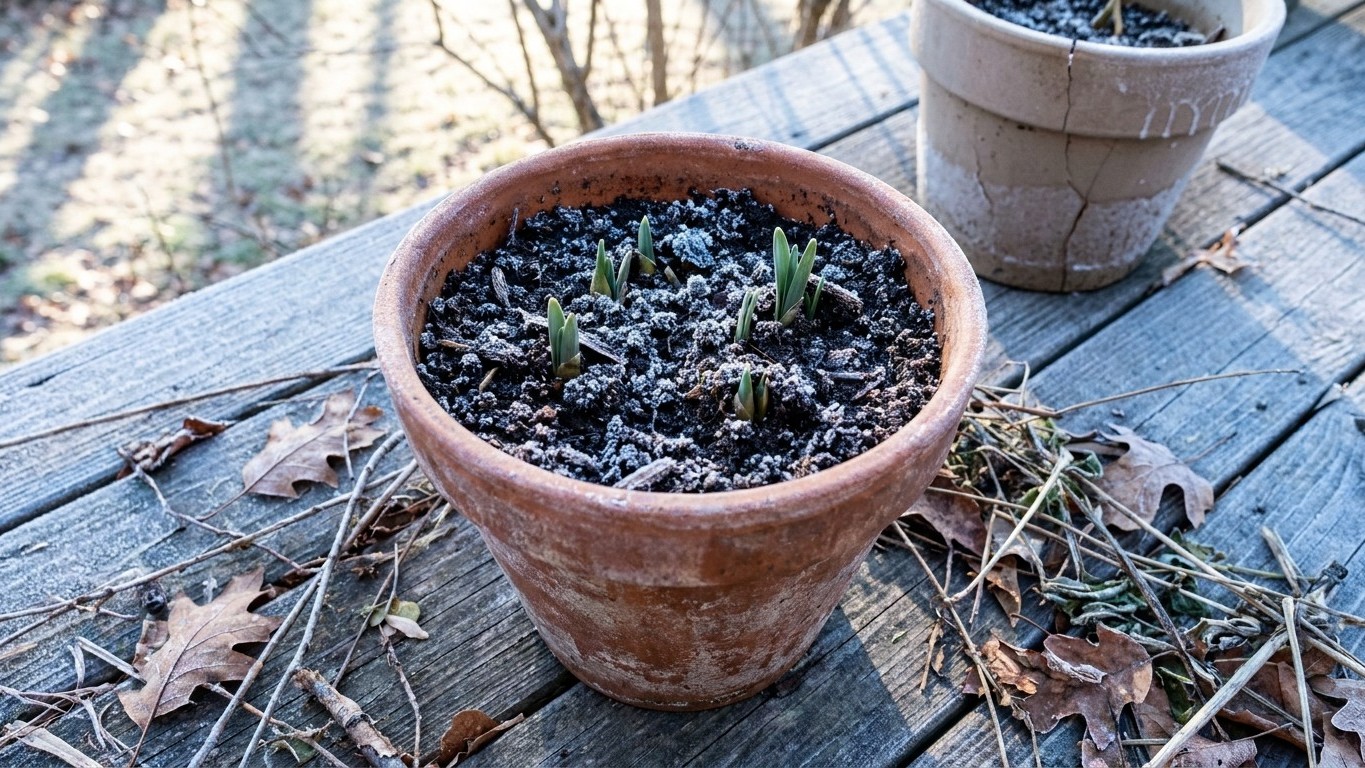

In Containers, bulbs in Missouri face a different threat than bulbs in the ground: not a shortage of cold, but too much of it applied directly to the root ball. The state’s winter already delivers more chill than any spring bulb needs, so the real skill here is protecting a potted bulb from a freeze the same bulb would shrug off in a garden bed.
Why this matters in Missouri

Start with the number that settles the question: the average daily minimum for the coldest month, measured at the Kansas City reference station, is 19.5°F (NOAA NCEI Climate Normals, 1991-2020). That figure sits far below the 45°F threshold a spring bulb needs to cross for its twelve to fourteen weeks of chilling. In territories where winter stays too mild to ever dip that low for long enough, gardeners force bulbs by hand, in a refrigerator or an unheated space, because the climate won’t do the job. That is not the Missouri problem. Here, an in-ground bulb gets its cold requirement met and then some, without any help from the gardener.
The complication is the pot itself. A bulb sitting in garden soil is insulated by the ground around it; even when the surface freezes, the mass of earth below buffers the root zone from the coldest air. A container has no such buffer. Once air temperature drops, a pot’s soil can freeze solid, roots included, because there’s no surrounding earth to slow the cold down. That changes the math completely: the USDA Plant Hardiness Zone Map (2023 edition, based on 1991-2020 normals) places Missouri across a range of zone 5b to 7b, but that rating describes what survives in the ground, not what survives in a pot exposed on all sides to the same air.
Practically, that means a bulb rated hardy to the zone printed on its bag can still die in a container in the exact same yard where it would return for years if planted directly in soil. The wider the state’s zone range, the more this matters for a gardener deciding whether to leave a container outside all winter or move it. A gardener in the milder southern pocket near 7b has more room for error than one near the Kansas City reference point, where the 19.5°F coldest-month minimum sets the baseline every container has to survive.
How to do it here
Because Missouri’s ground cold is already sufficient, the sequence below is built around protecting a container from a freeze-through, not around manufacturing chill that doesn’t exist. Anyone forcing bulbs indoors for an earlier bloom follows a parallel but separate track, noted where it applies.
- Decide the goal first. A container left outdoors on a porch or patio needs winter protection. A container brought indoors for an earlier bloom needs a deliberate cold period before it comes into a warm room, because skipping that step produces leaves without flowers.
- If forcing indoors, chill the bulbs somewhere reliably below 45°F for the weeks that bulb requires, such as an unheated garage that still stays above freezing, or a spare refrigerator drawer. Keep the drawer away from ripening fruit; the ethylene gas fruit gives off can damage the flower bud forming inside the bulb before it ever opens.
- Match the pot to a colder zone than the bulb’s rating. A container should be treated as roughly two USDA zones colder than the ground around it. A bulb rated for zone 6 needs container conditions closer to zone 4 to survive a Missouri winter without help.
- Move vulnerable pots to an unheated garage or an enclosed porch once hard freezes set in, somewhere the temperature stays cold but doesn’t swing down to outdoor extremes.
- If the pot must stay outside, insulate it. Push the container against a house foundation out of the wind, and pile 6 to 8 inches of straw or shredded leaves over the soil surface and around the pot’s sides.
- Check drainage before winter starts. A pot without functioning drainage holes traps meltwater during freeze-thaw cycles, and a waterlogged bulb rots before spring regardless of how well it was insulated.
- Bring outdoor containers back into light gradually once nighttime lows stay consistently above freezing, rather than moving them straight from cold storage into full sun.
Which bulbs are worth it
Not every spring bulb tolerates the freeze-and-thaw swings of container life, and stem height matters as much as cold tolerance once the plant is standing in a pot instead of anchored by garden soil around it. A short chilling requirement means faster, more predictable forcing; a tall, heavy flower stalk topples a lightweight container in wind or rain. For bulbs that gardeners already treat as a single-season purchase, especially tulips in Missouri’s heavy clay soils where repeat bloom is unreliable anyway, container growing or forcing costs nothing in the long run: the bulb was never going to come back regardless.
Reliable choices for containers or forcing here:
- Crocus, for its short stem and short chilling window
- Grape hyacinth (Muscari), compact and sturdy in a pot
- Hyacinth, dense flower spikes that stay upright
- Tulips (shorter varieties), since a single strong season is the realistic expectation anyway
- Paperwhite narcissus, which needs no cold period at all and forces indoors on a simple timeline
Bulbs that tend to sulk or fail in the same conditions:
- Tall daffodil varieties, which frequently topple once the flower opens in a lightweight pot
- Allium, which asks for a long chilling period and produces a stalk too tall for stable container balance
- Fritillaria imperialis, which resents root disturbance and container confinement generally
What goes wrong, and when you can still fix it
Leaves but no flower
This is a chilling problem: the bulb didn’t get enough time below 45°F before it started active growth. Nothing brings the missed flower back this season. The bulb itself is usually fine, so plant it out or restart the chilling process next fall with a longer, uninterrupted cold period.
A flower on a stem too short to see
This happens when a chilled bulb gets moved into heat and light too fast. The plant rushes to bloom before the stem has had time to elongate. There’s no fix for the flower already open. The adjustment belongs to next time: bring the pot into warmth gradually, over several days, rather than straight from cold storage into a heated room.
Rot in the pot
Soft, dark tissue at the base of the bulb points to standing water during dormancy, almost always a drainage failure rather than a cold failure. A rotted bulb doesn’t recover this season or any other. The pot itself can be reused once it’s cleaned out, but check that its drainage holes are actually clear before planting anything else in it.