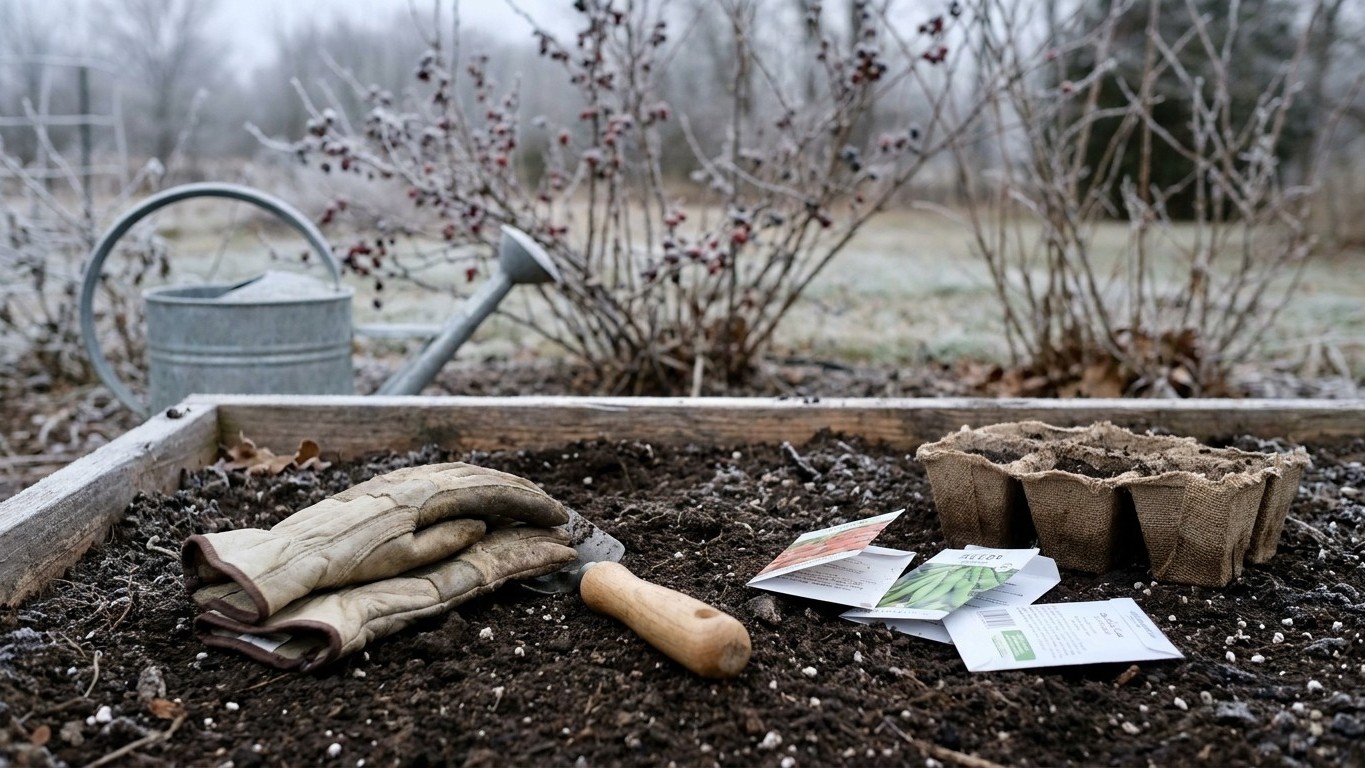

Nothing goes into open ground in Newfoundland and Labrador in February. The last spring frost averages May 30, three months out, and much of the province is still under snow. What this month is actually for: dormant pruning, ordering seed before good varieties sell out, forcing rhubarb indoors, and getting sowing schedules under cover ready for when the ground finally opens.
What goes in the ground in February

The calendar says February. The soil says something different, and soil is what a plant actually responds to. Newfoundland and Labrador’s last spring frost averages May 30, based on the ST JOHN’S A station’s 1981-2010 climate normals from Environment and Climate Change Canada. That’s a mean date, not a guarantee: in one year out of two, frost arrives later than that. So this month sits roughly thirteen weeks before the point where outdoor planting even becomes a reasonable bet, and that’s for the milder Avalon area. Inland and northern districts, and anywhere at elevation, run further behind still.
The bigger obstacle in February isn’t frost risk on paper, it’s the ground itself. Across most of the province the soil is frozen solid and buried under snow, which makes the frost-date math close to academic. You can’t direct-sow into ground you can’t dig, and workability, not the calendar, is the real gatekeeper here.
So the honest answer is that nothing goes into open ground this month. What’s genuinely possible sits close to the house or under cover:
- Garlic or shallots, only if a rare thaw has left a patch of ground actually workable, which is uncommon this early
- Cold frames and low tunnels holding overwintered hardy greens, not new plantings
- Bare-root fruit trees, canes, and shrubs kept dormant in a shed or cool garage, ready for planting once the ground softens
- Forced rhubarb and chicory, brought in from a dark, cool spot to push early stalks and heads indoors
None of this is a consolation list. Forced rhubarb in particular rewards patience: crowns lifted or covered to exclude light will push tender, pale stalks weeks ahead of anything grown outdoors, and it’s one of the few genuinely fresh things a Newfoundland garden can offer this early. Skip the temptation to squeeze in a hardy pea or spinach sowing outdoors just because a mild afternoon shows up. The soil under that thaw is still frozen an inch down, and seed sitting in cold, wet ground rots before it germinates.
What to start under cover
Indoor sowing runs on a different clock than outdoor planting, counted backward from the frost window rather than forward from a fixed date. With the last spring frost averaging May 30, the arithmetic works like this: take the weeks a given crop needs from seed to transplant-ready size, then count back from that late-May mean, keeping in mind it can land later half the time.
Onions and leeks, needing roughly ten to twelve weeks indoors before they’re sturdy enough to handle, land squarely in February for anyone growing them from seed rather than sets. Peppers, notoriously slow, want eight to ten weeks and also start now if the goal is a decent harvest before the short season closes. Tomatoes are the classic trap: six to eight weeks is plenty, and starting them alongside the onions in February means mid-May transplants sitting rootbound and leggy on a windowsill, stretched and stressed before they ever see the garden.
| Crop | Weeks needed indoors | Start relative to late-May frost mean |
|---|---|---|
| Onions/leeks from seed | 10-12 weeks | Now (February) |
| Peppers | 8-10 weeks | Now (February) |
| Tomatoes | 6-8 weeks | Hold until March |
The two failure modes bracket every seed packet: sow too early and the plant outgrows its pot before the ground is ready, sow too late and it never catches up to the province’s short frost-free stretch. A heat mat and a grow light matter more here than a sunny windowsill alone, since February daylight in Newfoundland and Labrador is thin and slanted, and seedlings without supplemental light stretch toward the glass regardless of the calendar.
What is ready to pick
Little comes out of an open garden bed in Newfoundland and Labrador in February, and it’s worth saying plainly rather than dressing up an empty list. What still feeds the household comes from three places: what’s under snow, what’s under cover, and what’s in storage.
Overwintered kale and leeks, tucked under a heavy mulch or a foot of snow, often survive intact and can be dug out on a mild day, snow cleared by hand. Kale in particular sweetens after hard cold, so a leaf pulled now tastes better than the same leaf in October. Cold frames holding spinach, mâche, or claytonia sown the previous autumn keep producing thin but real harvests through the coldest stretch, especially with a double layer of row cover on the worst nights.
Indoors, sprouts and microgreens are the quiet workhorse of a Newfoundland February: a tray of pea shoots or radish sprouts on a counter turns around in a week to ten days, no soil, no daylight requirement worth worrying about, and no dependence on the frost window at all.
Stored crops need a hands-on check this month rather than a glance. Squash should feel firm with no soft spots near the stem end; any give there means it’s turning and should be used first, not left to spread rot to its neighbors. Potatoes want a look for green-tinged skin or sprouting eyes, both signs of light exposure or rising storage temperature. Onions that have gone soft at the neck are past saving for storage but usually still fine for the pan. Going through the root cellar or storage bins now, rather than waiting for a bad smell to announce a problem, saves the rest of the batch.
The jobs that matter this month
February carries real deadlines even without a seed going into open ground, and treating it as a planning-only month wastes the one window where several jobs are actually easier than later in the season.
Pruning and dormant work
Fruit trees and cane fruit are still fully dormant, which is exactly the point: pruning apple, plum, or currant wood now, before sap starts moving, means clean cuts that heal fast and no risk of stripping off the season’s first growth by mistake. Waiting until buds swell in April makes the same job messier and riskier for the plant. This is also the moment to check stored dormant stock, bare-root trees or canes kept in a shed, for shriveled roots or mold, and to rewrap anything drying out.
Ordering, planning, and soil
Seed catalogs move fast, and the varieties bred for a short, cool Newfoundland season, quick-maturing tomatoes, cold-tolerant brassicas, sell out earlier than gardeners expect. Ordering now beats settling for whatever’s left in April. It’s also the natural point to sketch next season’s bed rotation, so brassicas don’t land where they grew two seasons back and disease pressure stays manageable.
Soil testing, where ground is accessible or a sample can be pulled before full freeze-up, tells you what to amend before spring planting rather than guessing after a poor season. Turning the compost pile, even a slow, half-frozen one, keeps it from going anaerobic and speeds up what’s ready to spread once beds thaw. Rounding out the list: cleaning and oiling tools, sharpening pruners and hoes, and checking raised beds and fencing for winter damage before they’re needed under a full spring workload.
What not to do in February
The classic February mistake in this climate is trusting the air instead of the soil. A run of unusually mild days feels like spring, and it tempts a gardener to direct-sow peas or uncover a bed early. But the ground several inches down is still frozen or close to it, and seed sitting in cold, damp soil doesn’t germinate, it rots. Wait for the soil itself to soften and drain, not for a warm afternoon.
A related error: pulling mulch or row cover off overwintered beds during that same mild spell, exposing kale, garlic, or perennial roots to the hard freeze that almost always follows a February thaw in this region. Once insulation is removed, a cold snap does more damage than if the bed had never been uncovered at all. Leave protective mulch in place until the thaw looks sustained, not just pleasant.
Feeding nitrogen this early is another misstep, and one that’s easy to justify with “getting a head start.” Dormant plants and overwintering greens aren’t in active growth, so a nitrogen feed either leaches away with snowmelt or pushes soft, frost-tender new growth right before the next freeze arrives, weakening exactly what you’re trying to protect. Hold fertilizer until real, sustained growth resumes closer to the frost window opening. Finally, resist starting warm-season transplants, tomatoes, peppers, cucumbers, too early indoors on the strength of February’s long seed-catalog wishlist; six to eight weeks before the last frost mean is plenty, and starting in February leaves them leggy and stressed long before the ground is ready to receive them.
Checking this against your own county
A province-wide month is a starting point, not an instruction. Newfoundland and Labrador’s frost dates and hardiness zone come from a single reference station, and elevation, coastal exposure, and the long north-south stretch of the province move real planting windows by weeks in either direction. A garden on the Avalon Peninsula and one in Labrador’s interior are not on the same clock, even though both fall under the same provincial page. The reference station sits at Canadian hardiness zone 6a, using Natural Resources Canada’s seven-variable system, which does not convert to a USDA zone and should never be read on the same scale as a US zone number.
For local frost records, soil test guidance, and current planting bulletins specific to a county or district, the Newfoundland and Labrador Department of Fisheries, Forestry and Agriculture publishes updated resources at gov.nl.ca/ffa.
Common questions
Can garlic still be planted in February in Newfoundland and Labrador?
Only if the ground is genuinely workable, which is rare this early across most of the province. In a typical year the soil is frozen and snow-covered, so garlic planting waits for a real thaw rather than a mild afternoon.
Is it too late to start tomato seeds indoors in February?
It’s early, not late. Tomatoes need only six to eight weeks before transplanting, so starting them now, against a last spring frost averaging May 30, risks leggy, rootbound plants well before the ground is ready.
What can be harvested from a Newfoundland garden in February?
Realistically, overwintered kale and leeks dug from under snow or mulch, cold-frame greens like spinach or mâche, and indoor sprouts or microgreens. Open-ground harvests otherwise are effectively nonexistent this month.
Why does this page cite an average frost date instead of a fixed safe date?
Because the May 30 figure is a mean from Environment and Climate Change Canada’s climate normals, not a guaranteed cutoff. Frost arrives later than that mean in roughly half of all years, so it should be read as the midpoint of a risk window, never a safe planting date.