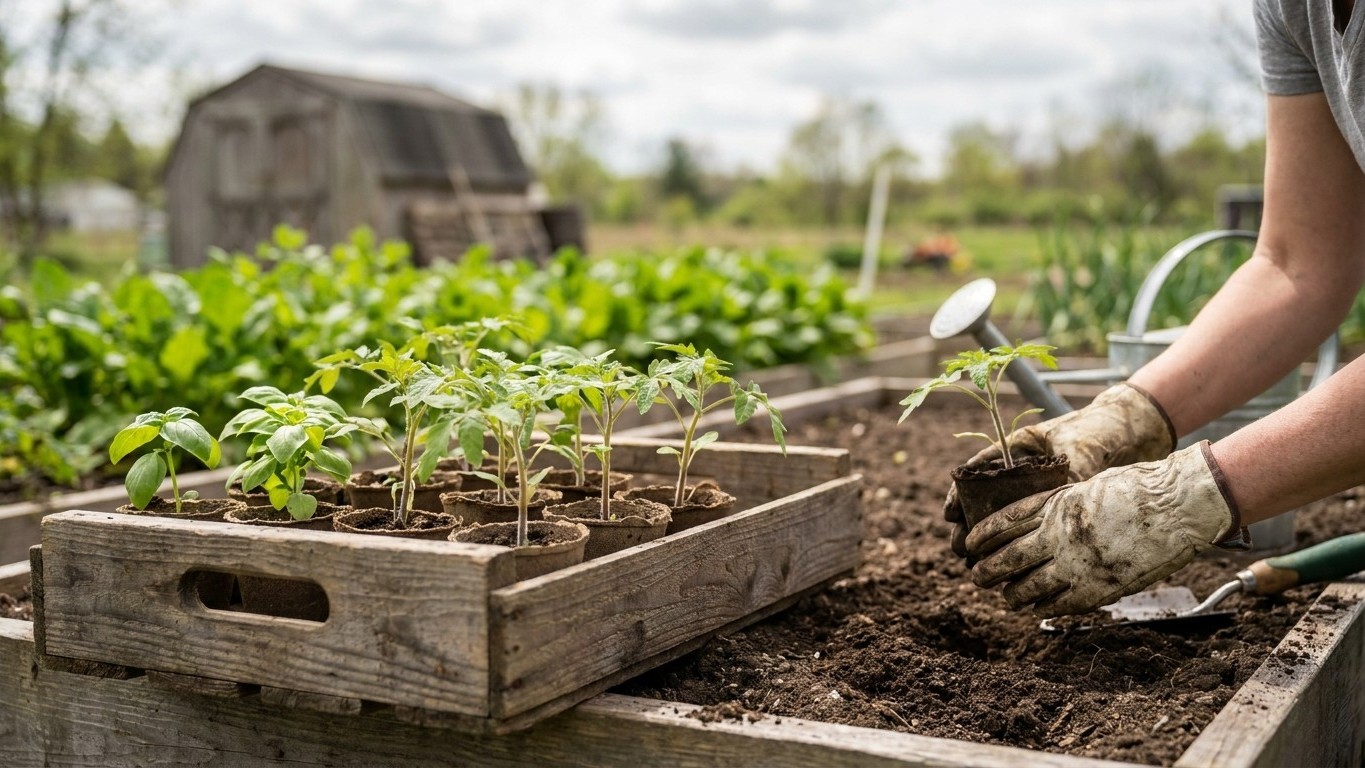

By May, Charlotte-area Piedmont gardens sit weeks past the last frost window (March 23 to April 5), which makes this the single biggest planting month of the year across most of North Carolina. Beans, squash, tomatoes, corn, and melons all move outside now. Mountain gardens above roughly 3,000 feet lag two to three weeks behind that Piedmont date, and coastal plain gardens usually lead it by a similar margin, so treat May as a green light with a regional asterisk.
What goes in the ground in May

The frost window that matters for reading this month is the one recorded for the Piedmont reference station: March 23 to April 5, from NOAA’s 1991-2020 climate normals. By the time May opens, Charlotte-area soil has had four to six weeks to warm past that freeze risk, which is why this month, more than any other, belongs to the crops that sulk or die in cold ground.
Direct-sow beans, corn, squash, cucumbers, and melons now. Soil temperature, not the date on the calendar, decides whether these germinate well, and by May in the Piedmont, soil has typically warmed enough for reliable germination of all of them. Transplant tomatoes, peppers, eggplant, and sweet potato slips once nighttime lows have settled, since a late cold snap can still stall them even after the frost date has technically passed. Basil and other tender herbs go in alongside the tomatoes.
Cool-season holdovers can still go in early in the month in spots that missed the earlier window: lettuce, spinach, and other quick greens for a last spring cutting before summer heat pushes them to bolt. Root crops like carrots and beets can still be direct-sown in the first half of the month in cooler pockets.
Elevation moves this whole calendar. A garden at altitude in the western mountains may still be inside or barely past its own frost window when Piedmont gardeners are already setting out tomatoes, while a coastal plain garden may have been planting warm-season crops for two or three weeks already.
| Region | Relation to Piedmont frost window | May planting status |
|---|---|---|
| Coastal Plain | Frost window generally arrives earlier | Warm-season crops already established; succession sowing underway |
| Piedmont (reference) | March 23 to April 5 | Prime month for direct-sowing and transplanting warm-season crops |
| Mountains (higher elevation) | Frost window generally arrives later | Still watching overnight lows before committing tender transplants |
What to start under cover
May is also when the fall garden gets its start, and the arithmetic runs backward from the first fall frost, October 30 to November 8. Broccoli, cabbage, and other fall brassicas need roughly two to three months from seed to harvest depending on variety, plus time to hold in a cell tray before transplanting. Started under cover in May, they’re ready to move to the garden in mid to late summer and still have enough runway to mature before that fall frost window closes in.
Count from the frost date, not from habit. Take the earliest date in the fall frost range, subtract the days to maturity listed on the seed packet, then subtract another two to three weeks for the seedling stage before it goes in the ground. That final number is roughly when to start the tray, and it moves every time the crop or the county changes.
The two ways this goes wrong are predictable. Start too early and the seedlings sit too long in a small cell, get rootbound, and never recover their vigor once transplanted. Start too late and the crop is still small when the fall frost arrives, with no time left to bulk up. Both failures trace back to skipping the backward count and guessing instead.
Succession trays for warm-season crops make sense too. A second and third round of squash or cucumber seedlings started under cover in May, staggered two to three weeks apart, keeps harvests coming instead of arriving all at once and then quitting.
What is ready to pick
Spring’s slower crops finish up this month. Asparagus beds that have been established for a few seasons are in full production, and the harvest window narrows as spears start coming up thinner, a sign to let the bed rest and grow ferns for the rest of the season. Strawberries hit their peak toward the back half of the month in much of the Piedmont, with fruit ready the moment it colors fully and pulls free without resistance.
Lettuce, spinach, and other spring greens are on borrowed time as temperatures climb. Pick them hard now, whole heads or repeated leaf cuts, because bolting is close behind once daytime heat sets in. Peas planted earlier in spring are usually finishing their run, with pods best picked while still snapping crisp rather than left to swell and toughen.
Radishes sown in early spring are ready when their shoulders push up out of the soil line, visible and firm to the touch. Overwintered kale, if any is still standing, has usually gone bitter by now and is better pulled to make room than harvested.
Anything still in cold storage from the previous fall, winter squash, onions, potatoes, deserves a check this month. Warming temperatures accelerate rot in storage, so look for soft spots, sprouting, or a sweet smell that signals a squash or onion on its way out, and use those first.
The jobs that matter this month
Mulch goes down now, while soil still holds some spring moisture and before summer heat sets in. A few inches of straw, shredded leaves, or wood chips around new transplants suppresses weeds and evens out soil moisture through the swings between spring rain and the first dry stretches of early summer.
Stake or cage tomatoes, peppers, and vining crops before they sprawl, not after. A plant that has already flopped over is harder to lift and stake without snapping stems than one caught early, and sprawling fruit sitting on wet soil rots faster than fruit held up off the ground.
Succession sowing keeps beans, corn, and summer squash coming instead of arriving in one glut. Put in a new short row every two to three weeks through the month rather than planting the whole bed at once.
Pest scouting matters more in May than almost any other month, because this is when populations are small enough to manage by hand. Check the undersides of squash leaves for the clustered orange eggs of squash vine borer, look for the black-and-yellow striped adults of Colorado potato beetle on nightshade family plants, and check bean leaves for the first Mexican bean beetle larvae. Catching these now, by hand-picking or targeted treatment, avoids a much bigger problem by midsummer.
Watering rhythm needs adjusting as the month goes on. Early May often still has enough rain to coast on; late May frequently doesn’t. Deep, less frequent watering builds stronger roots than a light daily sprinkle, especially for the transplants that went in earlier this month.
What not to do in May
The classic mistake is trusting the air instead of the soil and the calendar together. A warm afternoon in early May doesn’t mean the ground has caught up, and tender transplants set into cold, wet soil often just sit there, stalled, while the same plants set in two weeks later at true soil warmth take off immediately. Patience here beats a head start that never actually starts.
Mountain gardeners in particular should resist copying a Piedmont neighbor’s timeline. A frost that arrives weeks later at elevation can still take out tomatoes or peppers set out on a Piedmont schedule, since the March 23 to April 5 window is a Piedmont reference point, not a statewide guarantee.
Uncovering or removing mulch too early after a mild stretch is another common misstep, since it exposes soil to the next cool night or drying wind right when new transplants are least equipped to handle either.
Nitrogen timing trips up a lot of tomato and pepper growers this month. Heavy nitrogen right after transplanting pushes leafy growth at the expense of flowering and fruit set, leaving a lush, green plant that takes much longer to produce. A modest feeding at transplant, followed by a proper feeding once flowering starts, produces a sturdier, more productive plant than front-loading nitrogen out of enthusiasm.
Skipping the hardening-off step for anything started indoors is a fast way to lose a tray of seedlings to sunscald or wind stress. A few days of graduated outdoor exposure before planting saves weeks of setback.
Checking this against your own county
A statewide month is a starting point, not an instruction. Elevation alone can shift a frost window by weeks between a Piedmont garden and a mountain garden a few counties west, and the coastal plain runs its own schedule in the other direction. USDA hardiness zones across North Carolina span 5b to 8b, a range wide enough that a planting date good for one zone can be off by a full month for another.
Before committing tender transplants, check local conditions against the North Carolina Cooperative Extension Service, which tracks county-level guidance and local frost trends than any statewide date can.
Common questions
Is it too late to plant tomatoes in North Carolina in May?
No. May is generally the prime month for setting out tomato transplants across most of the state, well after the Piedmont’s frost window of March 23 to April 5 has closed.
Can I still direct-sow lettuce in May?
Early in the month, yes, but rising heat later in May pushes lettuce toward bolting quickly, so treat any May-sown lettuce as a fast, short-lived crop rather than a long-season one.
Why did my squash seedlings stall after transplanting?
Cold soil is the most common cause. Even after the air feels warm, soil that hasn’t caught up can stall warm-season transplants for days or weeks.
How do I know if my county’s frost date is different from the Piedmont reference?
Check elevation and region first: mountain counties trend later, coastal counties trend earlier. The North Carolina Cooperative Extension Service publishes county-level guidance that reflects those differences.