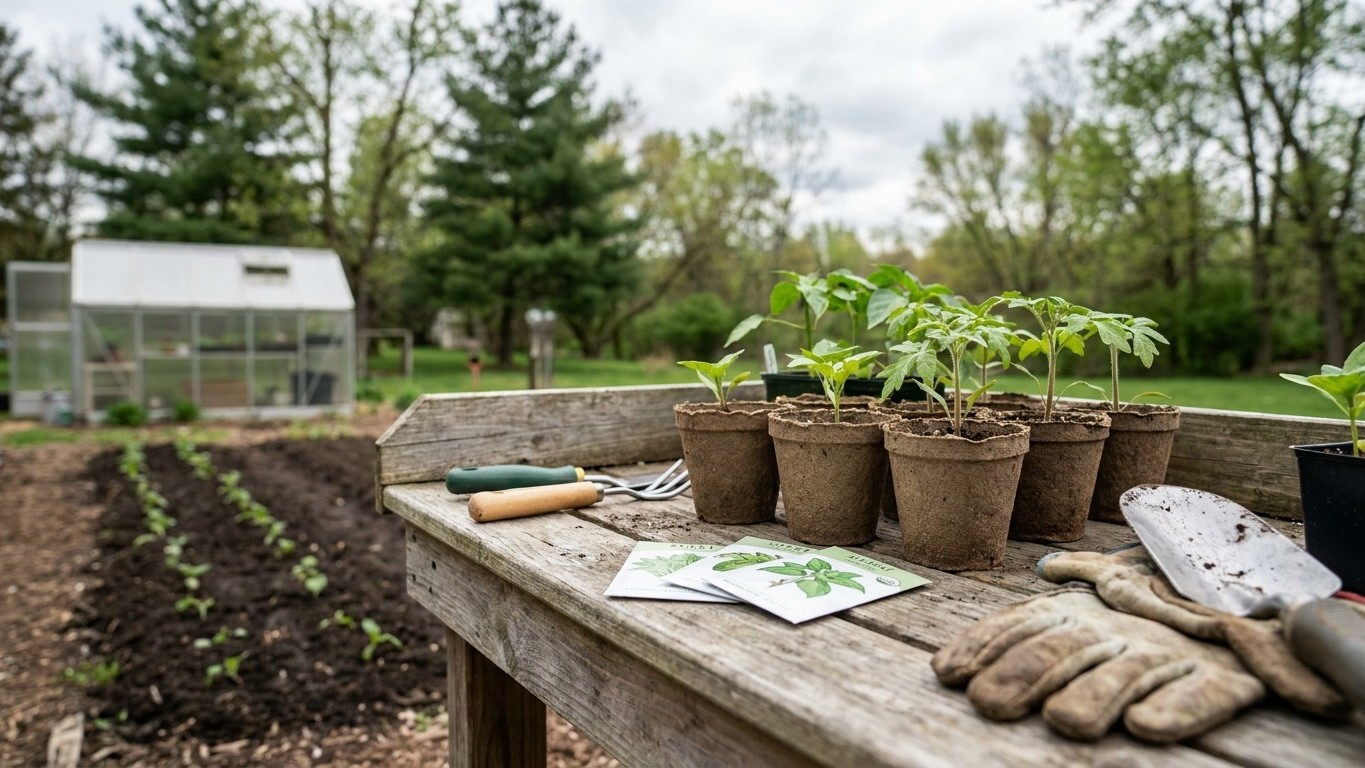

In Nunavut, April is not a planting month. Ground is frozen solid under snow across the territory, air temperatures are still well below freezing most days, and the territory sits in Canadian hardiness zone 0a, the coldest zone on the scale. Nothing goes into open soil. What actually happens this month is indoor: seed starting under lights, forcing dormant roots, and getting greenhouse structures ready for a growing season that will not really begin until summer.
What goes in the ground in April

Nothing goes into open ground in Nunavut in April. Say that plainly, because it is the honest answer, not a hedge. The soil is frozen to depth, snow cover is typically still present or has only just started to retreat in southern communities, and the average last spring frost at Rankin Inlet A falls on June 19. That is a mean date from Environment and Climate Change Canada’s 1981-2010 climate normals, not a guarantee: in roughly half of years the last frost lands later than that, sometimes well into July at higher latitudes or inland from the coast. April sits more than two months ahead of even the average frost-free date.
Zone 0a reflects that reality. It is the coldest classification in the Canadian plant hardiness system, which is built from seven climate variables rather than the single minimum-temperature measure the USDA system uses south of the border. A Canadian zone 0a rating does not translate onto a USDA scale at all, and readers should not try to match it against zone charts built for warmer growing regions.
The one exception worth naming is indoor forcing. Dormant rhubarb crowns or chicory roots held in a cold, dark space can be brought into gentle warmth and low light this month to produce a harvest of blanched stalks or chicons within a few weeks, entirely indoors. That counts as planting in the loosest sense, but it is not garden work. Cold frames and low tunnels, which extend the season in milder parts of Canada, do not function as season extenders in Nunavut in April. The air and the ground underneath them are both still locked in winter, and an unheated frame offers no real advantage over the outside world at this point in the year.
What to start under cover
Seed starting indoors under grow lights is the real April task, and the arithmetic runs backward from that June 19 average last frost, not forward from the calendar. A crop that needs six to eight weeks of indoor growth before it can move into a greenhouse or protected bed should go into trays roughly that many weeks ahead of the frost window, which points to sowing in the second half of April or into May for many households, depending on how much artificial light and warmth the space can supply.
Because the frost date is a mean, not a promise, building in a buffer matters more here than almost anywhere south of the territory. Counting to June 19 and stopping there ignores the years when frost lingers into early July.
Two mistakes show up every season. Starting too early leaves seedlings sitting under lights for weeks longer than planned, since the outdoor or unheated-greenhouse window will not open until real warmth and daylight arrive, and by then the plants are rootbound and stretched. Starting too late means the plant never finishes its life cycle before the first fall frost, which averages September 13 at Rankin Inlet A, again a mean date that can arrive earlier in a given year. Between June 19 and September 13 sits a growing window that, on average, spans roughly three months, and every week lost at either end eats directly into that.
| Crop | Weeks indoors before transplant window |
|---|---|
| Lettuce and other leafy greens | 4 to 5 weeks |
| Kale and hardy brassicas | 5 to 6 weeks |
| Peas (started in cells for early transplant) | 2 to 3 weeks |
| Tomatoes and peppers (heated greenhouse only) | 7 to 8 weeks |
What is ready to pick
Outdoors, there is nothing to harvest in Nunavut in April, and no amount of optimism changes that. The territory’s food-growing activity this time of year happens indoors or under artificial light, and that is where the harvest comes from too. Rhubarb crowns or chicory roots that were brought in for forcing a few weeks earlier can start yielding tender stalks or chicons now, one of the only fresh, homegrown items available at this point in the year.
Microgreens and sprouts sown on trays or in jars a week or two ago are usually ready to cut or rinse and eat, and they are worth treating as a real part of the household food supply rather than a garnish, since they are one of the few crops that go from seed to plate inside a month regardless of what is happening outside.
This is also the month to go through anything still in storage from a previous greenhouse or community-garden harvest. Root vegetables and any stored squash should be checked by hand: soft spots, a sour smell, or sprouting eyes on stored potatoes are signs that item needs to be used or discarded before it spreads rot to the rest of the bin. Onions with green shoots pushing from the top are still edible but are using up their stored sugars and should move to the front of the meal plan.
The jobs that matter this month
April carries real deadlines even though nothing is in the ground, and treating it as an empty month costs time later. Ordering seed is the first of them. Shipping to Nunavut communities takes longer than it does further south, and popular varieties suited to a short, cool season sell out at suppliers well before the actual sowing weeks arrive, so placing an order now rather than waiting for warmer weather protects the whole season’s plan.
Greenhouse and structure prep
Any community greenhouse, hoop structure, or indoor growing space benefits from being checked over now: insulation repaired, glazing or plastic inspected for winter damage, and shelving or lighting rigs cleaned and tested before the sowing rush begins. Doing this in April, while there is no seedling crop depending on the space yet, avoids scrambling to fix a broken heater or a torn cover once trays of seedlings are already relying on it.
Soil, tools, and planning
Any soil brought in for raised beds or greenhouse growing (native ground being frozen tundra rather than garden soil) is worth testing and amending this month, since amendments need time to work into the mix before anything is transplanted. Compost bins or worm systems kept indoors over winter should be turned and checked. Tools due for sharpening or repair, and any fencing or bed frames that took damage over winter, are easiest to deal with now, before the short growing season demands every spare hour outdoors. Sketching out which beds or containers will hold which crop, and where anything moved indoors from last season will go, saves real time once the sowing weeks actually arrive.
What not to do in April
The most common misstep is reading rising daylight and slightly milder air as a signal that outdoor sowing season has arrived. In Nunavut it has not. Longer days in April do not mean the ground has thawed or that frost risk has passed; the average last frost is still roughly two months away, and in many years considerably longer than that.
A second mistake is applying a planting calendar built for a milder Canadian province or a US state. Frost windows, daylight patterns, and soil behavior in Nunavut do not match those regions, and a schedule imported from further south will consistently push seedlings or transplants outdoors far too early.
Feeding seedlings a full-strength nitrogen fertilizer this early, while daylight is still limited and growth is naturally slow, tends to produce weak, stretched growth rather than sturdier plants. A light, diluted feed once true leaves appear is a safer approach than pushing growth before the plant’s light supply can support it.
Finally, resist the urge to open greenhouse vents or remove winter insulation on the first mild-feeling day. A short warm spell in April is not a season change, and structures reopened too early lose the heat buffer they will need through the following weeks.
Checking this against your own county
A territory-wide picture is a starting point, not a fixed instruction. Nunavut spans an enormous range of latitude, coastline, and elevation, and the frost dates and zone rating here are drawn from the Rankin Inlet A station specifically. Communities further north or further inland can run weeks behind that reference point, and coastal versus inland locations often see different snowmelt timing even at similar latitudes. For a community-specific planting calendar and support, Agriculture and Agri-Food Canada is a useful federal resource, and Natural Resources Canada’s plant hardiness site lets readers look up the zone rating for their own municipality rather than relying on the Rankin Inlet figure alone.
Common questions
Can anything be direct-sown outdoors in Nunavut in April?
No. Ground is frozen and typically still snow-covered, and the average last spring frost does not arrive until June 19. Direct sowing outdoors in April is not a viable option anywhere in the territory.
Is a cold frame or low tunnel useful this early in the season?
Not in April. These structures extend a season that has already started warming; in Nunavut at this point the surrounding air and ground are still fully in winter conditions, so a frame or tunnel offers little real advantage yet.
What is the safest first outdoor sowing date to plan around?
There is no single safe date, since June 19 is a mean and frost arrives later than that in about half of years. Treat it as the midpoint of a window and build in extra time before committing tender seedlings outdoors or into an unheated structure.
Why does the hardiness zone matter if nothing grows outdoors anyway?
Zone 0a signals how narrow and demanding the whole growing calendar is, which is why seed starting, greenhouse prep, and forcing dormant roots indoors carry so much weight in Nunavut’s gardening year compared with milder regions.