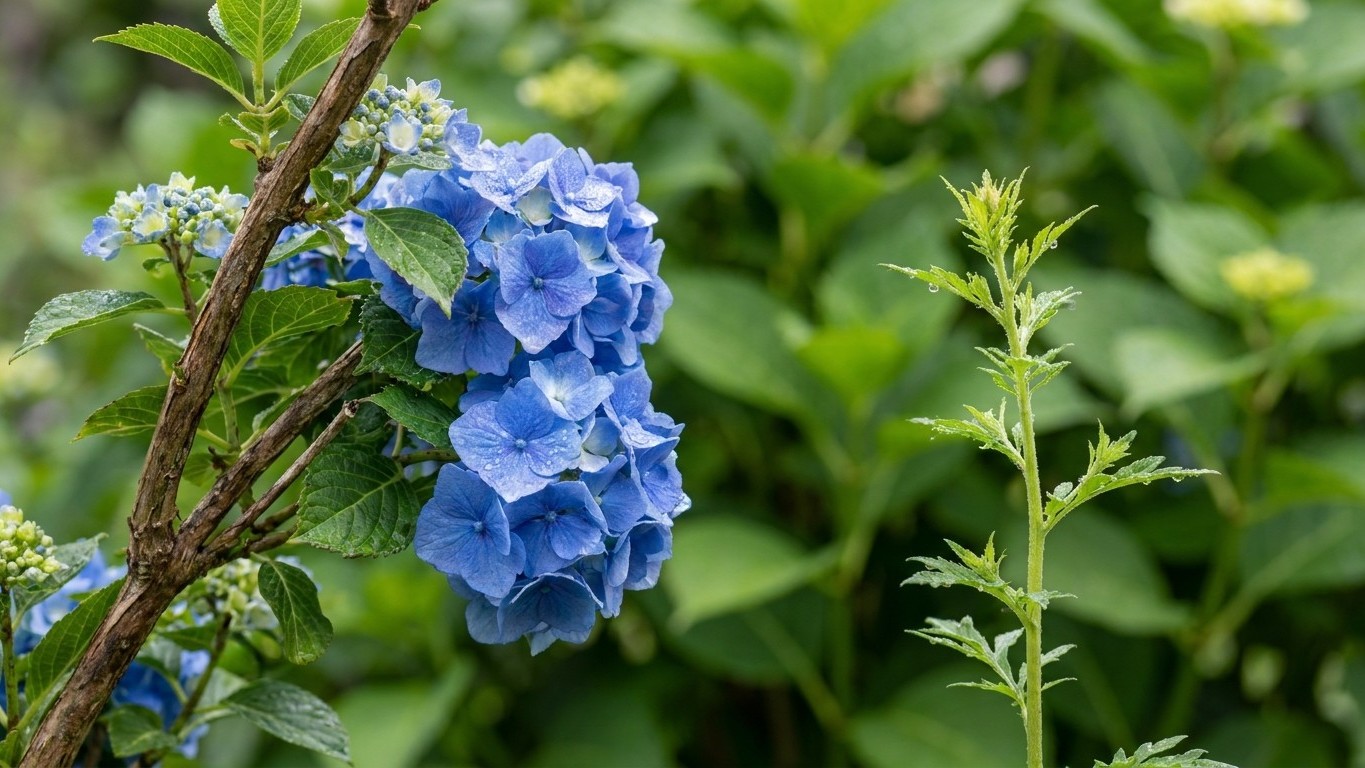

No hydrangea is a sure bet in the ground in Nunavut. The best odds belong to the types that flower on new wood and can die to the soil line each winter: smooth hydrangeas such as Annabelle, and panicle types such as Quick Fire. Bigleaf types that depend on last year’s buds have almost no chance outdoors. Rankin Inlet sits in Canadian hardiness zone 0a, the coldest rung of that system. Catalogue ratings for even the hardiest cultivars are written in the USDA system, and the two do not convert. Pots that winter indoors are the dependable route.
What this comes down to in Nunavut

At Rankin Inlet, the reference station for Nunavut, the mean last spring frost falls on June 19 and the mean first fall frost on September 13. That leaves a very short stretch for a shrub to wake up, grow stems and open flowers. The reference station has about 86 frost-free days between the mean last spring frost and the mean first fall frost.
Both dates are midpoints. In one year out of two the last spring frost comes after June 19, and in one year out of two the first fall frost comes before September 13. Treat them as the center of a window, never as a safe date. The zone figure also needs a label every time: 0a is a Canadian zone from Natural Resources Canada, it covers the reference city only, and it cannot be read as a USDA zone.
Two things decide a hydrangea’s fate here. The first is whether it forms flower buds on new growth or on old stems. A shrub that flowers on old wood loses its whole show when a hard winter kills the stems. A shrub that flowers on new wood can lose every stem and still bloom, if summer lasts long enough. The second is how many weeks it needs after waking up before the first flower opens. The cultivars below run from the shortest season to the longest. The USDA ranges are typical catalogue figures.
Quick Fire
A panicle hydrangea rated for USDA zones 3 to 8. It opens white and ages to pink, and it blooms on new wood. It is among the earliest panicles to flower, which makes it the best fit for a short season. It is still a long shot at Rankin Inlet, but the shortest lead time on this list gives it the most room to work.
Bobo
A compact panicle, USDA zones 3 to 8, with white flowers that fade to pink on new wood. Its small size suits a large container that can come indoors for winter. Bloom comes in midsummer in milder places, so here it sits right at the edge of the frost window.
Annabelle
A smooth hydrangea (Hydrangea arborescens), USDA zones 3 to 9, with big white round heads on new wood. It is the classic die-back-and-resprout shrub, which suits a place where winter kills top growth. The weakness is a short fall: flowers that open late can be frozen on the stem.
Incrediball
A stronger-stemmed smooth hydrangea, USDA zones 3 to 8, with white flowers on new wood. It has the same appetite for a long warm season as Annabelle, with heavier heads that need protection from wind. It makes sense only where a gardener can shelter it.
Limelight
A panicle rated for USDA zones 3 to 8. Its flowers open lime-green, turn white, then pink, all on new wood. It blooms mid to late summer in temperate gardens, and that timing is the problem. Past the early panicles, the season here runs out before the show starts.
Pinky Winky
A panicle, USDA zones 3 to 8, with white cones that blush pink on new wood. It flowers late even in gardens with a long season. At Rankin Inlet it will almost certainly leaf out and then meet frost before a single cone colors.
Endless Summer
A bigleaf hydrangea (Hydrangea macrophylla), USDA zones 4 to 9, blue or pink depending on soil acidity. It flowers on both old and new wood, but it relies on buds that formed the year before. Winter stem kill is standard here, so outdoors it is the least suitable of the seven. It works only as a potted plant kept indoors.
Working it out for your own garden
The method is to count backward from the first fall frost and forward from the last spring frost, then see whether a gap is left. Start with the lead time on the plant tag or the grower’s description: the weeks from the start of growth to the first open flowers. Where no figure is given, use a working number of about ten weeks for an early panicle and more for a late one, and adjust it with whatever the grower says.
Take Quick Fire as the worked example. September 13 minus ten weeks lands in early July. The shrub must be growing strongly by then, or the flowers will not finish before a mean-date frost. The last spring frost, June 19, is only the midpoint, so a gardener who waits for the dependable end of frost is already pushing the shrub toward late June or beyond. Between a late-June planting and the early-July deadline, there is room for the plant to make it in a mild year and none in a cold one. Since half of years bring frost earlier than September 13, the odds of seeing open flowers on a Quick Fire are better than even only in a warm, late-frost year.
Now take a longer-season cultivar, Pinky Winky. If it needs around fourteen weeks, September 13 minus fourteen weeks lands in early June. That is before the mean last spring frost, so the shrub cannot be actively growing that early, and the bloom never happens. The shrub may leaf out, but the flowers will not open before frost ends the year. The line falls between those two: cultivars that need roughly ten weeks or fewer sit at the edge of possible, and anything beyond that is out of reach.
The same arithmetic protects a gardener after a move. Swap in the new frost dates, subtract the cultivar’s lead time from the first fall frost, and compare the result with the last spring frost. If the answer lands before it, pick a different shrub or grow it in a pot indoors. A cold year makes the numbers worse, so a gardener who wants a margin should plan as if the first fall frost could arrive earlier than September 13 and the last spring frost later than June 19.
What changes across the territory
Nunavut is huge, and the reference station sits on the west shore of Hudson Bay. A gardener far to the north in the High Arctic islands faces a shorter, colder season than Rankin Inlet. A gardener on the southern edge of Baffin Island or inland on the mainland tundra may find the picture different, though not a milder one that can be assumed. The reference figures run weeks off in either direction depending on where you are.
Several things move the numbers. Coastal communities are slowed by sea ice that lingers in spring and keeps the air cool well into the season. Inland sites often warm faster in summer but lose heat quickly after the sun drops and can swing colder in the shoulder months. Wind may be the biggest local factor. A south-facing wall out of the wind can run noticeably warmer than a bare slope a few yards away, and drifting snow decides how much of a shrub stays insulated through winter.
Ground conditions matter as much as air. The soil thaws only shallowly over permafrost, so roots in the open ground sit in cold, wet conditions for much of the season. That holds across much of the territory, and it is why containers and raised beds are usually the better bet than direct planting. For a given community, a gardener should treat the Rankin Inlet window as a rough guide and expect the true dates to differ by weeks.
The mistakes this territory punishes
Planting after a warm spell is the first trap. A stretch of mild weather in early June can feel like the end of frost, but the mean last spring frost is June 19 and half of years run later. A hydrangea set out early can leaf out and have its new growth cut back, which burns weeks it cannot spare. Waiting for steady weather, and having row cover or a cold frame ready, costs less.
Choosing a long-season cultivar is the second. A late panicle such as Pinky Winky, or a bigleaf like Endless Summer that needs surviving old-wood buds, will look healthy and never flower. Pick from the short end of the list above, or accept foliage as the goal.
Leaving a pot outside for the winter is the third. Roots in a container freeze harder than roots in the ground, since there is no soil mass around them. The workable plan is to bring the shrub into a cool, unheated, frost-free space such as an entryway or insulated shed once the leaves drop, keep the mix barely moist, and move it back out when frost danger passes. Dry heat indoors, on the other hand, can break dormancy too soon and produce weak growth.
The last one is putting a tall, heavy-headed shrub like Incrediball in an open, windy spot. Wind snaps new stems and strips the snow that would otherwise insulate the crown. Shelter beats fertilizer in this climate.
Checking this against your county
Nunavut has no counties, so the nearest equivalent is your own community and region. A territory-wide figure is a starting point. Local conditions in your hamlet, and the exposure of your own yard, will move the dates. Agriculture and Agri-Food Canada is a good place to look for guidance, and the territorial agriculture contacts can speak to local conditions. For the broader growing basics, see the guide to growing hydrangeas in Nunavut.
Common questions
Can hydrangeas grow outdoors in Nunavut at all?
Only as an experiment. Smooth and panicle types that flower on new wood have the best chance, in a sheltered spot with deep snow cover. Plan on losing the top growth each winter, and expect flowers only in a warm, late-frost year.
Do bigleaf hydrangeas survive a winter outside?
Rarely. They rely on buds formed the previous year, and a hard winter kills the stems that carry them. Keep them in pots and bring them indoors for winter.
Which hydrangea is best in a pot?
A compact panicle such as Bobo is a sensible pick because it stays small and blooms on new wood. Use a large container with drainage, and overwinter it dormant in a cool, frost-free space.
Does snow cover help a hydrangea through winter?
Yes. A deep, steady blanket insulates the base of the shrub from the worst cold and wind. Wind-scoured spots lose that protection, so a sheltered location where snow collects does much of the work for a new-wood hydrangea.