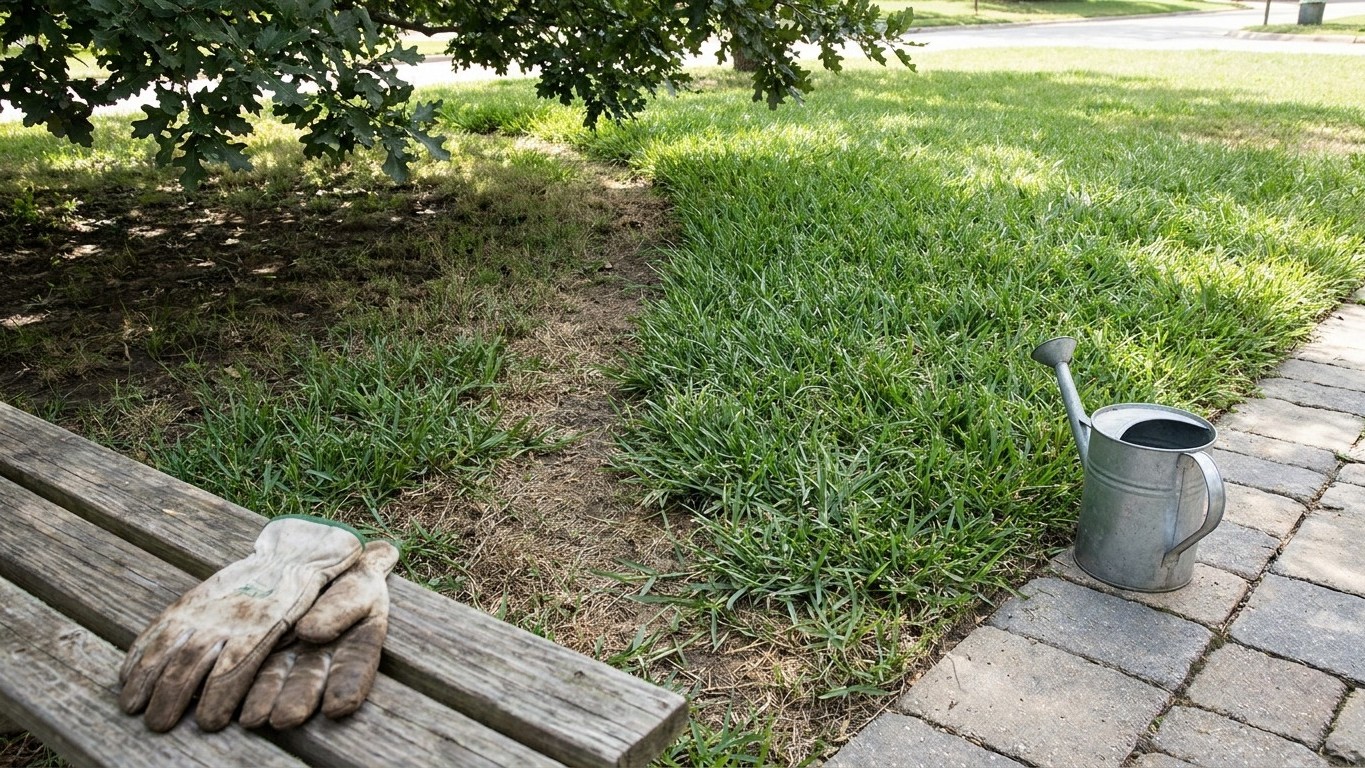

A gray-green mat creeping past the sidewalk crack, filling a bare patch before you even noticed it was thin — that spreading habit is the whole story of bermudagrass. It runs two ways at once, stolons on top and rhizomes below, which is also why cleats and paws barely dent it. Warm weather is when it works; cold weather it goes straw-brown and waits. Not dead, just dormant, crown and roots intact underground until soil warms again.
What Bermudagrass actually is

Bermudagrass is a warm-season grass, which means it grows hardest in the heat of summer and shuts down when nights turn cold. Clemson Cooperative Extension’s HGIC lists it alongside the other warm-season lawn grasses, all of them green from late spring through early fall and straw-brown the rest of the year. That browning is dormancy, not death. The crown and roots survive a frost and the grass greens up again once soil warms in spring.
You can pick it out of an existing lawn by its habit before you ever look closely at the blade. It spreads two ways at once, by stolons that run along the surface and by rhizomes underground, which is why a single sprig can fill in a bare patch within a season and why it climbs over a bed edge or a sidewalk crack just as fast. The leaf itself is fine to medium in texture and a gray-green color, growing in a dense, low mat rather than upright clumps. Clemson’s HGIC credits this same runner habit with the grass’s excellent wear tolerance, since a stolon scuffed by a cleat or a dog’s paw simply roots down again a few inches over.
In midsummer it throws up a thin seed head on a short stalk, a few spikes fanned out like fingers, though most home lawns never see this because regular mowing removes it before it forms. If you’re trying to identify an existing patch rather than plant a new one, the giveaway is usually the runners themselves. Pull back the thatch at the edge of a bare spot and you’ll find flat stems rooting at each node, spreading out in every direction rather than growing straight up.
Where it works, and where it fails
Bermudagrass is graded on two numbers that decide almost everything else: how many days a year the heat tops 90°F, and how cold the coldest month runs on average. NOAA’s climate data for a reference city in each state gives both, and the pattern across them is stark. Long, hot summers and mild winters make it a first choice; short summers and hard winter lows mean it will not hold at all.
| State | Days at 90°F+ (NOAA) | Coldest month avg. low (NOAA) | Fit for bermudagrass |
|---|---|---|---|
| Arizona | 169 | 45°F | First choice |
| Nevada | 131 | 39°F | First choice |
| Texas | 102 | 43°F | First choice |
| Florida | 73 | 41°F | First choice |
| Mississippi | 71 | 35°F | First choice |
| Louisiana | 71 | 45°F | First choice |
| Arkansas | 69 | 31°F | First choice |
| Alabama | 58 | 32°F | First choice |
| South Carolina | 55 | 38°F | First choice |
| Hawaii | 19 | 66°F | First choice |
| California | 2 | 49°F | First choice |
| Oklahoma | 71 | 29°F | Transition, a compromise |
| Kansas | 58 | 22°F | Transition, a compromise |
| Utah | 52 | 22°F | Transition, a compromise |
| Idaho | 48 | 24°F | Transition, a compromise |
| New Mexico | 42 | 26°F | Transition, a compromise |
| Tennessee | 40 | 28°F | Transition, a compromise |
| Colorado | 40 | 17°F | Transition, a compromise |
| Kentucky | 37 | 27°F | Transition, a compromise |
| Nebraska | 28 | 14°F | Will not hold |
| Iowa | 18 | 14°F | Will not hold |
| Delaware | 18 | 25°F | Will not hold |
| West Virginia | 16 | 26°F | Will not hold |
| Ohio | 15 | 23°F | Will not hold |
| Indiana | 15 | 20°F | Will not hold |
These are figures for one reference city per state, and a state is not a zone. The mountains of Arizona or the panhandle of Florida can sit a full climate zone away from the city NOAA measured, so check where your own county falls before assuming the state’s overall rating applies to your yard.
In the transition states, the compromise runs both ways. Bermudagrass gives up its green color earlier in fall and later in spring than it would further south, and a hard winter can thin or kill it outright in the coldest of these counties. A cool-season grass planted in the same yard would survive winter better but struggle through the hottest stretch of summer, so neither choice is clean.
In the states where it will not hold, plant a cool-season grass instead. The full range of options is laid out at Grass Types, and for the shaded, dry ground a lawn like this often leaves bare under trees, the fine fescues are worth a look at Fine Fescues: The Best Grass for Dry Shade.
Shade, drought, traffic: what it will take

Clemson’s HGIC publishes four ratings for bermudagrass, and each one only means something once you picture it in an actual yard.
HGIC rates shade tolerance very poor. Under a mature oak, a maple, or even a single-story roof overhang that shades a strip of lawn most of the day, bermudagrass thins within a season and disappears within two or three. It needs close to full sun to hold a stand at all, so a shaded side yard is the wrong place for it no matter how well the rest of the lawn is doing.
HGIC rates drought tolerance excellent. Its root system runs deep enough that an established stand can go through a dry summer with little or no irrigation and green up again once rain returns. It may slow and lose color under real drought stress, which looks different from the tan, dormant color it takes on after the first frost.
On ground that stays wet and acidic rather than dry, bermudagrass is the wrong choice regardless of how much sun it gets. That’s the niche filled instead by Carpetgrass: For Wet, Acid Ground Where Nothing Else Holds.
HGIC rates wear tolerance excellent, and this is the trait the whole grass is built on. A path worn daily by kids, a dog’s running line along a fence, a spot where a trampoline or grill sits all summer: bermudagrass recovers from this kind of traffic faster than the other lawn grasses HGIC rates, which is why it’s the standard under southern sports fields, from Little League outfields to college practice fields.
HGIC rates cold hardiness good, not excellent, and that distinction is why the map above breaks the way it does. Good cold hardiness carries a warm-season grass through the winters of the first-choice and most transition states, but it is still a different thing from the hardiness bred into a grass built for a cold winter, and it’s what fails first in the coldest transition counties and in the states further north.
Seeding or sodding it
Four ways in, four different budgets
Bermudagrass is one of the few lawn grasses you can establish four different ways: sod, sprigs, plugs, or seed, according to Clemson’s HGIC. That range matters for a budget. Sod costs the most per square foot but gives an instant, weed-free lawn. Sprigs and plugs, small pieces of living stolon or a plug of turf pressed into prepared soil, cost less than sod but need a full growing season to knit together and cover the ground, and they leave the yard patchy and open to weeds in the meantime. Seed is the cheapest of the four, though not every bermudagrass type on the market is available as seed. Hybrid types bred for finer texture and heavier wear, such as ‘Tifway 419’, are sterile crosses and produce no viable seed, so they are sold only as sod, sprigs, or plugs, while common bermudagrass is the type most often sold as seed.
Timing follows the season it grows in. Clemson Cooperative Extension’s HGIC 1203 places warm-season grass planting around May, once soil has warmed and the risk of a late freeze has passed. That is the opposite window from a cool-season lawn, which HGIC 1203 puts in mid to late September. Planting bermudagrass on a cool-season calendar gives the seed or sprigs too little warm weather left to root in before dormancy, so the two windows are not interchangeable.
Seed needs consistent moisture to germinate and several weeks of mowing before it can take normal traffic, so a new lawn from seed isn’t ready for the dog or the kids’ game of catch the same summer it goes in. Sod, by contrast, can often take light use within a few weeks of rooting down, which is worth the extra cost for a yard that needs to be usable fast. Whichever method you choose, it starts from the same decision covered under Grass Types: matching the grass to the sun, traffic, and climate the yard actually has, before matching it to a planting method.
Mowing and keeping it

HGIC sets the mowing height for bermudagrass at 0.75 to 1.5 inches, considerably lower than most other lawn grasses. That low height works because of the same runner habit that makes the grass wear-tolerant: it spreads horizontally rather than growing tall, so cutting it short doesn’t stress the plant the way scalping a bunch-type grass would. Mowing higher than that range lets it go shaggy and thatch up faster, while mowing much lower than 0.75 inches starts to expose the crown and invite weeds and scalping on uneven ground.
The one-third rule still applies here even though the target height is low. Never remove more than a third of the leaf blade in a single cut. On a lawn kept at an inch, that means mowing again once growth reaches about an inch and a half, which in the middle of a hot summer can mean twice a week rather than once.
What this grass asks that others don’t
- Dethatch at least once during the growing season, since stolons and rhizomes build up thatch faster than most grasses.
- Edge beds, walkways, and driveways on a routine schedule, not once a year, since live runners will root well past the border within a season.
- Expect a uniform tan-brown color across the whole lawn after the first hard frost. That’s dormancy, not death.
- Watch for uneven, patchy browning rather than a uniform color change. That pattern points to winterkill in the coldest spots, not normal dormancy.
The crown at soil level stays alive through dormancy, and color returns on its own once the soil warms enough in spring to restart growth. A lawn that behaves this way every winter in a first-choice or transition state is doing exactly what a warm-season grass is supposed to do.
Common questions
Can I overseed bermudagrass with ryegrass for green winter color?
Many southern lawns are overseeded with a cool-season ryegrass each fall to keep some green through winter dormancy. The rye grows through the cool months and fades out on its own once bermudagrass wakes up and the summer heat returns, so it doesn’t need to be removed by hand.
What’s the difference between common and hybrid bermudagrass?
Common bermudagrass produces viable seed and is what most seed bags contain, while hybrid types such as ‘Tifway 419’ are sterile crosses bred for a finer leaf and heavier wear, the kind used on golf greens and athletic fields. Because hybrids set no usable seed, they have to go in as sod, sprigs, or plugs, which raises the cost of the project.
It’s spreading into my garden beds, how do I stop it?
A physical barrier works better than mowing alone, since a buried edging strip or a trenched gap a few inches deep stops the stolons from rooting across. For runners already established in a bed, pulling them by hand controls small patches, but a larger invasion may need an herbicide labeled for use around the specific plants in that bed. Check with your state extension service for options suited to your situation before spraying near ornamentals or vegetables.
Can I make it work in a shaded yard if I water and fertilize it more?
No. Shade tolerance very poor, as rated by HGIC, is about light, not water or nutrients, and extra irrigation or fertilizer won’t make up for the lack of sun. A yard with real afternoon shade does better with a grass suited to those conditions, such as a fine fescue, planted instead of pushing bermudagrass past what it can take.