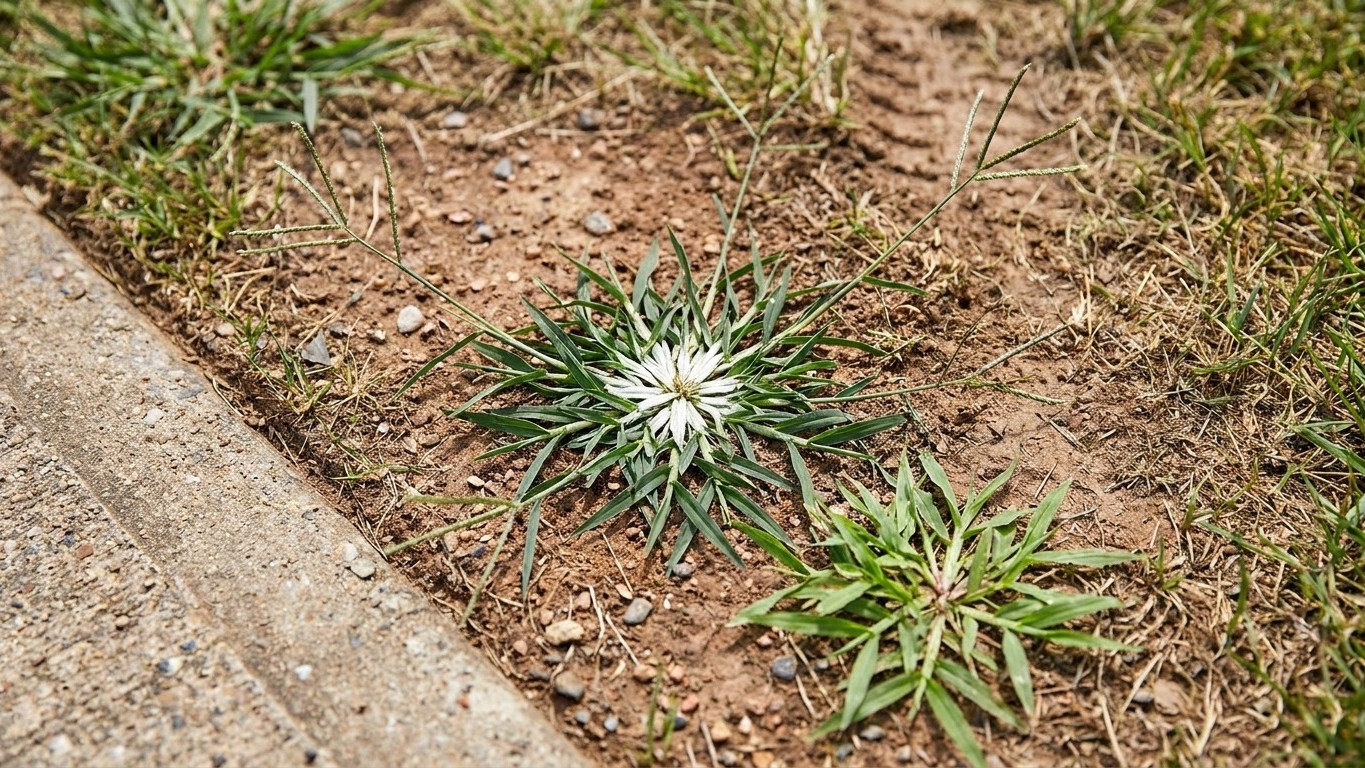

Alabama lawns are warm-season grass, and the right mowing height depends on which species you have. Bermudagrass, zoysiagrass, carpetgrass and seashore paspalum take 1 to 2 inches. Centipedegrass takes 1.5 to 2 inches. St. Augustinegrass wants 2.5 to 4 inches, and bahiagrass 3 to 4. Mow St. Augustine at bermudagrass height and it thins and burns out. Let bermudagrass grow to bahiagrass height and it turns shaggy and weak.
The mowing height for Alabama lawns
The spread between 1 inch and 4 inches comes down to how each grass builds its canopy. Bermudagrass, zoysiagrass, seashore paspalum and carpetgrass spread by low creeping stems and pack in fine blades close to the soil. That dense mat keeps photosynthesizing even when it is cut short. St. Augustinegrass and bahiagrass have coarser, wider blades on thicker runners, and they depend on that leaf surface to feed their roots. Cut them low and you remove the very tissue they live on.
| Grass | Mowing height |
|---|---|
| Bermudagrass | 1 to 2 inches |
| Zoysiagrass | 1 to 2 inches |
| Seashore paspalum | 1 to 2 inches |
| Carpetgrass | 1 to 2 inches |
| Centipedegrass | 1.5 to 2 inches |
| St. Augustinegrass | 2.5 to 4 inches |
| Bahiagrass | 3 to 4 inches |
Identify the grass before you set the deck
Most mistakes start with a guess. A lawn that came with the house may be centipedegrass, which is light green, slow-growing and common on acidic sandy soils, or a rough pasture-type bahiagrass along a rural lot. St. Augustine has broad, flat blades and thick stolons that look like green cords. Bermudagrass is fine-bladed and fast to fill in. If you cannot tell, a sod sample taken to your county office of the Alabama Cooperative Extension System settles it in a few minutes.
Why the other season’s grasses do not hold here
Cool-season grasses grow best in mild weather and stall when summers are long, hot and humid. In the Deep South they thin out under heat stress, warm nights and fungal disease, and they rarely survive more than a year or two without constant reseeding and watering. Every species in the table is built for this climate. Cool-season mowing logic, as in How High to Mow a Lawn in New Brunswick, belongs to a different growing season.
Raising the deck when the heat comes
June, July and August bring about 12.1 inches of rain to the reference weather station behind NOAA’s 1991-2020 climate normals: 4.06 inches in June, 4.49 in July and 3.55 in August, the driest of the three. The year as a whole adds up to 54.3 inches. That sounds like a lawn that waters itself, and in many weeks it does not.
Soil makes the difference. A sandy surface drains an inch of rain within the day, so a lawn on sand can need water every second day even in a wet summer. Clay holds that same inch for a week. Heat adds its own drain. On days at or above 90°F, evaporation pulls moisture out of the top inches fast, and much summer rain arrives as a single thunderstorm that runs off hard ground instead of soaking in. These are normals for one station over thirty years, not a forecast for your yard. A slope, a rain shadow or a paved lot nearby will change the picture. A rain gauge on your own lawn gives the real number.
The deck is your cheapest drought tool. In midsummer, move toward the upper end of your species’ range: 2 inches for bermudagrass, zoysiagrass, paspalum and carpetgrass, and 2 inches for centipedegrass. St. Augustinegrass and bahiagrass do best at 4 inches. Taller blades shade the soil, which keeps it cooler and slows evaporation, and they support deeper roots that reach moisture the surface has lost.
Shade pushes the same direction. St. Augustine under oaks does better at the top of its range, because leaf area is its only way to catch what little light gets through. Compacted or stressed turf behaves the same way. If the lawn is wilting or turning blue-gray, raise the deck first and mow less often until it recovers.
Mow when the grass is dry, with a sharp blade. A dull blade tears the tips, leaving a brown cast across the lawn a day later. Midday mowing in peak heat is hard on the grass and on you, so early morning or late afternoon works better.
The one-third rule, and why it is not arbitrary
Never remove more than one-third of the blade height in a single mowing. The rule exists because the leaf is the grass’s food factory. Strip too much in one pass and the plant has less to photosynthesize with, so it pulls energy out of the roots and runners to regrow. Roots shorten, the lawn turns less drought-tolerant, and weeds fill the gaps.
The arithmetic is simple. If you keep St. Augustinegrass at 4 inches, mow when it reaches 6 inches at most. Bermudagrass kept at 1.5 inches should be cut when it hits 2.25 inches. Zoysiagrass or paspalum held at 1 inch needs mowing before it passes 1.5 inches, which in peak growth can mean twice a week. Tall species give more room: bahiagrass kept at 3 inches can reach 4.5 inches before the next cut.
A wet week or a missed weekend is where people break the rule. If the grass has outrun you, do not drop straight to your usual height. Cut off a third, wait two or three days, then cut again. It costs an extra pass, but the lawn avoids the yellow, stubbly look of a scalped cut. For more on the mechanics of cutting, including blade care and clipping management, see Mowing a Lawn.
Clippings are another reason to follow the rule. Cut within a third and the short pieces fall between the blades, break down quickly and return nitrogen to the soil. Cut too much and you leave clumps that smother the grass underneath. Bag or rake only when the clumps are heavy. The same logic holds neighboring states over; the species and frost calendar change, but the one-third rule does not, as How High to Mow a Lawn in Arkansas shows.
The first and last cut of the year
The first cut of the season follows the grass, not the calendar. Warm-season turf stays tan through winter, then greens up from the soil as it warms. For the reference station, NOAA’s 1991-2020 normals put the last 32°F freeze between March 19 and April 3 (the 30-70% probability band). Suburban and rural yards often get their last frost one to two weeks later than an airport station, and higher ground later still. Check your own county before you plan around those dates.
Once new green shoots show and a hard freeze looks unlikely, make the first mowing at the low end of your species’ range. That removes the dead tan blades from last year and lets sun reach the new growth. Do not go below the range, though. Bermudagrass, zoysiagrass, paspalum and carpetgrass bottom out at 1 inch, centipedegrass at 1.5 inches, St. Augustinegrass at 2.5 inches and bahiagrass at 3 inches. Cutting under those floors in spring exposes the crown to cold snaps.
In the fall, the same station’s normals place the first 32°F freeze between November 2 and November 16, again as a reference-station figure. Rural and suburban lawns commonly see it one to two weeks earlier, and elevation moves it earlier still. Warm-season grasses slow down as nights cool, and a hard frost turns them tan and ends the growing season for the year.
Your last mowing comes when growth stops, not on a set date. If the grass is not growing enough to need cutting, put the mower away. For the final pass, stay in the normal range instead of dropping low. Cutting short just before dormancy leaves the crown exposed, and a bit of extra blade helps insulate it. Clear fallen leaves too. A thick mat of oak or sweetgum leaves smothers the dormant turf and invites disease before spring.
Common questions
What is the best mowing height for most Alabama lawns?
There is no single number, because Alabama lawns are a mix of species. For bermudagrass, zoysiagrass, seashore paspalum and carpetgrass it is 1 to 2 inches. Centipedegrass runs 1.5 to 2 inches. St. Augustinegrass needs 2.5 to 4 inches and bahiagrass 3 to 4 inches.
Should I mow shorter in summer to cut less often?
No. Shorter grass in summer dries out faster and loses its shade over the soil. Raise the deck to the top of your species’ range when the heat arrives. If the grass is growing fast, mow more often, but keep to the one-third rule.
When should I stop mowing in the fall?
When the grass stops growing. At the reference station, the first 32°F freeze falls between November 2 and November 16, but many rural and suburban yards see it one to two weeks earlier. A frost-browned lawn does not need cutting until spring green-up.
Can I grow cool-season grass in Alabama?
It can look good in cooler months, but it struggles through long, hot, humid summers and usually needs reseeding. Warm-season species are far better adapted. Your county Extension office can recommend the right one for your soil and shade.