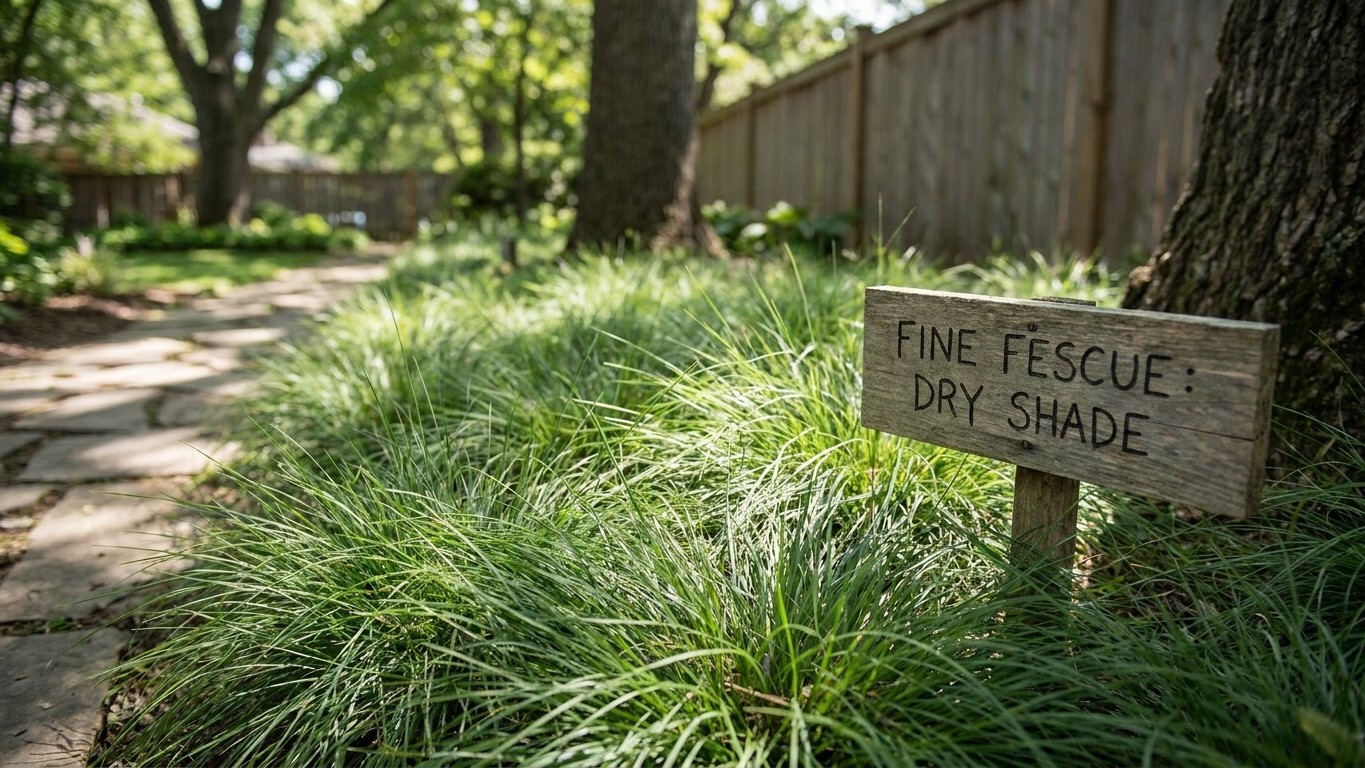

Fine fescues have the best shade tolerance of the cool-season grasses and are very persistent in dry conditions, but they are still a cool-season grass, so your summers matter. Before you buy seed, find your state in the table below and treat the group it lands in as your first answer.
What Fine Fescues actually is

University of Georgia Extension lists fine fescues in its table of cool-season turfgrasses in Lawns in Georgia: Selection and Species. The same publication says cool-season grasses grow well during the cool months of spring and fall, when temperatures average 60 to 75 °F. They may become stressed, dormant, or injured during the hot months of summer.
How it grows
NC State Extension’s Extension Gardener Handbook (chapter 9, Lawns) names creeping red, chewings and hard fescue as the fine fescues. It says the name comes from very finely textured leaves, almost as fine as pine needles. University of Georgia Extension gives a slightly different list, red, sheep’s and hard fescue. It describes the leaves as extremely fine and the grass as suited to low fertility, low maintenance and shaded situations.
NC State Extension also says most fine fescues are bunch type and do not have the ability to spread. Virginia Cooperative Extension says fine fescue seed germinates pretty quickly, in 10 to 14 days, but that the grass is a somewhat slow establisher, so fall seedings are best.
What sets it apart is the pairing in the title. Virginia Cooperative Extension says the fine fescues have the best shade tolerance of the cool-season turfgrasses and are very persistent in dry conditions and somewhat poor soils. It is one of many lawn grasses, and the grass types index lists the rest.
Where it works, and where it fails
The figures below are NOAA’s 1991-2020 climate normals from NCEI, taken at each state’s reference city. A state is not a zone, so the far ends of a large state can fall in the neighboring group. The grouping into first choice, transition and will-not-hold is The Homestead Post’s own reading of those figures, not a ruling by any extension service.
| State | Days at 90°F or more | Coldest-month average low | Group |
|---|---|---|---|
| Nebraska | 28 | 15°F | First choice |
| Iowa | 18 | 14°F | First choice |
| Delaware | 18 | 26°F | First choice |
| West Virginia | 16 | 26°F | First choice |
| Ohio | 15 | 22°F | First choice |
| Indiana | 15 | 21°F | First choice |
| Illinois | 14 | 19°F | First choice |
| South Dakota | 14 | 8°F | First choice |
| New York | 12 | 28°F | First choice |
| North Dakota | 12 | 0°F | First choice |
| New Hampshire | 11 | 17°F | First choice |
| Minnesota | 11 | 9°F | First choice |
| Wyoming | 10 | 18°F | First choice |
| Michigan | 10 | 19°F | First choice |
| Oklahoma | 71 | 27°F | Transition |
| Kansas | 58 | 22°F | Transition |
| Utah | 52 | 24°F | Transition |
| Idaho | 48 | 25°F | Transition |
| New Mexico | 42 | 26°F | Transition |
| Tennessee | 40 | 30°F | Transition |
| Colorado | 40 | 18°F | Transition |
| Kentucky | 37 | 28°F | Transition |
| Arizona | 169 | 45°F | Will not hold |
| Nevada | 131 | 40°F | Will not hold |
| Texas | 102 | 44°F | Will not hold |
| Florida | 73 | 43°F | Will not hold |
| Mississippi | 71 | 37°F | Will not hold |
| Louisiana | 71 | 46°F | Will not hold |
What the extension services say
NC State Extension says fine fescues may not persist in sunny locations exposed to high temperature extremes, excessive soil moisture or humidity, or heavy traffic. University of Georgia Extension adds that in Georgia they generally do not perform as well as tall fescue. In the transition states, treat fine fescue as a compromise in which no grass excels.
Where the grouping says will not hold, a warm-season grass is the choice, and bermudagrass is one to read up on. Cool-season and warm-season grasses are not interchangeable. They grow in opposite halves of the year and are seeded in opposite seasons, so a swap means a new plan, not the same plan with different seed.
Wet ground is a separate limit. Virginia Cooperative Extension says fine fescues generally do not fare well in persistently wet soils. Penn State Extension’s seed mixtures page lists fine fescues alone for heavy shade on well-drained soils and names rough bluegrass (Poa trivialis) for heavy shade on poorly drained soils. The rough bluegrass page covers that damp-shade case. Your state’s extension office can confirm where your own county falls.
Shade, drought, traffic: what it will take

The ratings below come from University of Georgia Extension, Lawns in Georgia: Selection and Species, Table 1 (cool-season turfgrasses for Georgia lawns), column “Fine Fescues”. Another state’s extension may rate the same grass differently, so check your own if it publishes a table.
| Quality | University of Georgia Extension rating |
|---|---|
| Shade tolerance | Excellent to very good |
| Drought resistance | Good |
| Wear tolerance | Good to fair |
| Cold hardiness | Excellent to very good |
| Heat hardiness | Fair to poor |
| Establishment rate | Medium |
Reading the ratings against other sources
Shade is the top mark, the kind of rating that describes a lawn under a tree canopy. Virginia Cooperative Extension goes further and gives fine fescues the best shade tolerance of the cool-season turfgrasses. Rutgers NJAES (Seeding Your Lawn, FS584) says, as a group, they persist in shady areas as well as in dry, infertile locations. On drought, University of Georgia Extension’s table says good, while Virginia Cooperative Extension calls the grass very persistent in dry conditions and somewhat poor soils.
Wear is where the sources pull apart. University of Georgia Extension’s table says good to fair, which is the rating you might read for a lawn that sees the occasional walk across it. Virginia Cooperative Extension says fine fescues have poor traffic tolerance and warns you to be wary if the lawn will get a lot of use from kids or pets. Rutgers NJAES says they do not tolerate high traffic.
Cold hardiness matches the shade mark at excellent to very good. Heat hardiness is the weak column at fair to poor, and NC State Extension backs it up: fine fescues may not persist in sunny spots exposed to high temperature extremes. Establishment rate is medium.
Seeding or sodding it
This grass is established by seed. University of Georgia Extension’s Table 1 marks the “Can be seeded” column for fine fescues. The rate is the part that varies by source, and the range across the sources below is 4 to 6 lb per 1,000 square feet.
- Penn State Extension (Lawn Establishment): 4 to 5 lb, for partially shaded and fully shaded areas.
- Penn State Extension (Seed and Seed Mixtures): 4 to 5 lb, for heavy shade on well-drained soils.
- University of Maryland Extension: 4 to 6 lb.
- Rutgers NJAES: 4 to 6 lb.
Virginia Cooperative Extension says they are commonly sold as sun-shade mixes, where bluegrass is intended to dominate in the sun and fine fescue in the shade. It adds that fine fescue has the best chance of persisting in moderate shade. The Kentucky bluegrass page covers the other half of that mix.
When to sow
Virginia Cooperative Extension says that for cool-season grasses, spring establishment is possible but fall is the preferred time for planting. It puts fine fescue seed germination at 10 to 14 days, and you can compare that with the germination time on the perennial ryegrass page. The same extension calls fine fescue a somewhat slow establisher. Your state’s extension office can give a local sowing window.
Mowing and keeping it

Published mowing heights for fine fescues run from 1.5 to 4 inches. Each source is named with its own figure.
| Source | Height | Note |
|---|---|---|
| Purdue Extension | 2.5 to 4 inches | Best for home lawns |
| University of Illinois Extension | 1.5 to 2 inches | Creeping red fescue |
| NC State Extension (Extension Gardener Handbook) | 1.5 to 2.5 inches | Mixed with Kentucky bluegrass |
| NC State Extension (Extension Gardener Handbook) | 2.5 inches or higher | Mixed with tall fescue |
| University of Georgia Extension | 3 to 4 inches | Fine fescues |
| Virginia Cooperative Extension | 1.5 to 2.5 inches | Fine fescues |
Whatever height you pick, cut often enough that you never take off more than a third of the leaf. NC State Extension says to remove less than one-third of the total leaf surface, and University of Illinois Extension says no more than one-third of the leaf blade in any one cutting.
What it asks of you
Less than most lawns. Virginia Cooperative Extension calls fine fescues ideal for low-maintenance lawns where minimal fertility and fewer mowing events are desired. University of Georgia Extension likewise describes them as suited to low fertility and low maintenance.
Because most fine fescues are bunch type and cannot spread, NC State Extension’s description means a thin area does not knit back together the way a spreading grass can. In hot months University of Georgia Extension says cool-season grasses may become stressed, dormant, or injured, so a brown lawn in summer is a cue to ask your extension office which of the three you are looking at. Virginia Cooperative Extension rates the traffic tolerance as poor.
Common questions
Will fine fescue fill in bare patches on its own?
Not reliably. NC State Extension says most fine fescues are bunch type and do not have the ability to spread.
Is creeping red fescue the same thing as fine fescue?
It is one of the fine fescues, not the whole group. NC State Extension lists creeping red, chewings and hard fescue. University of Georgia Extension lists red, sheep’s and hard fescue.
Why is my fine fescue lawn brown in July?
University of Georgia Extension says cool-season grasses may become stressed, dormant, or injured during the hot months of summer. Your state’s extension office can help you tell them apart.
I seeded three weeks ago and the lawn still looks thin. Did it fail?
Probably not. Virginia Cooperative Extension says the seed germinates in 10 to 14 days but the grass is a somewhat slow establisher. University of Georgia Extension’s table rates the establishment rate as medium. Sprouting and filling in are two different stages.