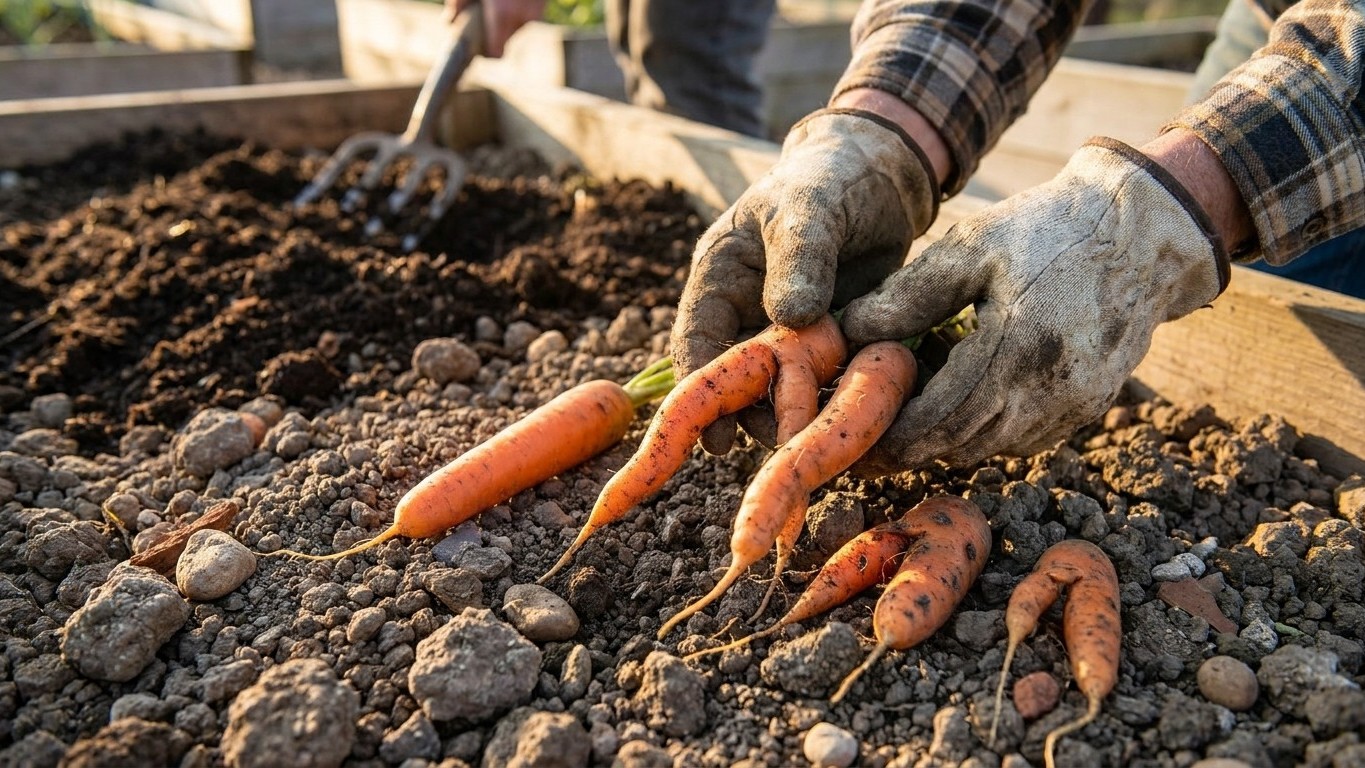

A forked or twisted carrot root usually means the tip hit something it couldn’t push through, or the soil around it changed moisture too many times while it grew. Utah State University Extension lists what carrots actually want: fertile, well-drained, deep, sandy soil rich in organic matter. Heavy or rocky ground, and uneven watering, are the two things published as forking the root. Neither is a mystery once you know what to check.
The short answer
Utah State University Extension names the cause directly. Carrots grown in soil that’s heavy or rocky “need to be amended with plenty of compost and should be double dug to allow good root development” or the root forks into several roots instead of one. That’s the whole diagnosis in a single sentence: the crop wants fertile, well-drained, deep, sandy soil rich in organic matter, and when it doesn’t get that, the taproot branches around whatever is in its way.
Notice what the remedy is not. It’s not a different seed packet, a raised bed miracle, or a soil test kit promising a number. The published fix is physical: work in compost, then double dig the bed so the loosened, enriched layer runs deep enough for a straight root to travel through it. Heavy clay compacts around a young taproot tip the way a closed door stops a hand. The root doesn’t punch through, it splits around the obstruction, and you end up pulling something that looks more like a wishbone than a carrot.
Watering plays a separate role. Utah State University Extension calls for watering that’s “frequent and uniform.” Uneven watering is named as the other cause of a split root, alongside heavy soil. A carrot that dries out and then gets soaked will often crack or fork along the way it grew during that stress, even in soil that’s reasonably loose. So the short answer really has two parts: fix what the root grows through, and keep what reaches it consistent.
There’s a second option worth knowing, and it costs nothing in compost or labor. NC State Extension describes cultivars built for exactly this problem. ‘Atlas’ produces small spherical roots 1 to 2 inches long, described as good for shallow soil and containers. ‘Little Finger’, a Nantes type, runs about 4 inches long, small and sweet. The Nantes group generally grows 6 to 7 inches with cylindrical roots and is noted to grow well in heavy soils. None of that changes the clay underneath your feet. A round or short-rooted carrot simply never has to travel far enough into it to fork. It’s a workaround, not a fix for the ground itself, and the two approaches pair rather than compete.
What actually decides it
Picture the growing tip of a carrot root as a small drill bit pushing straight down. As long as the material ahead of it is loose and evenly moist, it keeps that single, tapered line. The moment it meets something denser than the soil beside it, a compacted clay layer, a buried stone, a hardpan left by years of foot traffic, the tip does one of two things. It deflects sideways and keeps growing at an angle, which is what produces a twisted root. Or growth splits into two or more points at once, which produces a true fork. Either way, the shape you pull at harvest is a record of resistance the root met weeks earlier, underground, where you never saw it happen.
Sandy soil rich in organic matter avoids this because it offers almost no resistance in any direction. The particles are large and loosely packed, water drains through rather than pooling, and the root can extend its full length without branching. That’s the soil Utah State University Extension describes as ideal, and it’s ideal precisely because it removes the decision point. The root never has to choose a direction, so it doesn’t fork.
Water changes the equation on a different axis. A root under steady moisture grows at a steady rate, and the outer tissue expands in step with the inner tissue. Let the soil dry hard, then drench it, and the inside of the root can swell faster than the outer skin can stretch. The result is a crack running down the root, or a section that splits open rather than forks into branches. It’s a different failure than the clay-and-rock story, but it starts from the same principle: the root is a soft, elongating structure, and it records every abrupt change it’s forced to absorb.
This is also why a soil description at the state level only gets you partway. Utah, like every state, contains hundreds of distinct soil series, from sandy valley bottoms to heavy clay benches a few miles apart. A general description of what a state’s soil tends to be like is a starting point, not a diagnosis of the ground in your own bed. The way to settle it at home is simple and doesn’t need a lab: dig a spade-deep hole where you plan to sow, and look. Loose, crumbly, easily worked soil with no visible rock in the top foot behaves like the sandy loam the crop wants. Soil that holds together in a dense clod, or that turns up stones as you dig, is the heavy or rocky kind the forking warning is about, regardless of what the regional average says.
How to do it
- Dig a test hole about a foot deep where you intend to sow, and check by feel and by eye whether the soil is loose or dense, and whether it carries visible rock.
- If the soil is heavy or rocky, amend it with plenty of compost and double dig the bed so the loosened, enriched layer runs deep enough for the full length of a root to grow through it.
- Choose a cultivar that matches what you found. A round type such as ‘Atlas’ or a short Nantes type such as ‘Little Finger’ suits shallow or container soil; a longer Nantes-type root is described as growing well in heavy soils once they’re amended.
- Sow the seed directly where it will grow. Carrots are sown in place; there is no transplanting step for this crop.
- Once seedlings reach 3 to 4 true leaves, thin them to 2 to 3 inches apart, with rows spaced 12 to 18 inches apart.
- Water on a frequent, uniform schedule for the rest of the season, avoiding the dry-then-soak pattern that splits roots.
- Count maturity from the sowing date, not from any later step. Roots are ready 70 to 100 days from seeding, depending on the cultivar.
- After harvest, store the roots at 32 F and 95 percent relative humidity to hold their quality.
What goes wrong
- Skipping the soil prep on heavy or rocky ground. The root meets compacted clay or a stone and forks or twists around it. The remedy is the one already published: work in plenty of compost and double dig the bed before sowing, not after the roots are already growing.
- Watering on and off instead of steadily. A dry stretch followed by a heavy soak swells the root faster than its skin can stretch, and it splits. Keep watering frequent and uniform for the whole season rather than catching up after a dry week.
- Planting a long-rooted type in shallow or rocky soil without amending it. Even a well-chosen cultivar can’t outgrow ground that hasn’t been prepared. If double digging the whole bed isn’t practical, a round type like ‘Atlas’ or a short type like ‘Little Finger’ avoids the depth the root would otherwise need to travel.
- Counting the maturity window from the wrong starting point. There is no transplant date for this crop to count from. The 70 to 100 days run from the day the seed goes into the ground, and treating any later date as day one leads to pulling roots too early or leaving them too long.
- Leaving harvested roots at room Temperature. Carrots pulled correctly still lose quality fast if stored warm and dry. Cool them to 32 F at 95 percent relative humidity as soon as possible after harvest.
Common questions
Does a forked carrot mean the soil is bad everywhere in my yard?
Not necessarily. Soil conditions can change within a few feet, especially where fill dirt, old foundations, or compacted paths have altered one section of a yard. Dig a test hole in the specific bed before assuming the whole property needs amending.
Can I fix forking after the carrots are already growing?
No. The shape is set by what the root met on its way down earlier in the season. The published remedy, compost and double digging, has to happen before sowing, and the cultivar choice has to happen before you order seed.
Is a twisted carrot safe to eat?
Nothing in the forking or twisting itself makes a root unsafe. It’s a mechanical response to resistance in the soil, not a sign of disease, and the same growing and storage guidance applies regardless of shape.
Will a shorter variety fix my heavy soil for other vegetables too?
No. Choosing ‘Atlas’ or ‘Little Finger’ only sidesteps the depth a carrot root would need to reach. The clay or rock is still there for anything that roots deeper, so amending the bed with compost remains the only fix that addresses the soil itself.