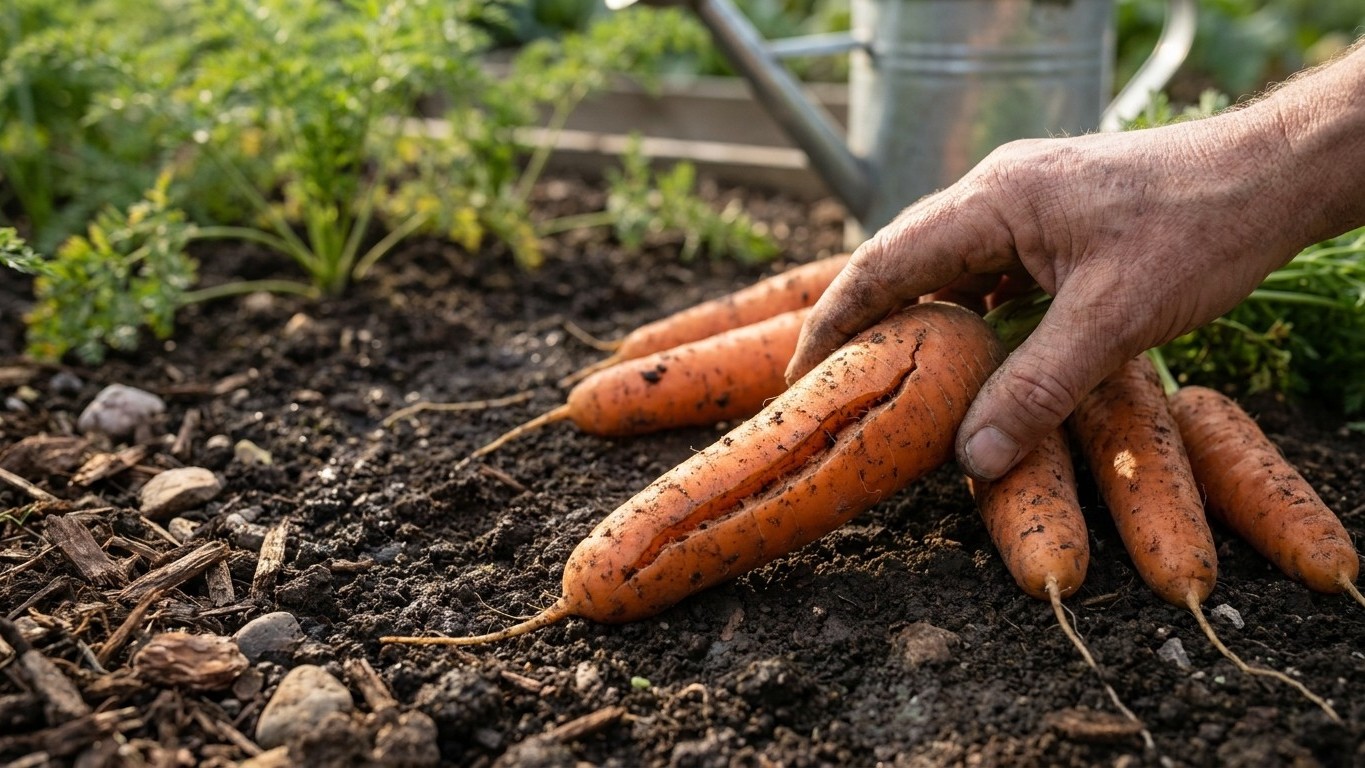

Split carrot roots trace back to irregular soil moisture more often than gardeners realize. Utah State University Extension names uneven watering as one of two direct causes of a split or forked root, the other being heavy soil that resists the root’s expansion. The remedy isn’t a product or a soil amendment, it’s a watering rhythm the extension describes simply as “frequent and uniform.” Keep the moisture level steady from sowing to harvest, and the crack that ruins a carrot’s shape has far less chance to form.
The short answer
Utah State University Extension is direct about this: a carrot splits when the soil around it swings between dry and saturated instead of staying evenly moist. That single mechanical fact explains why some rows come out of the ground clean while a neighboring row, planted the same week from the same seed packet, produces roots with a long crack running down one side. The extension lists two culprits side by side, uneven watering and heavy soil, and the two often act together, since heavy soil is exactly the kind of ground that swings hardest between bone-dry and waterlogged.
Carrots are sown directly where they’ll grow. There’s no transplanting step to blame for stress, no shock from being moved between containers. The root spends its entire life, from seed to harvest, in the same patch of soil, which means every watering decision made over that stretch shows up in the shape of the final root. Utah State University Extension puts the harvest window at 70 to 100 days from seeding, a span wide enough to cover cooler and warmer growing conditions, but narrow enough that a few weeks of erratic watering in the middle of that window can leave a permanent mark.
Thinning plays into this too. The extension recommends thinning seedlings once they reach 3 to 4 true leaves, spacing them 2 to 3 inches apart with rows 12 to 18 inches apart. Crowded roots compete for the same pocket of soil moisture, which makes any watering lapse hit harder, there’s simply less water to go around when three seedlings are drawing from the space meant for one. Thinning on schedule doesn’t prevent splitting by itself, but it removes one more variable that makes uneven moisture worse.
None of this requires guessing at a soil type or chasing a pH number the extension doesn’t publish. The short answer is mechanical: keep water frequent and uniform, thin on time, and the root grows at a steady pace instead of lurching between drought and flood.
What actually decides it
A carrot root grows in two ways at once, it lengthens, and it thickens. The outer layer, called the epidermis, has to stretch to keep pace with both. When soil moisture stays even, that stretching happens gradually, and the tissue keeps up. When the soil dries out for a stretch and then gets soaked, the root often takes in a sudden rush of water and swells fast from the inside. The outer layer, still built for the slower pace, doesn’t have time to expand. It tears. That tear is the split gardeners find at harvest.
Heavy soil makes this worse in a specific way. Dense, compact ground holds water unevenly, it can stay soggy near the surface after a rain while staying dry a few inches down, or it can crust over and shed water instead of absorbing it, so the root gets nothing for days and then everything at once. Utah State University Extension flags heavy soil as a cause of splitting for exactly this reason: it’s a soil structure that makes uniform moisture hard to achieve even when the gardener is watering on a normal schedule.
Here’s where the reasoning has to travel beyond any single soil description, because the extension’s guidance is a starting point, not a diagnosis. A state, or even a single county, can span hundreds of distinct soil series, sandy loam in one yard, heavy clay two miles away, a mix of both in the same bed depending on where a foundation was once poured or fill dirt was brought in. No article can describe your soil for you. The test that settles it is simple and doesn’t require a lab: dig a hole about a foot deep, fill it with water, let it drain, then fill it again and time how long the second fill takes to disappear. Water that vanishes in a few hours drains fast and dries out fast between waterings. Water that sits for the better part of a day signals the dense, slow-draining ground that struggles to stay evenly moist.
Once you know which pattern your ground falls into, the watering decision becomes a matter of adjusting frequency to match, not following a fixed number of days between waterings regardless of what the soil is actually doing.
How to do it
- Sow the carrot seed directly in the bed. There’s no transplanting stage with this crop, so the soil where the seed goes down is the soil the root will grow in for its entire life.
- Once seedlings reach 3 to 4 true leaves, thin them to 2 to 3 inches apart, keeping rows 12 to 18 inches apart, per Utah State University Extension. This reduces competition for the same pocket of soil moisture.
- Run the drainage test described above if you haven’t already assessed how your bed handles water. Knowing whether it drains fast or slow tells you how often you’ll need to check soil moisture between waterings.
- Water frequently and uniformly, following the extension’s guidance directly, avoid letting the bed swing between dry and saturated. The goal is a steady moisture level, not a fixed number of minutes on a hose timer.
- Check the bed regularly through the growing period, especially during any stretch of hot or windy weather that dries soil faster than usual, and adjust watering frequency rather than waiting for a set day of the week.
- Harvest within the 70 to 100 day window from seeding, since roots left too long in inconsistent conditions have more time to develop cracks even if the watering routine was solid early on.
- Store harvested roots at 32 F and 95 percent relative humidity, the conditions Utah State University Extension specifies for keeping carrots in good condition after harvest.
What goes wrong
- Watering on a fixed calendar instead of by soil condition. A schedule that ignores rainfall or heat spells lets the soil dry out between visits, then gets doused all at once. Check the bed itself before watering, not just the date on a calendar.
- Skipping or delaying thinning. Leaving seedlings crowded past the 3 to 4 true leaf stage means several roots are drawing from the same limited moisture, which magnifies any watering lapse. Thin to 2 to 3 inches apart as soon as the plants reach that stage.
- Treating heavy soil the same as fast-draining soil. Dense ground needs a different watering rhythm than sandy ground, since it holds water unevenly by nature. Run the drainage test rather than assuming your soil behaves like a neighbor’s or like a generic guide.
- Letting harvest slide past the window. Roots sitting in the ground beyond the 70 to 100 day range from seeding have more exposure time to any moisture swings that occur late in the season. Track the seeding date and plan harvest around it.
- Storing carrots at the wrong Temperature or humidity after a good harvest. Even a perfectly grown, unsplit root can degrade in storage if it isn’t kept at 32 F and 95 percent relative humidity, the conditions Utah State University Extension recommends.
Common questions
Does uneven watering split carrots that are otherwise healthy?
Yes. Utah State University Extension names uneven watering as a direct cause of splitting on its own, separate from soil type. A root can be growing in decent ground and still crack if the watering pattern swings between dry stretches and heavy soakings.
How long does a carrot take to reach harvest size?
Utah State University Extension puts the window at 70 to 100 days from seeding. Since carrots are sown directly and never transplanted, that count starts the day the seed goes into the ground.
What spacing prevents overcrowded roots?
Thin seedlings once they show 3 to 4 true leaves, spacing them 2 to 3 inches apart with rows 12 to 18 inches apart, following Utah State University Extension’s guidance. Crowded roots compete for moisture, which worsens the effects of any watering inconsistency.
How should harvested carrots be stored to avoid post-harvest damage?
Utah State University Extension specifies 32 F and 95 percent relative humidity as the storage conditions that keep carrots in good shape after they leave the ground.