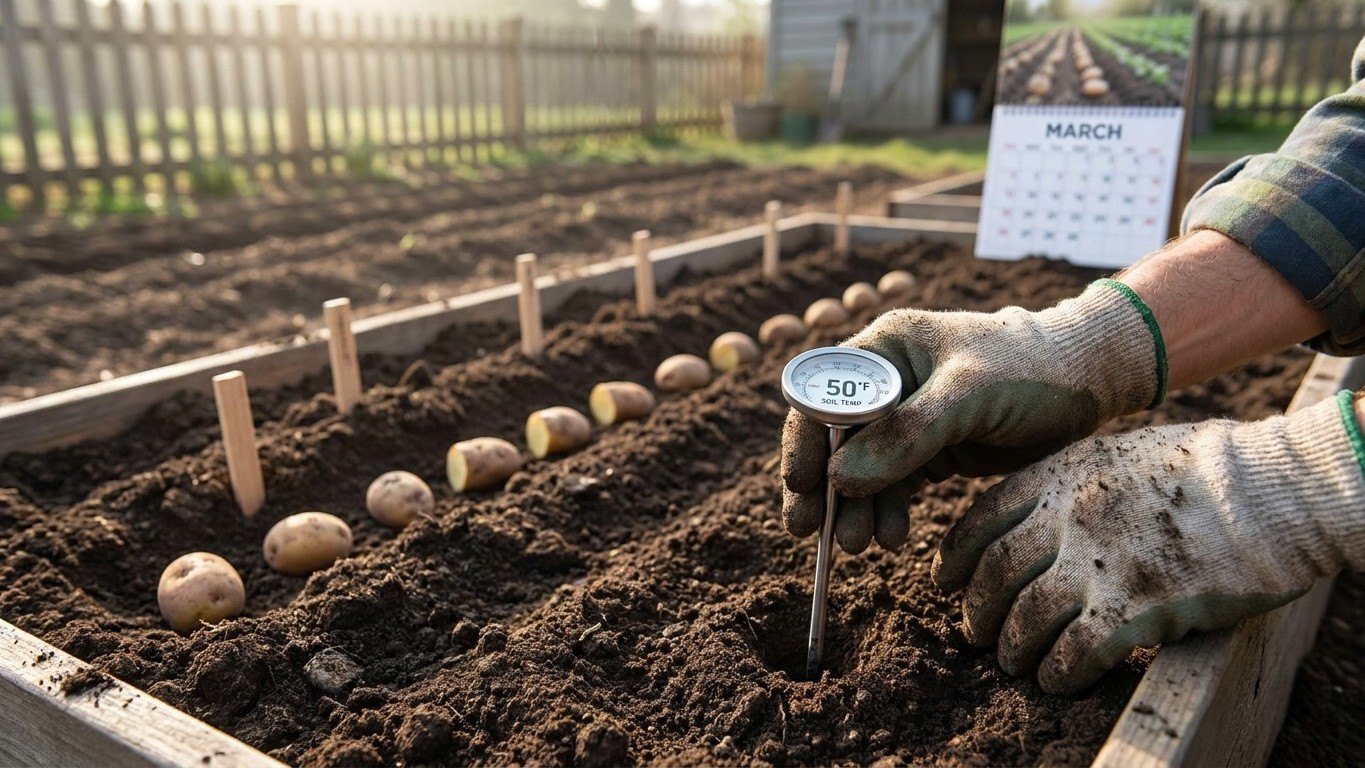

Soil temperature decides potato planting, not the date on a calendar. Plant as soon as the soil reaches 50°F, a point that typically falls 14 to 21 days before the last frost date in your area, according to Utah State University Extension and the University of Maine Cooperative Extension. That gap exists because a seed potato needs warming ground to sprout cleanly, while the plant’s foliage can shrug off a light frost once it emerges. Read the dirt, not the wall calendar.
The short answer
Both Utah State University Extension, in its guide Potatoes in the Garden, and the University of Maine Cooperative Extension, in Bulletin #2077, land on the same threshold: 50°F soil, measured 14 to 21 days ahead of your last spring frost. That’s not a suggestion to plant on a specific week. It’s a temperature you check with a soil thermometer pushed a few inches into the ground, ideally at the same depth the seed piece will sit. Once the reading holds at 50°F or above, the window is open.
The two extensions agree on the physical setup that goes with that timing, too. Maine’s Bulletin #2077 calls for a furrow 4 to 6 inches deep, with the seed piece covered by 2 inches of soil once it’s set in place. Spacing runs 8 to 12 inches between seed pieces along the row, with 30 to 36 inches left between rows, a figure both Maine and Utah State publish. None of that changes with variety. An early-season potato and a late-season one go into the ground at the same depth and spacing; what differs between them is how long they hold in the garden before harvest, not how they’re planted.
Why the range matters more than a single date
The 14-to-21-day window isn’t sloppy rounding. Soil warms at different rates depending on drainage, color, and whether it’s been worked recently, so the same calendar date can sit on either side of 50°F depending on the plot. A sandy raised bed in full sun might clear 50°F two weeks ahead of a heavy clay row a few yards away. That’s exactly why both extensions frame the recommendation around a thermometer reading tied loosely to frost date, rather than a fixed day count from either end. The frost date tells you roughly when to start checking. The thermometer tells you when to act.
What actually decides it
The cold-soil mechanism: rot before growth
A seed potato set into ground below 50°F doesn’t just sit and wait patiently for warmth. Cold, wet soil around a cut seed piece favors decay organisms over sprouting, so the piece can rot before it ever pushes a shoot. That’s the reason the recommendation is framed as a floor rather than an early-is-better instinct. Gardeners in a hurry to beat the frost date often beat the soil temperature instead, and the seed piece pays for it underground where nobody sees the failure until the row stays bare.
The heat-ceiling mechanism: tuber set shuts down
At the other end of the season, Utah State University Extension notes that tuber set and fill are inhibited by high temperatures, specifically once soils climb above 90°F. This is a separate mechanism entirely from the cold-soil problem at planting. It doesn’t matter how healthy the foliage looks above ground; once the soil around the developing tubers crosses that ceiling, the plant’s energy stops translocating into new and swelling tubers the way it should. Watering more doesn’t undo that heat signal. This is the piece of the puzzle a lot of gardeners never learn until a hot summer costs them a crop: irrigation manages drought stress, but it doesn’t lower soil temperature past a threshold the plant is responding to biologically.
Put the two mechanisms together and you get the actual logic behind “soil temperature, not the calendar.” The floor (50°F) and the ceiling (90°F) are both soil-temperature triggers, not date triggers, and they explain why the same planting instructions can apply from one region to another even though frost dates and summer heat arrive on wildly different schedules. Where summers run long above 90°F, the working answer isn’t a later planting date. It’s an earlier one, timed to let the crop set and fill before the ceiling closes the window, with the harvest coming as a spring crop rather than a summer one.
How to do it
- Push a soil thermometer a few inches into the planting bed, checking readings over several days rather than relying on one warm afternoon, starting roughly three weeks ahead of your area’s last frost date.
- Wait until the reading holds at 50°F or above; this is the trigger point named by both Utah State University Extension and the University of Maine Cooperative Extension, not a specific date on the calendar.
- Open a furrow 4 to 6 inches deep along the row, per the depth range published in Maine’s Bulletin #2077.
- Set seed pieces along the furrow 8 to 12 inches apart.
- Space additional rows 30 to 36 inches from the first, matching the row spacing both extensions publish.
- Cover the seed pieces with 2 inches of soil, the covering depth Maine’s Bulletin #2077 specifies at planting.
Once the crop is in the ground, the soil-temperature logic doesn’t stop mattering. Keep an eye on the season ahead, particularly in regions where summer soil reliably climbs past 90°F, since that’s the ceiling that shuts down tuber set and fill regardless of how well the planting itself went in spring.
What goes wrong
- Planting by frost date alone, ignoring the soil reading. A calendar can say the window is open while the soil still sits below 50°F, especially in heavy or shaded ground. Check the thermometer before the furrow goes in, not just the frost date on the wall.
- Digging the furrow too shallow or too deep. Straying from the 4-to-6-inch range changes how much soil sits over the seed piece and can leave it exposed to temperature swings it wasn’t set up to handle. Stick to the published depth rather than guessing by eye.
- Crowding seed pieces closer than 8 inches. Tight spacing competes underground for the same limited soil volume each plant needs to set tubers. Hold the 8-to-12-inch spacing in the row and the 30-to-36-inch spacing between rows even when the bed feels like it has room to spare.
- Trying to water your way past a 90°F soil ceiling. Once soil temperature crosses that mark, tuber set and fill are inhibited regardless of moisture. Where summers routinely run that hot, the fix is timing, not irrigation: plant as early as the 50°F floor allows and treat the harvest as a spring crop rather than pushing it into peak summer heat.
Common questions
Can I plant potatoes before the last frost date?
Yes, and both extensions expect it. The recommended window falls 14 to 21 days before the last frost date, timed to the point where soil reaches 50°F rather than to the frost date itself.
What happens if soil is colder than 50°F when I plant?
The seed piece sits in cold, wet ground longer than it should, which favors rot over sprouting. Waiting for the 50°F threshold, as published by Utah State University Extension and the University of Maine Cooperative Extension, avoids that risk.
Does watering help when soil gets too hot?
No. Utah State University Extension is specific that tuber set and fill are inhibited once soils climb above 90°F, and that’s a temperature response, not a moisture one. In regions where summer soil regularly exceeds 90°F, planting earlier so the crop matures before the heat arrives is the working solution, not extra irrigation.
Do early, mid-season, and late varieties need different planting times?
The planting depth, spacing, and 50°F soil threshold don’t change by season class. What changes is how long each type holds in the ground before harvest, with early-season types finishing sooner and late-season types staying in longer, which matters most in areas where the 90°F soil ceiling arrives before a late-season crop would otherwise be ready.