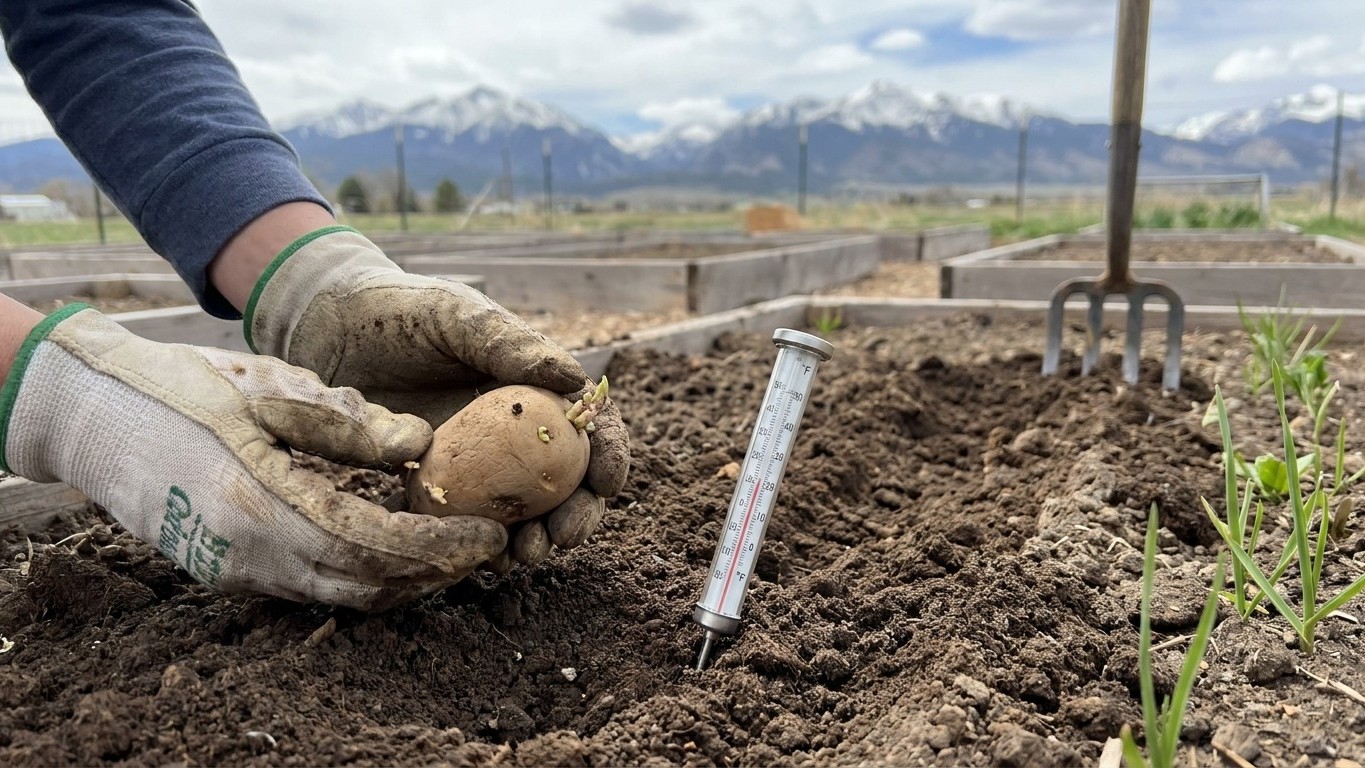

Count back 14 to 21 days From Your Last Frost date, then plant once soil hits 50°F. In Denver, NOAA NCEI puts that frost date between May 1 and May 11, which lands the planting window somewhere around the second to fourth week of April. But that math only holds at Denver’s elevation and latitude. Mountain towns and the western slope run on a different clock entirely.
The short answer
The NOAA National Centers for Environmental Information, using 1991-2020 Climate Normals for station USW00003017 (Denver), lists the 32°F freeze probability window at May 1 to May 11. That’s the last-frost figure most Front Range gardeners actually work from, since it’s the closest long-record station most of them have.
Potatoes don’t wait for frost to pass, though. Utah State University Extension and the University of Maine Cooperative Extension (Bulletin #2077) both describe the same rule: potatoes go in the ground as soon as soil temperature reaches 50°F, and that point typically arrives 14 to 21 days before the last frost date. Apply that to Denver’s May 1-11 window and you land somewhere between roughly April 10 and April 27, depending on where in that frost range your particular spring falls and which end of the 14-to-21-day spread your soil hits first.
That’s not a fixed calendar date. It’s a range built from two moving numbers, a frost probability band and a soil-warming lag, stacked on top of each other. A cold, wet April pushes the whole window later. A dry, sunny stretch in raised beds or south-facing plots pulls it earlier, because soil warms faster than air and faster than open, unprotected garden rows.
None of this transfers cleanly outside Denver. The NOAA figure above is tied specifically to that one station, at that one elevation on the plains. A gardener in a mountain valley, a high park, or the western slope is working from a different frost record entirely, and neither extension source publishes a single statewide date because no such date would be accurate. What both sources agree on, no matter the location, is the mechanism: soil temperature triggers planting, frost date only tells you how much buffer you have before that soil-warming clock even starts ticking.
What actually decides it
The last-frost date is a proxy, not the real trigger. What actually starts the countdown is soil temperature, and what ends the growing window on the other side is soil heat. Understanding both lets you work out a planting date for a location this page never names.
Why soil temperature outranks frost date
A potato seed piece planted in cold, wet soil doesn’t wait patiently for warmth. It sits there vulnerable to rot before it ever sprouts. That’s why Utah State and Maine both anchor the planting rule to 50°F soil, not to the calendar. Air temperature and soil temperature move at different speeds. South-facing slopes, raised beds, and sandy soils warm faster than shaded, clay-heavy, low-lying ground. Two gardens ten miles apart, at the same elevation, can hit 50°F soil a week or more apart depending on exposure and drainage. If you know your local last-frost date, the 14-to-21-day setback gives you a planting estimate, but a soil thermometer confirms it, and confirmation always beats a guess built on a frost date alone.
Why elevation resets the whole calculation
Denver’s May 1-11 window describes the plains at roughly 5,280 feet. Move up into the mountains and the frost season compresses dramatically, some high-elevation towns can see freezing temperatures into July, which collapses the entire counting-back exercise into a much narrower, later window. The western slope runs on its own pattern again, shaped by different air drainage and different elevation profiles than either the plains or the high country. The mechanism doesn’t change: still 14 to 21 days before local last frost, still triggered by 50°F soil. Only the input, the local frost date, changes, and using Denver’s figure anywhere else in the state substitutes a real number for the wrong location.
Why the other end of the season matters just as much
Soil above 90°F inhibits tuber set and fill, according to Utah State and Maine’s fact sheets, and watering doesn’t reverse that damage once it happens. This is the ceiling that decides whether a location can support a full-season crop or only an early spring one. Where summer soil heat routinely crosses that threshold, the answer isn’t to plant later and hope for cooler tubers, it’s to plant as early as the frost math allows and dig before the heat arrives.
How to do it
- Pull your local last-frost date from the nearest long-record NOAA NCEI station, not a statewide average, since a single figure never holds for the whole state.
- Count back 14 to 21 days from that date to get your planting window estimate.
- Confirm with a soil thermometer, pushed a few inches into the planting bed, and wait until it consistently reads 50°F before digging.
- Order or buy certified seed potatoes rather than grocery-store tubers; uncertified seed carries viruses that grocery potatoes are never screened for.
- Let whole small seed potatoes sit in bright, cool conditions to chit (pre-sprout) before cutting, which Maine’s extension bulletin describes as improving early vigor.
- Cut larger seed potatoes into pieces a few days ahead of planting and let the cut surfaces cure, which reduces rot risk once they’re in cool spring soil.
- Plant once soil has reached 50°F, matching the window calculated in steps one and two.
- Hill soil around the emerging plants as they grow, keeping developing tubers covered and shielded from light.
- Track soil temperature again as the season progresses; where 90°F soil is a realistic summer risk, plan to dig before that threshold hits rather than leaving tubers in the ground through peak heat.
What goes wrong
- Planting by a fixed calendar date instead of soil temperature. A date on a calendar doesn’t know whether the soil is actually 50°F yet. The remedy is a five-dollar soil thermometer and patience, planting a week late in cold soil beats planting on schedule into ground that will rot the seed piece.
- Using grocery-store potatoes as seed. They aren’t certified, and uncertified seed can carry viruses that quietly reduce yield without any obvious symptom the first season. The fix is sourcing certified seed potatoes from a supplier that states certification plainly.
- Ignoring the 90°F soil ceiling. Planting late, then hoping a hot summer sorts itself out, runs directly into the fact that tuber set and fill stop above that soil temperature and irrigation doesn’t undo it. Where summer heat is a known risk, the remedy is planting as early as the frost math allows and treating the crop as an early, spring-dug harvest rather than a full-season one.
- Applying Denver’s frost date to a mountain town or the western slope. The NOAA figure cited here is specific to one station at plains elevation. Higher elevations can see frost risk running into July, which makes the same 14-to-21-day count-back land on a completely different date. The fix is pulling frost data from the nearest station to the actual planting site, not the nearest well-known city.
- Cutting seed potatoes and planting the same day. Fresh-cut surfaces are an easy entry point for rot in cool, damp spring soil. Letting cut pieces cure for a couple of days first lets the surface heal over before it ever touches soil.
Common questions
Can I just plant on the last-frost date itself?
You can, but you’re planting later than the soil-temperature rule suggests. Utah State and Maine both frame 50°F soil, not the frost date, as the trigger, and that point typically falls 14 to 21 days ahead of last frost. Waiting for the frost date itself usually means planting into soil that warmed up weeks earlier.
Does early planting risk frost damage to the plants?
Seed potatoes go in before the last frost specifically because the tubers themselves sit below the danger zone underground while they sprout. Emerging foliage can still be nipped by a late frost, but that’s a separate risk from the seed piece itself, which the extension sources treat as tolerant of cool, above-50°F soil.
What if my town doesn’t have its own weather station data?
Use the nearest long-record NOAA NCEI station and adjust mentally for elevation and exposure differences. There’s no substitute here, this page doesn’t have a published figure for every town, and inventing one wouldn’t be accurate.
Should I choose an early, mid-season, or late variety based on my planting date?
Season class matters more where summer soil heat crosses 90°F, since an early-season variety gives you a better shot at finishing tuber fill before that ceiling hits. Neither Utah State nor Maine publishes a specific days-to-maturity number for varieties, only the season class, so plan around that classification rather than a fixed day count.