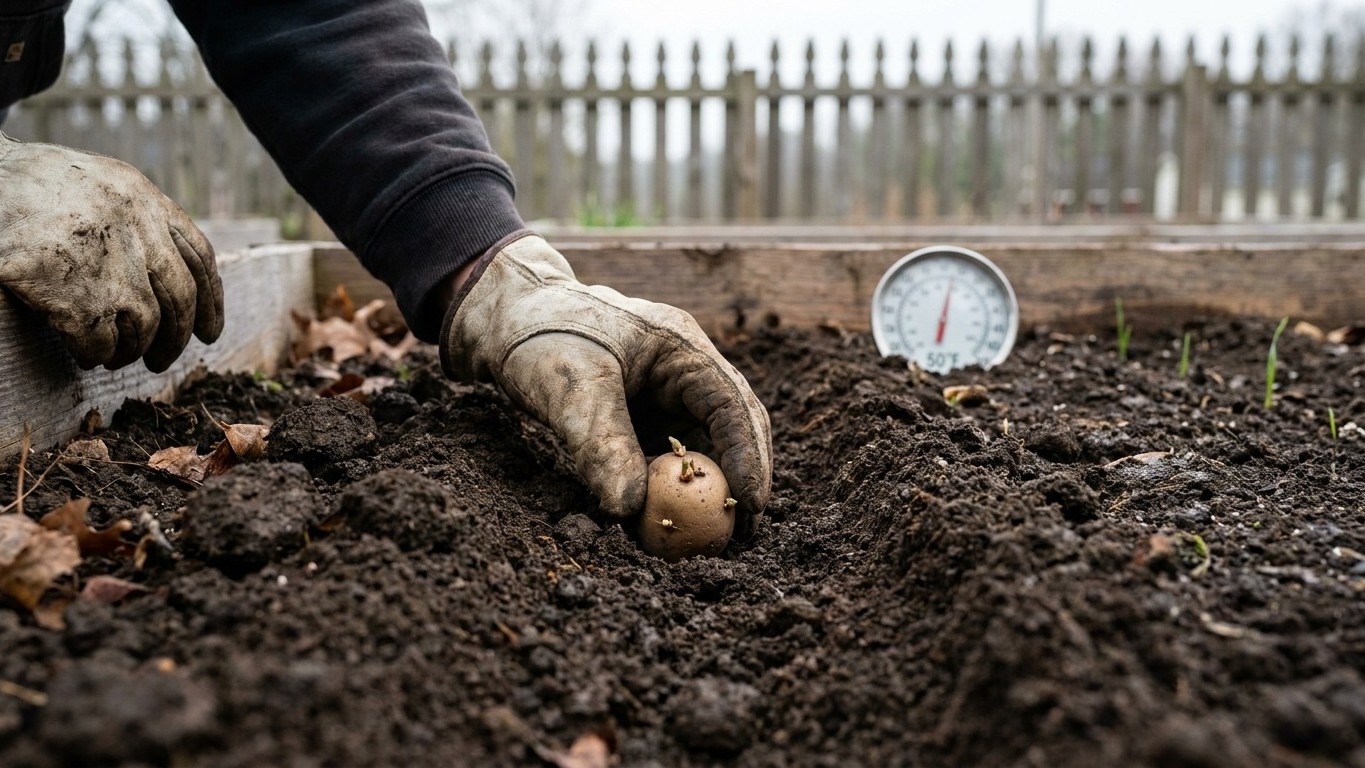

Plant potatoes in Delaware 14 to 21 days before your last frost date, as soon as soil temperature reaches 50°F, not by a fixed calendar date (Utah State University Extension). Delaware’s last spring frost falls between April 3 and April 14, based on NOAA NCEI’s 1991-2020 Climate Normals for one Delaware airport station. Counting back from that window puts safe planting somewhere between mid-March and the very end of the month, depending on where in the state you garden.
The short answer
NOAA NCEI’s 1991-2020 Climate Normals put Delaware’s last spring 32°F freeze between April 3 and April 14, using the 30-70% freeze-probability band for the airport station tracked in that dataset. That’s not a single date. It’s a two-week band, and it comes from one station’s history, not a survey of the whole state. If you garden closer to the coast or in the Wilmington corridor, your microclimate may run warmer or cooler than that station’s record by a week or more.
Run the math from Utah State University Extension’s planting rule and you get a working window. Fourteen to twenty-one days before April 3 lands you at March 13 to March 20. The same count from April 14 lands you at March 24 to March 31. Stack those two ranges together and Delaware gardeners are generally looking at mid-March through the very end of March as the planting stretch, with the earliest dates for gardeners confident in a milder, well-drained site and the later dates for anyone farther inland or at higher ground where cold air settles.
That range only matters if the soil agrees with it. Utah State’s fact sheet is specific: potatoes go in the ground once soil temperature hits 50°F, and that threshold is what actually triggers planting, not the date on a seed packet or a wall calendar. In a mild March, Delaware soil can reach 50°F well ahead of the state’s typical last-frost window closes out. In a cold, wet March, it can lag behind even the late end of that range. The frost date tells you when the air stops threatening young foliage. The soil temperature tells you when the tuber can actually start growing. Both numbers matter, and they don’t always move in step.
None of this replaces a soil thermometer pushed two to four inches into your own bed. NOAA’s station data is the best public benchmark available for the region, but it’s a benchmark, not a guarantee for your particular yard, and the University of Maine Cooperative Extension’s planting bulletin treats soil temperature as the deciding factor precisely because air-temperature averages vary so much from one plot to the next.
What actually decides it
Soil temperature, not calendar date
Potato planting timing hinges on a threshold, not a season. Utah State University Extension’s fact sheet sets that threshold at 50°F soil temperature, the point where a seed piece will actually sprout rather than sit dormant and risk rotting in cold, wet ground. Below that line, a planted tuber isn’t gaining anything by being in the soil early. It’s waiting, and waiting exposes it to fungal and bacterial rot in soil that’s still cold and damp from winter. That’s why the 14-to-21-day window before last frost is expressed as a range and not a single number: it’s the stretch of time when soil in most home gardens is likely to have crossed 50°F, but the actual crossing date depends on your soil type, your drainage, and how much sun your bed gets in early spring. A raised bed with sandy loam warms faster than a low, clay-heavy spot in the same yard, sometimes by a week or more.
The 90°F ceiling that ends tuber sizing
The other end of the season matters just as much, and it’s the part gardeners in a warm mid-Atlantic state can’t ignore. Both Utah State University Extension and the University of Maine Cooperative Extension’s Bulletin #2077 identify soil temperatures above 90°F as the point where tuber set and tuber fill are inhibited. Once soil crosses that line, the plant stops sizing up the tubers already forming underground, and no amount of irrigation reverses that. Watering a stressed potato patch in July heat keeps the foliage alive, but it does not restart tuber growth once soil has been baking above 90°F.
That mechanism is the real reason the planting window skews early rather than late. Delaware’s coastal-plain summers push soil temperatures into that danger zone well before the growing season Utah State University Extension describes would naturally wind down. Planting as close to the early end of the window as your soil allows gives the crop the longest stretch of cool-to-moderate soil before summer heat arrives, and it’s the difference between digging a full-sized spring crop and digging a patch of undersized tubers that stopped growing in mid-summer.
How to do it
- Buy certified seed potatoes. Uncertified seed carries viruses that stunt yield and can persist in your soil, and neither Utah State University Extension nor the University of Maine Cooperative Extension treats this as optional.
- Check the variety’s published season class, early, mid-season, or late, and choose based on when you want to dig rather than on an assumed number of days to maturity, since neither extension source publishes a days-to-maturity figure.
- Match the variety to its published use, baking or boiling, rather than relying on texture words like waxy or floury, which aren’t terms these two sources use.
- Push a soil thermometer two to four inches into the bed on a dry day and track it over a week rather than trusting a single reading.
- Once soil holds at 50°F, count back from your local last-frost expectation, using the 14-to-21-day range Utah State University Extension gives, to confirm you’re inside the window rather than ahead of it.
- Cut seed potatoes into pieces with at least one eye each, and let cut surfaces callus for a day or two before planting to reduce rot risk in cool soil.
- Plant seed pieces at the depth and spacing recommended for your chosen variety’s season class, in soil that drains well rather than a low spot that stays saturated.
- Hill soil around the emerging stems as they grow, covering developing tubers so they aren’t exposed to light and heat at the surface.
- Watch soil temperature again as summer approaches, and plan your digging date around staying ahead of the 90°F ceiling rather than around a fixed calendar date.
What goes wrong
- Planting by the date on a seed packet instead of soil temperature. A seed piece sitting in soil below 50°F isn’t getting a head start, it’s sitting in cold, wet conditions that favor rot. Check the soil with a thermometer before you plant, regardless of what the calendar says.
- Using saved grocery-store potatoes as seed. Uncertified stock can carry viruses invisible to the eye that reduce yield for the whole season. Buy certified seed potatoes instead, every time.
- Planting too late and running the crop into summer heat. Once soil crosses 90°F, tuber set and fill stop, and irrigation doesn’t reverse it. If your site is warm, lean toward the early end of the 14-to-21-day window and consider harvesting as a spring crop rather than pushing into peak summer.
- Trusting one frost date for the whole state. NOAA’s April 3 to April 14 window comes from one Delaware airport station. Gardens in low-lying, cold-air-collecting spots, or farther from that station, can see frost outside that range by a week or more. Track your own site’s history if you have it.
- Skipping the hilling step. Tubers exposed to sunlight at the soil surface turn green and become bitter. Keep hilling soil over the row as the plant grows, not just once at planting.
- Choosing a variety by texture guesswork. Picking a potato because it “sounds” like a baker or a boiler leads to disappointing results. Check what the variety is published to be used for, and match your recipe plans to that, not to a texture label.
Common questions
Can I plant potatoes in Delaware before the last frost date?
Yes, and that’s the point of the 14-to-21-day rule from Utah State University Extension: potato foliage can handle a light frost better than the seed piece benefits from being planted too late, so planting ahead of the last frost date is standard practice once soil hits 50°F, not a risk to avoid.
What if my soil hasn’t hit 50°F by late March?
Wait. Utah State University Extension is clear that the 50°F soil threshold, not the date, is what determines planting. A cold, wet spring can push that threshold past the typical window, and planting into colder soil raises rot risk rather than gaining you growing time.
Does Delaware’s last frost date come from a National Weather Service forecast?
No. The April 3 to April 14 range cited here comes from NOAA NCEI’s 1991-2020 Climate Normals dataset, a statistical average of past freeze occurrences at one station, not a forecast for any particular season.
Why does Delaware’s warm summer matter for potato timing?
Because the same soil that needs to warm to 50°F in spring can also climb above the 90°F ceiling identified by Utah State University Extension and the University of Maine Cooperative Extension by mid-summer. Planting early gives the crop more cool soil weeks before that ceiling arrives, which matters more in a warm mid-Atlantic climate than in a cooler northern one.