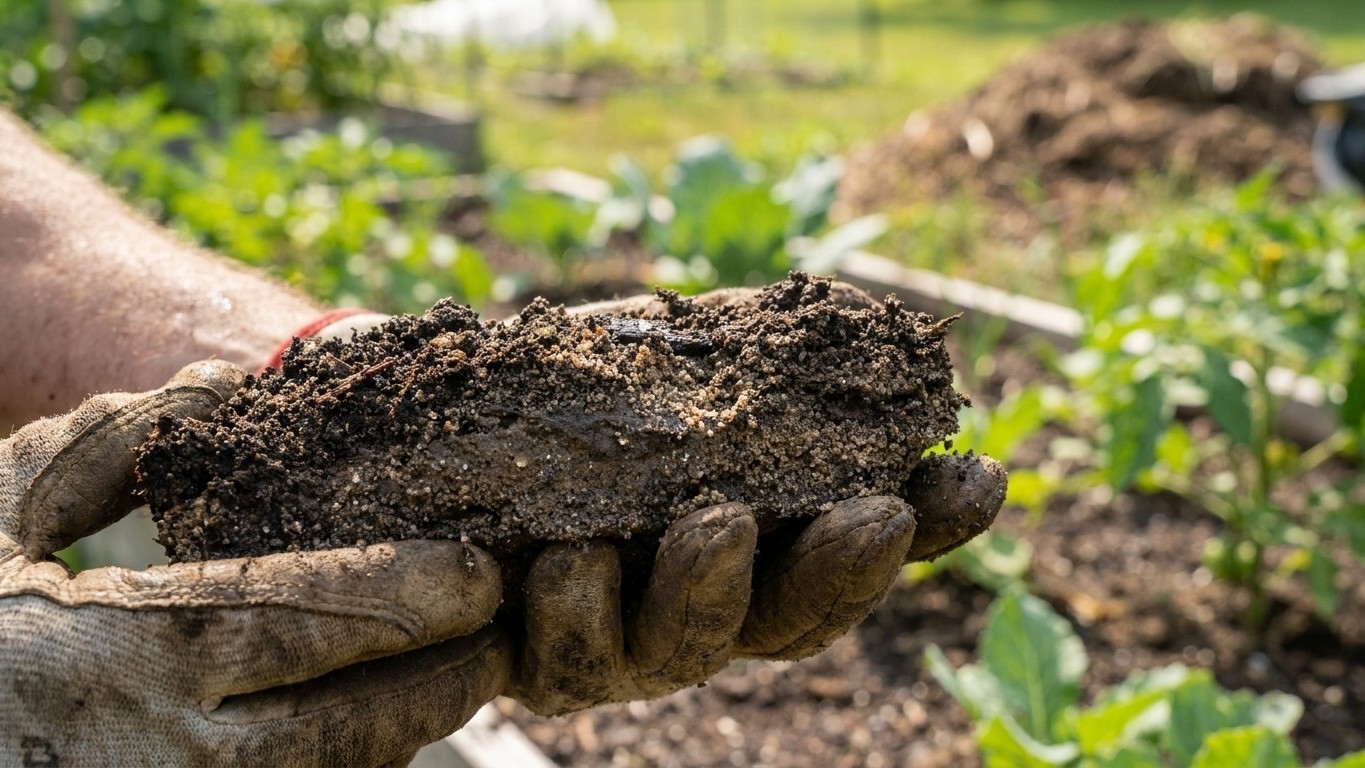

Dig a foot down almost anywhere in Delaware and you’re likely standing in some version of the Greenwich series, the state’s official soil since 2000. It’s a well-drained, acid, low-fertility loam that farmers and gardeners have fought and fed for three centuries. Here’s what’s actually in it, and what to do about it.
What is under your garden

Delaware’s official state soil is the Greenwich series, an Ultisol. That word matters more than it sounds like it should: Ultisols are old soils, heavily weathered and leached over thousands of years, which is why they tend to run acid and short on nutrients no matter how much compost you dumped in last fall. The USDA’s own survey data for the Greenwich series puts the surface horizon at a pH of about 6.0, slightly acid, with a texture of 48 percent sand, 9 percent clay, and 43 percent silt, and organic matter around 1.7 percent. That combination reads as a loam-to-silt loam: not sticky clay, not loose beach sand, but a fine-grained soil that drains reasonably well and holds its structure.
| Reading | Value |
|---|---|
| Surface pH | about 6.0 (slightly acid) |
| Sand | 48% |
| Silt | 43% |
| Clay | 9% |
| Organic matter | about 1.7% |
| Drainage class | Well drained |
Now the honest part. Greenwich is the soil that represents Delaware in the federal soil survey, not the soil under your specific tomato bed. It’s a composite of eleven mapped components, an average of what the state tends to look like, not a measurement anyone took in your yard. River bottoms along the Nanticoke or Christina run heavier and wetter. Sandy ground near the coast drains faster and holds less. And if a builder graded your lot, scraped the topsoil, and brought in fill before laying sod, none of these numbers apply to you at all. Compacted subsoil dressed up with two inches of purchased topsoil behaves nothing like a native Ultisol.
Reading your own dirt in five minutes
You don’t need a lab to get a rough read. Wet a small handful of soil until it’s moist but not dripping, then squeeze it between your thumb and forefinger, pushing it upward into a ribbon. Loam and silt loam, like Greenwich, tend to form a short ribbon, maybe an inch or two, before breaking. Clay forms a long, greasy ribbon that resists breaking. Sand won’t ribbon at all; it just crumbles.
The jar test tells you more overnight. Fill a clear jar a third full with soil, top it off with water, shake it hard, and let it sit undisturbed for 24 hours. Sand settles within minutes and forms the bottom layer, silt settles over the next few hours, and clay stays suspended longest, forming the top layer. The relative thickness of those layers tells you, roughly, whether you’re closer to the sandy-silty Greenwich profile or something heavier and stickier.
Testing before you amend
Guessing at soil amendments is how people spend money making problems worse. Adding lime to soil that’s already near neutral, or sulfur to soil that’s already acid, moves the number the wrong direction and can take a season or more to undo. A real soil test tells you the actual pH of your bed, the phosphorus and potassium levels, and often organic matter content, none of which you can reliably eyeball no matter how long you’ve gardened.
Given the regional pH of about 6.0 in the state soil survey, you can reasonably expect a garden bed in Delaware to test somewhere in the mildly acid range, maybe 5.5 to 6.5, especially on ground that hasn’t been limed in years. But expecting is not knowing. Ultisols like Greenwich are prone to gradual acidification as organic matter breaks down and nutrients leach out, and a bed that tested fine three years ago may have drifted since.
A representative sample takes a little more effort than scooping one trowel of dirt near the back door. Here’s the routine:
- Pick the area you’re testing, say, one vegetable bed or one lawn zone, and treat it as a single sample.
- Push a clean trowel or soil probe 6 to 8 inches deep, the depth where most roots actually feed.
- Take 8 to 10 of these cores scattered across the area, avoiding spots right next to fences, driveways, or old brush piles.
- Mix the cores together in a clean plastic bucket, breaking up clumps and removing rocks, roots, and mulch.
- Let the mixed sample air-dry on newspaper, then bag about a pint of it for the lab, labeled by bed or zone.
Test each distinct area of your yard separately. A vegetable bed, a lawn, and a spot near an old foundation can come back with wildly different numbers even on the same quarter-acre lot.
Amending it
Liming acid ground
The Greenwich series sits at about pH 6.0, slightly acid, which is neither the crisis end of the scale nor comfortably neutral. As an Ultisol, though, this soil’s whole history is one of weathering and leaching, and that process doesn’t stop once you plant a garden. Left alone, organic matter breakdown and rainfall leaching push these soils further acid over time, which is why lime, not sulfur, is the tool Delaware gardeners reach for far more often. If your own test comes back below roughly 5.5, that’s the acid range where phosphorus starts locking up chemically and becomes unavailable to roots, and where brassicas like broccoli and cabbage struggle and become more vulnerable to clubroot disease. Applying agricultural lime, worked into the top 6 inches, is the standard fix. It’s slow. Lime needs a full season, sometimes two, to fully react with the soil and shift the pH, so don’t expect results by next month’s harvest. Sulfur has no business going on ground that’s already trending acid; it only compounds the problem.
Organic matter: the real fix here
The bigger weakness in this soil isn’t pH, it’s the organic matter figure: about 1.7 percent, which is thin. Organic matter is what holds nutrients in place long enough for roots to use them, and what gives a loam soil like this the crumb structure that resists crusting after heavy rain. Working in 2 to 3 inches of compost or well-rotted manure each fall, and keeping beds mulched through summer, builds that number up gradually. Unlike lime, this correction rewards patience over years rather than seasons; a single truckload of compost won’t turn thin soil rich overnight, but three or four years of consistent additions will.
If your soil tests heavier in clay
Greenwich itself runs low in clay, just 9 percent, but plenty of Delaware yards, especially where fill dirt or subsoil got exposed during construction, test heavier. If yours does, organic matter is again the answer, not sand. Working sand into clay is a classic mistake that can create something closer to concrete than soil. Never work clay-heavy ground while it’s wet; you’ll compact it into bricks that take years to break down.
If your soil tests sandier
On the flip side, coastal and sandier stretches of the state drain fast and hold onto neither water nor nutrients for long. Organic matter helps here too, acting like a sponge, but expect to water more often in smaller amounts rather than one deep soak a week, since sandy ground simply can’t hold a large reserve.
Drainage and compaction
The Greenwich series is classified as well drained, which in plain terms means water moving through it after a normal rain shouldn’t leave standing puddles for days. That’s good news for root rot and fungal disease pressure, but it also means the soil dries out faster between rains than a poorly drained clay would.
You can check your own drainage with a simple percolation test. Dig a hole about a foot deep and a foot wide, fill it with water, and let it drain completely once to saturate the surrounding soil. Refill it a second time and time how long it takes to drop, say, 6 inches. A drop of 1 to 3 inches per hour is typical of well-drained loam like Greenwich. Faster than that, and you’re likely in sandier ground that will need more frequent watering. Much slower, an inch or less over several hours, points to compaction or a heavier, poorly drained layer, and that’s often where a raised bed beats years of amendment.
Compaction from foot traffic, riding mowers, and construction equipment is common on suburban lots even where the native soil drains fine on paper. Double digging, once the standard fix, has fallen out of favor because it disturbs soil biology and structure more than it helps, and the compaction often returns within a season anyway. If a percolation test comes back slow and the compacted layer sits within the top foot, building up rather than digging down is usually the more honest answer.
- Do: water deeply but less often, since well-drained loam won’t hold excess moisture long
- Do: keep mulch on beds to slow evaporation between rains
- Avoid: working the soil or walking on beds right after heavy rain, when it’s most prone to compacting
- Consider elsewhere: true bog or moisture-loving plants, which won’t thrive in ground this well drained without extra irrigation
Local help
The University of Delaware Cooperative Extension runs the state’s soil testing program and is the most direct route to an actual number for your yard. Submit a sample through your county office, and staff there will walk through the results with you, translating lab figures into what to add and when. Find contact details and submission instructions through the UD Cooperative Extension website.
Common questions
Is Delaware soil good for growing vegetables?
The Greenwich series is a workable loam once its low organic matter and mild acidity are addressed. It’s not naturally rich, but it’s far easier to improve than heavy clay or pure sand, which is part of why it was chosen as the state soil.
Why does my soil test different from the state average?
The Greenwich figures describe a mapped composite of eleven representative sites across the state, not your specific lot. Fill dirt, grading during construction, and local drainage patterns can all push your own soil’s numbers well away from that average.
How often should I retest my soil?
Every two to three years for an established garden bed is a reasonable rhythm, and sooner if you’ve just limed heavily, added a lot of manure, or noticed plants struggling despite normal care.
Does Delaware soil need lime every year?
No. Lime reactions play out over a season or more, so annual applications without a fresh test risk overshooting and pushing pH too high. Test first, then lime only if the number calls for it.
Related guides
- Maryland Soil: What You Are Digging Into, and How to Improve It
- Pennsylvania Soil: What You Are Digging Into, and How to Improve It
- Florida Soil: What You Are Digging Into, and How to Improve It
- Indiana Soil: What You Are Digging Into, and How to Improve It
- New York Soil: What You Are Digging Into, and How to Improve It