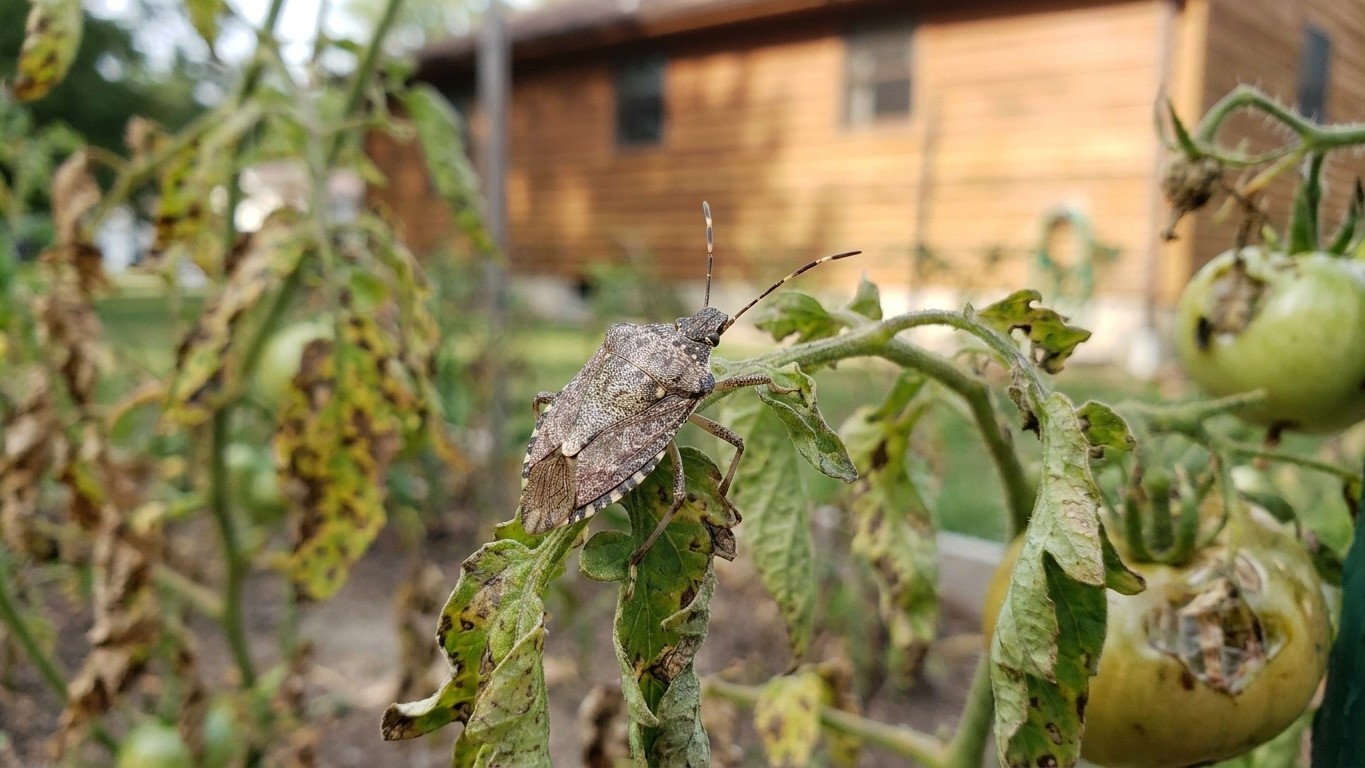

The brown marmorated stink bug (Halyomorpha halys) is an invasive insect that pierces fruit, vegetables, and ornamental plants with a needle-like mouth, leaving discolored, pitted flesh behind. It isn’t native to North America and has spread across a wide swath of the country since it first showed up. Most homeowners never clock it in the garden until fall, when adults cluster on warm siding and slip indoors to spend the winter. That indoor invasion, more than the crop damage, is what made this insect a household name.
What it is and what it attacks

The name comes from the insect’s shield-shaped body, marbled in shades of brown, gray, and copper (the “marmorated” part refers to that mottled, marble-like pattern). It belongs to the stink bug family and, true to form, releases a sharp odor when crushed or threatened. Originally from East Asia, it turned up in the mid-Atlantic in the 1990s, likely as a hitchhiker in shipping cargo, and has since expanded its range far beyond that first foothold.
What sets it apart from native stink bugs isn’t just appearance. It feeds on an unusually broad menu: tree fruit like apple and peach, vegetables including tomato, pepper, and sweet corn, soybean fields, and a long list of ornamental shrubs and hardwood trees. A single orchard or backyard garden can host it at nearly every stage of the season, because it doesn’t specialize the way many pests do. That flexibility, feeding on whatever is available as one crop finishes and another starts, is part of why populations have been hard to predict from one year to the next.
This page works as a starting point for three questions that deserve their own answers. What does the damage actually look like on fruit and leaves, and how do you tell it apart from cosmetic issues or other insects? When does it move through its life stages, and why does that calendar shift depending on where you live? And what actually reduces numbers, as opposed to what just kills the bugs you can see today? The sections below summarize each of those, with links to the fuller pages for anyone dealing with an active problem right now.
One more thing worth knowing upfront: this insect doesn’t reproduce or cause damage indoors. Bugs that get into a house in October are looking for shelter, not a way to breed in your walls or feed on your houseplants. Understanding that distinction changes how you approach control, since the fall invasion and the summer crop damage call for different tactics entirely.
Recognizing it
Feeding damage shows up as small, discolored, sometimes sunken spots on fruit skin, a condition often called “cat-facing” on peaches and apples because of the puckered scarring left behind. On leaves, feeding can cause stippling or localized dead patches. None of this is exclusive to the brown marmorated stink bug, though, which is why identifying the insect itself matters more than reading the damage alone. The damage page walks through what this feeding pattern looks like crop by crop and how to separate it from other causes like sunscald or hail.
Identification comes down to a few reliable markers. The adult has alternating light and dark bands on the last two antennal segments, and the exposed edges of the abdomen show a similar black-and-white banded pattern beneath the wings. Several look-alikes get confused with it constantly, especially indoors in autumn.
| Insect | Key feature | How it differs |
|---|---|---|
| Brown marmorated stink bug | Banded antennae, marbled brown shield | Broadly mottled coloring, banded abdomen edge |
| Western conifer seed bug | Flattened, leaf-like hind legs | Longer, narrower body, no marbling |
| Boxelder bug | Black body with red-orange lines | No shield shape, no marbling |
| Native brown stink bug | Smooth, uniform brown shield | No antennal banding, less mottled |
Nymphs are easy to misjudge, too, since they don’t resemble the adult at all early on. Young nymphs are nearly black with red or orange markings, gradually taking on the mottled brown coloring as they molt through several stages. Finding clusters of these on a wall or windowsill in midsummer is a sign of local breeding nearby, not an indoor infestation, since egg-laying and development happen outdoors on host plants.
When it appears
The species runs through one generation per year across much of its range, though warmer regions can support a partial second generation. Adults emerge from overwintering sites in spring, mate, and the females lay clusters of pale, barrel-shaped eggs on the undersides of leaves. Nymphs pass through five stages before reaching adulthood, feeding throughout the summer as they go. As days shorten in fall, adults stop feeding, stop reproducing, and start searching for tight, dry, sheltered spaces, which is when they show up on siding, in attics, and around window frames.
That calendar isn’t fixed nationally, and treating it as one is where a lot of homeowners and growers go wrong. Spring emergence, egg-laying windows, and the point at which nymph populations peak all shift with regional climate, and even shift year to year within the same state depending on how warm the spring was. A grower in one part of the country might see peak nymph activity weeks apart from a grower one state over. The life cycle page breaks down each stage in more detail and explains why monitoring, not a fixed date on a calendar, is the only reliable way to track where a local population stands.
This is also the reason extension services matter so much for this particular pest. University entomologists track degree-day accumulation and trap catches specific to their state, and they update guidance as conditions change through the season. A national average emergence date would be close to meaningless for someone deciding when to act, since it would be wrong for most of the country most years.
What works
Timing beats almost everything else with this insect. Because feeding damage accumulates over a long season and because chemical controls (where used) only work within specific windows tied to nymph activity, acting on a schedule set by a local extension office produces far better results than a calendar guess. That’s true for backyard gardeners and commercial growers alike.
Physical barriers do real work outside of any spray schedule. Fine-mesh exclusion netting over vulnerable fruit trees or garden beds keeps adults and nymphs off the plant entirely during the highest-risk weeks. Around the house, sealing gaps in siding, around utility penetrations, and along window and door frames before fall migration begins is the single most effective step against the indoor invasion, since it stops entry rather than trying to manage bugs after they’re already inside.
Natural enemies are the piece most homeowners overlook, and they matter more than people assume. The samurai wasp (Trissolcus japonicus), a tiny parasitoid that lays its own eggs inside brown marmorated stink bug eggs, has established on its own in a number of states following research releases, and it’s now considered the most promising long-term check on populations in the areas where it has taken hold. Protecting it means avoiding broad-spectrum insecticide applications during egg-laying periods whenever possible, since those treatments hit the wasp along with the target pest. General predators like spiders and ground beetles also take a share of eggs and young nymphs, though their impact is smaller and less consistent.
The control page covers monitoring tools, exclusion techniques, and how biological control fits into a season-long plan in more depth. Because emergence timing and recommended action windows vary so much by region, the most useful next step is checking this site’s page for your own state, which links directly to your local extension service’s current guidance.
Common questions
Does the brown marmorated stink bug bite people or pets?
No. It has piercing mouthparts built for feeding on plant tissue, not for biting animals. The main nuisance is the odor it releases when handled or crushed, along with the sheer number that can gather indoors in fall.
Will it reproduce inside my house over the winter?
No. Adults that come indoors in autumn are seeking shelter, not a breeding site. They go dormant and typically become active again in late winter or early spring, at which point they try to find their way back outside, sometimes ending up in living spaces instead.
Is the brown marmorated stink bug found in every state?
It has spread widely since its introduction and is established in a large number of states, though population density and how much of a nuisance it presents vary a lot by region and even by county. Checking a local territory page or extension service is the best way to know current status nearby.
Do store-bought traps get rid of an infestation?
Pheromone traps are useful for monitoring how active a local population is, which helps with timing other control steps. They aren’t strong enough on their own to meaningfully reduce numbers around a home or in a garden, since they attract only a fraction of the bugs present in the area.