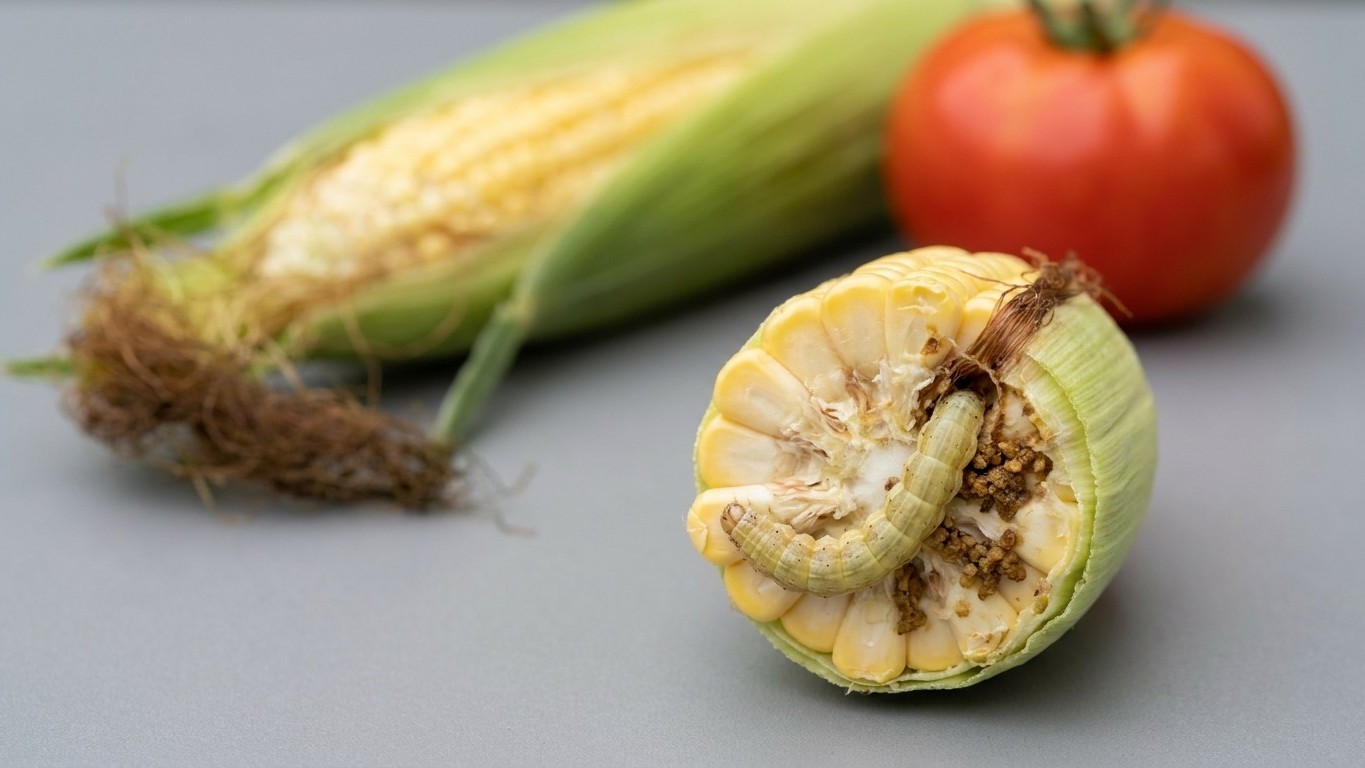

Corn earworm (Helicoverpa zea) is the caterpillar stage of a moth that tunnels into the tip of a corn ear or the shoulder of a tomato fruit and feeds from the inside out. Because the larva enters through the silk channel or the stem scar, you won’t see a mark on the husk or skin until you cut into the crop. That single fact drives everything else about spotting it, timing a response, and choosing a control that actually pays off.
What it is and what it attacks

The moth lays a single egg on fresh corn silk or on the calyx of a ripening tomato. Within days a tiny larva hatches and, on corn, crawls straight down the silk channel toward the kernels at the tip of the ear. On tomatoes, it bores in near the stem end, often before the fruit even shows color. That entry point matters more than people realize: the silk or the stem scar hides the hole, so a grower walking the rows sees nothing wrong. The first visible clue usually shows up only after harvest, when the husk comes off or the fruit is sliced.
Sweet corn and tomatoes are the two hosts homeowners run into most, but the same species also feeds on field corn, peppers, green beans, and cotton, where it’s known regionally as the cotton bollworm. It’s present across nearly every corn-growing region of the country, though pressure and generation count shift with climate. Southern states can see several overlapping generations in a single season; northern growers may deal with just one or two waves tied to moth migration from warmer regions each spring.
Questions this pest raises, and where the answers live
Once you know what the insect is and where it hides, three practical questions follow. First: what does the damage actually look like, and how do you tell it apart from other caterpillars doing similar things to the same plants? That comparison, including the frass patterns and kernel-chewing signatures that separate corn earworm from fall armyworm and European corn borer, is covered on this site’s damage and identification page.
Second: when does it actually show up in your area, and how many generations should you expect to defend against? Moth flights, egg-laying windows, and generation counts are tracked by degree-day models that differ by state, and the full mechanics of the life cycle are laid out on the life-cycle page.
Third: what actually reduces damage, versus what just adds cost without changing the outcome? That’s the subject of the control page, which walks through timing, physical barriers, and the natural enemies worth protecting.
Recognizing it
The signs concentrate at the tip of the ear: chewed kernels, a trail of moist greenish-brown frass packed into the silk channel, and sometimes the larva itself, which ranges from pale yellow to green to a dark reddish-brown depending on its age and diet. Corn earworm is territorial in a way that actually limits damage. Larvae are cannibalistic, so it’s common to find just one caterpillar per ear even though several eggs were laid on the same silk mass. On tomatoes, the entry hole near the stem is often small and easy to miss until the fruit is picked and the rot sets in around the feeding tunnel.
The trouble is that two other common caterpillars leave damage that looks similar at a glance. Fall armyworm feeds on corn whorls and ears with a comparable chewing pattern, and European corn borer tunnels into stalks and ear shanks rather than just the tip. Telling them apart matters because the timing of their damage, and the point in the season when protection actually helps, isn’t the same for all three. The damage and identification page lines up the frass color, larval markings, and feeding location side by side so a grower staring at a chewed ear can narrow it down quickly rather than guessing.
One detail worth flagging here: absence of visible larvae doesn’t mean absence of damage. A larva that’s already pupated and left the ear, or one that was eaten by a sibling, leaves behind chewed kernels and frass with no insect in sight. Judging the pest only by whether you can find a live caterpillar undercounts the actual pressure in a given planting.
When it appears
Corn earworm doesn’t overwinter reliably in cold climates. In much of the northern half of the country, the pupae can’t survive winter soil temperatures, so each season’s population arrives by moth migration from warmer regions to the south, riding wind currents that can carry them hundreds of miles in a few nights. Farther south, where soil stays warm enough, the insect overwinters as a pupa and emerges locally each spring, which is one reason pressure is heavier and more continuous in those states.
From egg to adult moth takes roughly a month under warm conditions, and a single season can run through anywhere from one generation in the far north to several overlapping generations in the Gulf states. That range is exactly why a planting calendar or spray-timing chart written for one state can be useless, or actively misleading, in another. Extension services track moth flights with pheromone traps and translate accumulated heat units into degree-day models that predict when eggs are being laid on silk in a given county, week by week.
The practical upshot is that the single most useful thing a home gardener or small-scale grower can do is stop treating “corn earworm season” as a fixed calendar date and start treating it as a moving target tied to local heat accumulation and moth activity. The life-cycle page breaks down each stage, from egg to larva to pupa to moth, and explains how the timing shifts by region and by planting date within a single state.
What works
Timing beats almost everything else with this pest, because the egg and newly-hatched larva stage on fresh silk is the only point where a treatment or barrier actually reaches the insect before it disappears into the ear. Once a larva is a few days into feeding at the tip, it’s protected by husk and kernel tissue, and most interventions stop mattering. That’s why extension guidance for corn earworm centers on scouting during the silking stage and matching any action to local degree-day thresholds rather than a fixed date on the calendar.
Physical barriers matter too. Hybrid corn varieties with tight husk coverage and long husk extension past the ear tip physically slow larval entry, and a small dab of mineral oil applied to the silk channel shortly after pollination can smother eggs and young larvae before they tunnel in, a tactic still recommended by several university extension programs for home gardens. On tomatoes, row covers during the egg-laying window keep moths from reaching fruit in the first place.
Biological control is worth taking seriously here, not as a consolation prize but as a real lever. Tiny parasitic Trichogramma wasps lay their own eggs inside corn earworm eggs, killing them before a larva ever hatches. Minute pirate bugs (Orius species) and lacewing larvae both prey on eggs and newly hatched caterpillars in the field. All three are wiped out fast by broad-spectrum insecticide use, which is one reason heavy spraying can backfire over a season by knocking out the predators that were suppressing the next generation. Leaving flowering border plants nearby, and reserving any treatment for windows when scouting actually shows an active egg-laying flight, protects these allies while still targeting the pest.
The full mechanics, including which barrier methods pair well with which planting scale, are on the control page. Because emergence dates, degree-day thresholds, and locally permitted products vary by state and change from one growing season to the next, check this site’s page for your own territory, which links directly to your state extension service’s current guidance.
Common questions
Can corn earworm damage be prevented completely?
No. Even well-timed barriers and biological control reduce damage rather than eliminate it, because moths can arrive in waves and a missed egg-laying flight will still produce some infested ears or fruit. The goal for most home growers is keeping damage below a level that affects the usable harvest, not achieving a zero-damage crop.
Is it safe to eat corn or tomatoes with earworm damage?
The damaged tip or feeding tunnel simply gets cut away before cooking or eating; the rest of the ear or fruit is unaffected. Most home gardeners who grow their own sweet corn deal with some tip damage most seasons and just trim it off.
Does corn earworm attack anything besides corn and tomatoes?
Yes. The same species feeds on peppers, green beans, and cotton, where it’s called the cotton bollworm, and it will move between these hosts within a single garden or field depending on what’s flowering or fruiting at the time.
Why does my neighbor in a different state deal with corn earworm on a different schedule than I do?
Because the insect doesn’t overwinter the same way everywhere. Southern states often have local overwintering populations and multiple overlapping generations, while northern regions depend on moths migrating in each spring, which pushes peak pressure later and compresses it into fewer generations.