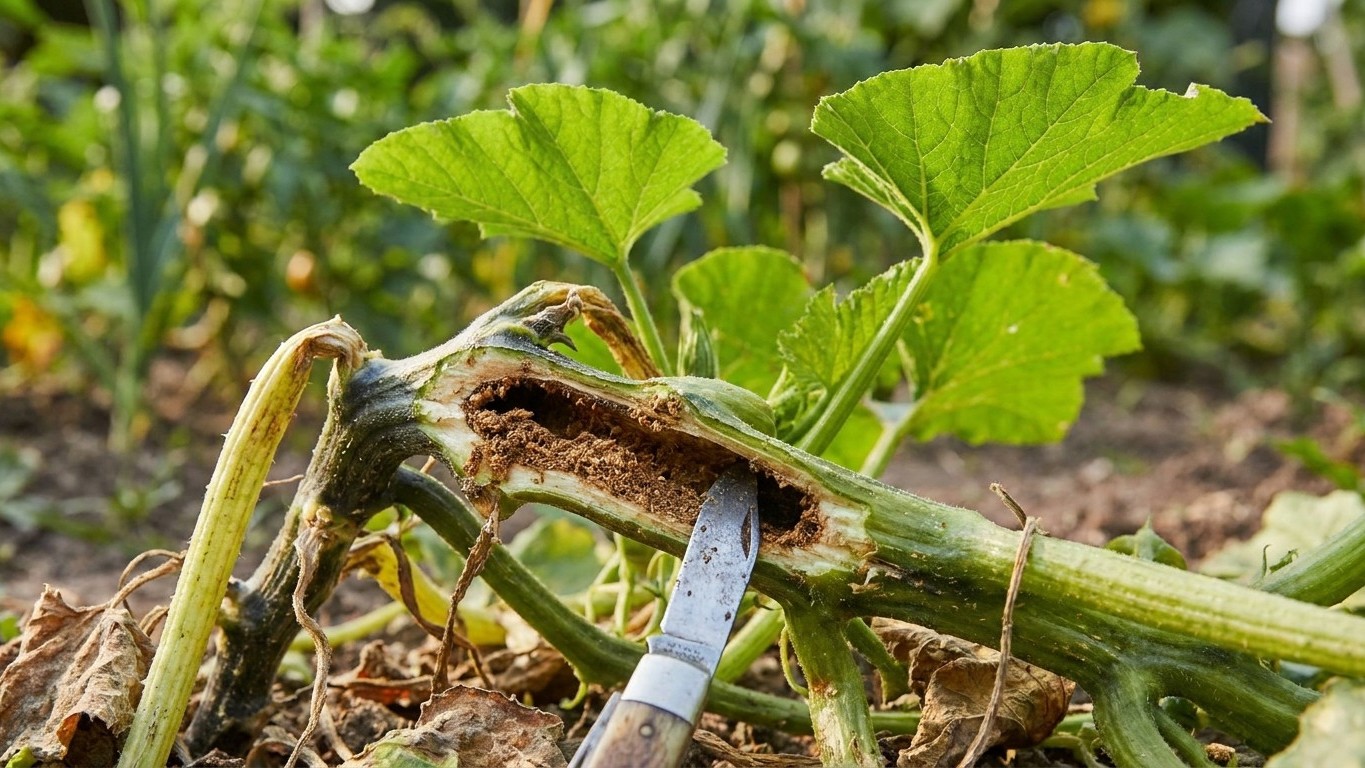

Squash vine borer (Melittia cucurbitae) is the larva of a day-flying moth that tunnels inside squash and pumpkin stems, cutting off water to the plant. The telltale sign is a vine that collapses seemingly overnight while its leaves still look green and healthy. It’s found across most of the continental United States, and the exact timing of attack, the best control window, and which look-alike problems get confused with it all depend on where you garden.
What it is and what it attacks

The name gives away the habit: this insect doesn’t chew leaves or skeletonize foliage the way many garden pests do. It feeds inside the stem, hollowing out the base of the plant from the inside while the surface looks almost normal. That’s the single fact that trips up more gardeners than anything else, because by the time the damage is visible from outside, the larva has often already done most of its work.
Its preferred hosts are members of the cucurbit family, with a clear hierarchy of risk. Summer squash and winter squash (particularly hubbard and other thick-stemmed varieties) are highly attractive. Pumpkins get hit hard too, especially in the weeks after fruit set when vines are sprawling and stems are thickening. Cucumbers and melons are occasionally attacked but far less often, likely because their stems are thinner and less appealing to an egg-laying female moth looking for a place to insert her larvae.
The adult is a moth, not the drab gray kind most people picture. It flies during the day, has an orange abdomen with black markings, and is often mistaken for a wasp when it’s spotted hovering near the base of a plant. That daytime activity matters for detection: if you’re scouting at dusk expecting a typical moth, you’ll miss it. The female lays eggs individually at the base of stems, near the soil line, and it’s that narrow window between egg and tunneling larva where control has any real chance of working.
Three separate questions come up once a gardener suspects this pest, and each one gets its own full treatment elsewhere on this site. First: how do you actually confirm it’s squash vine borer and not something else causing the same wilt? That’s covered in detail on the squash vine borer damage page, which walks through the visual signs step by step. Second: when does this insect actually show up, and why does that answer change depending on where you live? The squash vine borer life cycle page breaks down the stages and the regional variation behind them. Third: what actually reduces losses, and what’s a waste of time? That’s the focus of the squash vine borer control page. This page ties those three pieces together and points you toward whichever one answers your immediate question.
Recognizing it
Wilting is the symptom that sends most gardeners searching, but wilting by itself doesn’t confirm anything. A squash plant can wilt from drought stress, from squash bugs feeding on the stem’s surface, from bacterial wilt spread by cucumber beetles, or from simple transplant shock. What separates squash vine borer damage from the rest is a combination of clues at the base of the plant: a small entry hole near the soil line, often with a sawdust-like frass pushed out of it, and stems that feel hollow or mushy when pressed near that entry point. Cutting open a suspect stem lengthwise usually settles the question outright, revealing tunneling and sometimes the cream-colored larva itself.
The look-alikes matter because the response is different for each one. Bacterial wilt, for instance, has a simple field test: cut the stem and slowly pull the two halves apart, and if you see thin strands of milky sap stretching between them, that’s bacteria, not a borer. Squash bugs cause a different kind of collapse, usually starting at the leaf margins and spreading inward, without the hollow-stem symptom. Drought-stressed plants wilt uniformly and recover once watered, while a plant hollowed out by a larva stays wilted no matter how much water goes into the soil, because the plumbing inside the stem is physically destroyed.
One detail worth flagging: a single squash plant can be infested by more than one larva at a time, and older, thicker-stemmed varieties like hubbard squash are more tolerant of an infestation than a slender-stemmed summer squash, simply because there’s more undamaged tissue left to carry water and nutrients. That’s why two plants of different varieties, infested on the same day, can show wildly different timelines to collapse.
Because misidentification leads directly to the wrong response, spending five minutes cutting open a wilted stem before reaching for any control measure is worth the trouble. The full breakdown of entry holes, frass patterns, and how to distinguish this damage from every common look-alike lives on the squash vine borer damage page.
When it appears
The moth doesn’t have a single national emergence date, and that surprises a lot of gardeners who expect a simple calendar answer. Adults emerge from overwintering pupae in the soil once conditions warm enough, then spend a few weeks flying, mating, and laying eggs on stems near the ground. Those eggs hatch into larvae that tunnel in and feed for several weeks before the cycle repeats, sometimes with a second generation later in the season depending on the length of the growing season in a given region.
That regional variation is the whole reason a single national date would be misleading rather than helpful. A garden in the Deep South can see adult moths flying weeks before a garden in the Upper Midwest, and a region with a long enough season can support two full generations while a shorter, cooler season only supports one. Extension entomologists track this with degree-day models and pheromone trap counts specific to their state, because a fixed calendar date drifts out of sync with the insect’s actual biology as spring temperatures vary year to year.
This is precisely the kind of detail where guessing costs a harvest. Treating too early wastes effort on a pest that hasn’t emerged yet; treating too late means the larva is already inside the stem and out of reach of anything applied to the surface. The squash vine borer life cycle page lays out each stage in sequence, from overwintering pupa to adult flight to egg-laying to larval tunneling, and explains how to read local signals rather than rely on a fixed date.
Because timing is genuinely regional, this hub links out to territory-specific pages that carry the actual dates and degree-day thresholds tracked by each state’s extension service. That’s the resource worth checking before deciding when to act, rather than any generic seasonal guess.
What works
Timing beats everything else with this pest, and it’s not close. Once a larva is tunneling inside a stem, it’s largely protected from anything sprayed on the plant’s surface. That single fact reorders the entire control conversation: the highest-leverage moment is before eggs hatch, not after wilting starts. Scouting the base of stems regularly during the local flight period, and removing any eggs found stuck to the stem surface, is tedious but genuinely effective because it interrupts the insect before it ever gets protection from the plant tissue.
Physical barriers are the next most reliable tool. Wrapping the base of young stems with a floating row cover, foil, or a nylon stocking during the egg-laying period keeps the female moth from reaching the spot where she’d normally lay eggs. The barrier has to come off before flowering, though, since squash needs pollinator access once it starts to bloom, which means the window for using a barrier is narrower than gardeners often assume.
Natural enemies matter more here than most gardeners realize, but their leverage point is specific: general predators like lady beetles and soldier beetles will feed on squash vine borer eggs before they hatch, and that predation on the exposed egg stage is worth more than anything that happens after the larva has burrowed in and become inaccessible. Parasitic wasps and tachinid flies also attack the earlier life stages to some degree. None of that works if broad-spectrum insecticides wipe out the predator population along with the pest, so preserving those generalist predators, by avoiding unnecessary sprays targeting other insects on the same plants, indirectly protects against this borer too.
Succession planting (staggering sowing dates so some plants are past the vulnerable stem stage when moths are flying) and choosing hardier, thicker-stemmed varieties in heavily infested gardens round out the practical toolkit. Full detail on scouting schedules, barrier materials, and how to salvage a stem after a larva is already found lives on the squash vine borer control page. For the dates and thresholds that actually apply to your garden, check this site’s page for your own state or region, since your local extension service is the authority on when flight actually starts where you live.
Common questions
Can a squash plant recover after squash vine borer damage?
Sometimes, if the infestation is caught early and only a small section of stem is hollowed. Mounding moist soil over the damaged section can encourage the stem to root at additional points, giving the plant a second source of water and nutrients even if the original entry point stays damaged.
Does squash vine borer affect cucumbers and melons the same way it affects squash?
Not to the same degree. Squash and pumpkins are the preferred hosts, and cucumbers and melons are attacked far less frequently, likely because of differences in stem thickness and surface chemistry that make them less attractive to egg-laying females.
Is it worth removing squash vine borer larvae by hand once they’re found inside a stem?
Yes, if you catch it early enough. Slitting the stem lengthwise near the entry hole, removing the larva, and then burying that section of stem in moist soil to encourage rooting can save a plant that would otherwise collapse. It’s a rescue measure, not prevention.
Why do some gardens have squash vine borer every year while neighboring gardens seem unaffected?
Overwintering pupae stay in the soil right where the infested plants grew the previous season, so gardens that don’t rotate cucurbit crops to a new spot each year tend to carry the problem forward. A neighbor rotating plantings or gardening in soil with no recent squash history often sees far less pressure.