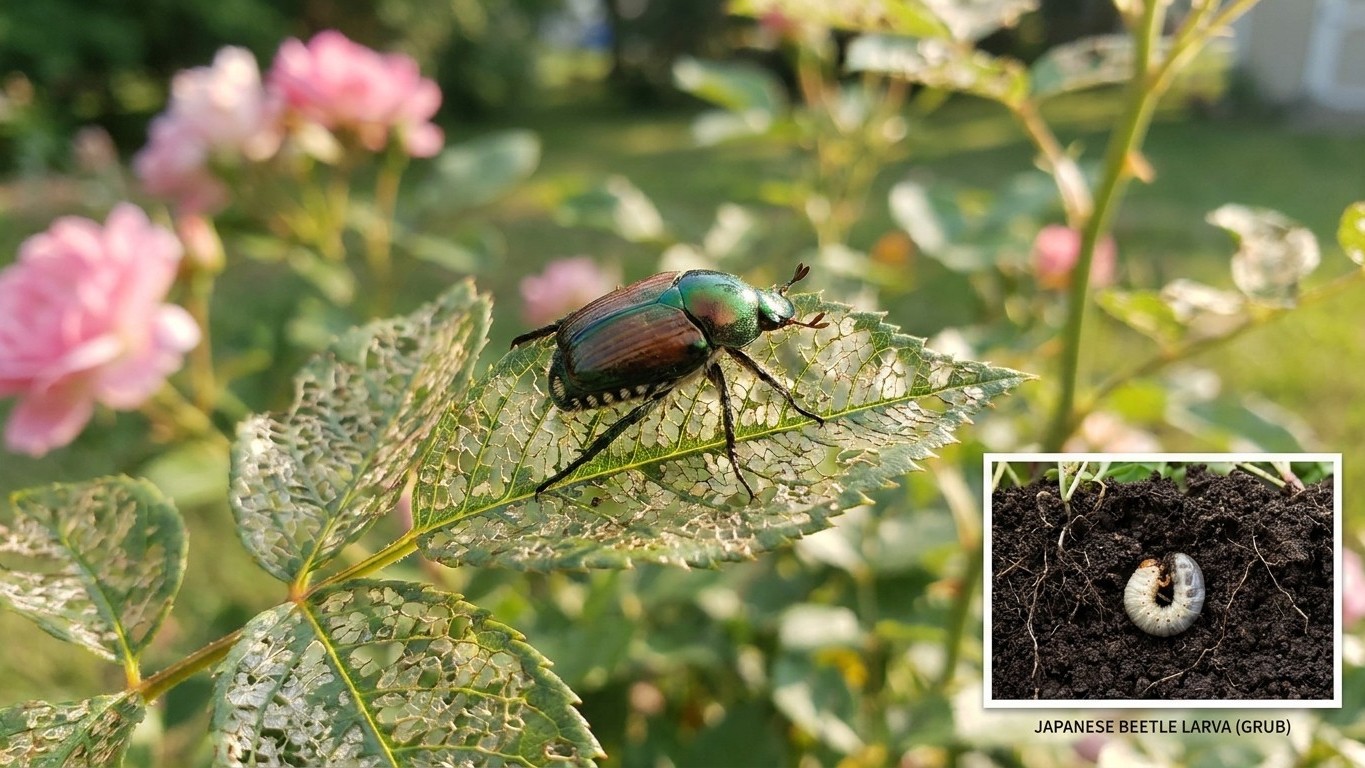

Popillia japonica, the Japanese beetle, is a half-inch, metallic green and copper insect that feeds on more than 300 plant species as an adult while its grub stage chews through lawn roots underground. The adults skeletonize leaves on roses, grapes, beans and fruit trees from early to midsummer; the grubs damage turf from late summer through fall. Because the two life stages attack completely different things, control decisions depend on which stage you’re actually seeing.
What it is and what it attacks

The Japanese beetle arrived in the United States over a century ago and has since spread across most of the eastern and midwestern states, with populations now established as far west as parts of Colorado and Oregon. It didn’t evolve alongside American plants, which is part of why it causes so much damage here compared to its native range in Japan, where natural predators and competing insects keep it in check.
Adults emerge from soil in summer and feed in groups, which is why damage often looks concentrated on a handful of plants rather than spread evenly across a yard. They favor roses, grapes, linden trees, crabapples, raspberries and beans, but they’ll also work through birch, elm and rows of vegetable crops. Feeding starts at the top of the plant and works downward, and beetles are drawn to sun-warmed foliage, so the sunniest side of a shrub or tree usually shows the worst damage first.
The larval stage, a C-shaped white grub living in soil, is a separate problem entirely. Grubs feed on grass roots from late summer into fall, then again briefly in spring before pupating. A lawn with a heavy grub population can develop spongy, dead patches that pull up like loose carpet, and that damage is often what draws skunks and raccoons digging for a meal.
Because one insect creates two distinct kinds of damage, at two different times of year, the practical questions homeowners ask tend to split the same way. What does the damage actually look like, and how do you tell it apart from other pests? When does each stage show up in your area? And what actually reduces numbers without wasting money or effort? Each of those questions gets its own detailed answer on this site: damage and identification, life cycle and timing, and control methods. The sections below summarize each one.
Recognizing it
Adult Japanese beetles leave a distinctive signature: leaves reduced to a lace-like skeleton of veins, with the soft tissue between them eaten away. This is different from ragged holes or chewed edges caused by many other leaf-feeding insects, and it’s usually the fastest way to confirm what you’re dealing with before you even spot the beetles themselves. Grub damage looks nothing like that. It shows up as irregular brown patches in turf, often in late summer, and a simple tug test tells you a lot: if the grass lifts away in a mat because the roots are gone, grubs are the likely cause.
A few look-alikes cause confusion. The rose chafer, a tan, long-legged beetle, feeds on similar plants and can leave comparable leaf damage, but it lacks the Japanese beetle’s metallic green thorax and copper wing covers. June beetles are larger, duller brown, and mostly nocturnal, so they’re rarely seen feeding in daylight the way Japanese beetles are. Green June beetles are bulkier and fly with an audible buzz, and their grubs tend to surface on the soil at night rather than staying below the root zone.
Distinguishing the beetle from its look-alikes matters because treatment timing and methods aren’t identical across species, and misidentifying the pest usually means wasted effort on the wrong control window. The full breakdown of damage patterns, photos-in-words descriptions of each look-alike, and how to confirm a grub infestation without digging up half the lawn lives on the damage and identification page. That page is the right next stop for anyone who has already spotted skeletonized leaves or dead turf patches and wants to confirm the cause before doing anything else.
When it appears
Japanese beetle timing follows a fairly predictable arc within a given region, but the calendar dates shift considerably depending on where you live. Adults typically emerge from soil once it warms into the mid-60s at a few inches depth, feed and mate for several weeks, then the females lay eggs in turf through midsummer. Grubs hatch, feed on roots into fall, move deeper to overwinter below the frost line, then return near the surface in spring to resume feeding briefly before pupating into the next generation of adults.
That single-generation-per-year pattern holds across most of the country, but the actual emergence window can differ by a month or more between a southern state and a northern one, and even between two spots in the same state depending on elevation, soil temperature and the previous winter’s severity. Extension entomologists track this using soil temperature and degree-day accumulation rather than a fixed calendar date, which is exactly why a national “spray by this date” figure doesn’t hold up region to region.
This is also why grub treatments timed for one part of the country can miss the target window entirely somewhere else. A treatment aimed at newly hatched grubs needs to land after egg hatch but before the grubs grow large and move deeper into soil, and that window is a state-specific calculation, not a fixed date on a bag of product. The life cycle page walks through each stage in more detail, and the territory-specific pages on this site point to the appropriate state extension service for the emergence and treatment windows that actually apply where you garden.
What works
Timing is the first lever, and it matters more than the choice of method. Hand-picking adult beetles into a bucket of soapy water works surprisingly well on small plantings, especially in the early morning when beetles are sluggish from the cool overnight temperatures. Physical barriers like fine mesh row covers protect high-value plants such as roses or young fruit trees during the peak feeding weeks, then come off once the adult flight period tapers.
Pheromone traps deserve a specific warning: research from university extension programs has repeatedly found that these traps often attract more beetles into a yard than they capture, effectively making a home’s plants the bait. If a neighbor two doors down runs one of these traps, that’s not a small detail, it can mean a heavier beetle load for everyone nearby.
Natural enemies matter more for this pest than for most turf insects. Istocheta aldrichi, a parasitic fly sometimes called the winsome fly, lays eggs on adult beetles and has established itself in several regions where Japanese beetles have been present for decades, helping suppress local populations over time. Spring tiphiid wasps (Tiphia vernalis and related species) parasitize grubs in the soil. Birds, particularly starlings and grackles, will pull grubs from damaged turf, which is one reason a lawn showing grub damage often shows bird activity first. Preserving these allies mostly comes down to avoiding broad, unnecessary insecticide applications that kill beneficial insects along with the target pest.
Entomopathogenic nematodes and naturally occurring soil bacteria that target grubs are legitimate biological options for lawns, applied when soil moisture and grub stage are right, and both are covered along with barrier and cultural methods on the control page. Because permitted products, action thresholds and timing windows are set by each state, the smartest next step is finding the page on this site for your own territory, which links directly to your state extension service’s current guidance.
Common questions
Do Japanese beetles bite or sting?
No. They have chewing mouthparts built for leaf tissue, not defense, and they pose no threat to people or pets. Any discomfort from handling them is purely from their spiny legs gripping skin, not a bite.
Will Japanese beetles kill an established tree?
Rarely from a single season of feeding. Mature, healthy trees can lose a significant portion of their leaves to skeletonizing and still recover the following year. Repeated heavy defoliation over several consecutive seasons, especially combined with drought stress, is what actually weakens a tree long term.
Why do Japanese beetles show up in some yards and not others?
Soil conditions during the grub stage matter as much as adult plant preferences. Irrigated turf held at consistent moisture through late summer is more attractive to egg-laying females than dry, unwatered lawns, which is part of why well-tended lawns sometimes see heavier grub activity than neglected ones nearby.
Can Japanese beetle grubs damage more than lawns?
Yes. Grubs feed on the roots of many turf and pasture grasses and can also damage roots in vegetable garden beds and container plantings with soil-based mix, though established lawns remain the most commonly affected area because of the large expanse of shallow grass roots available to feed on.