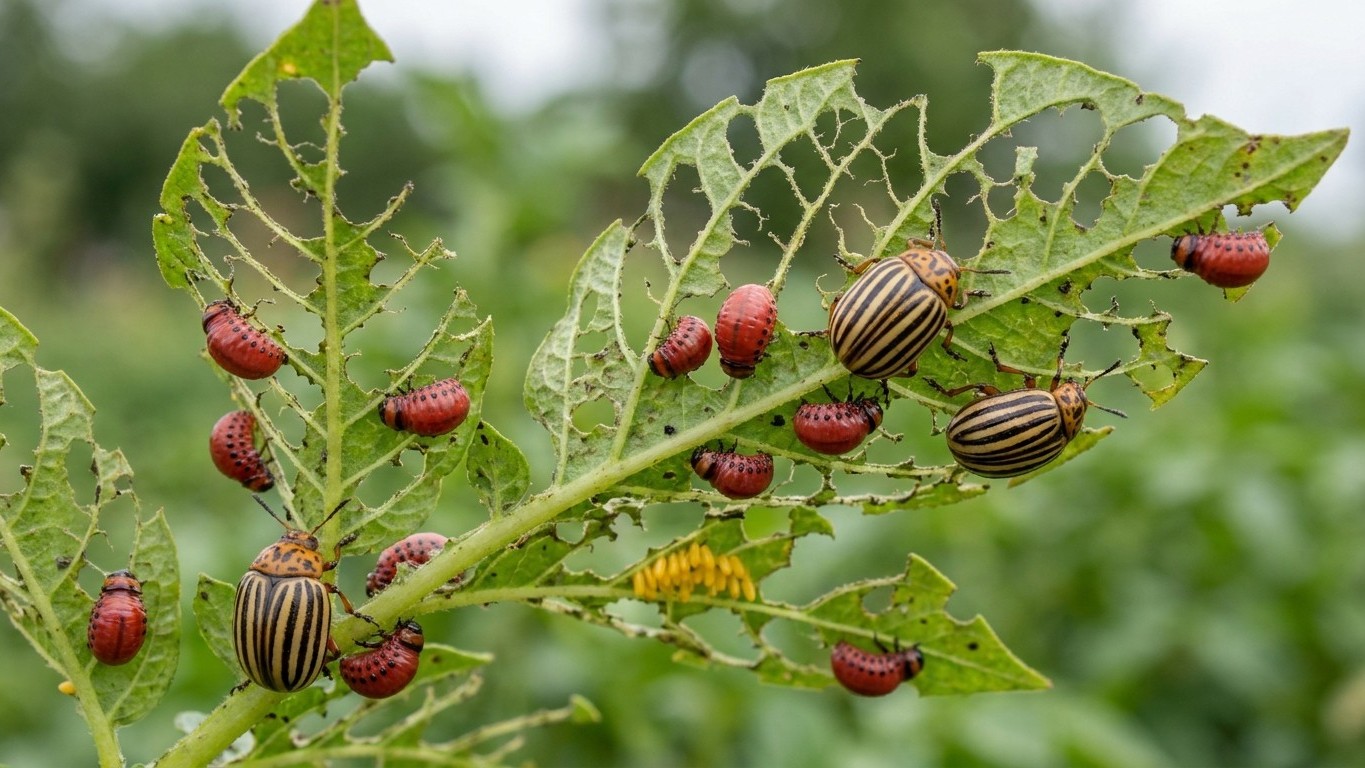

The Colorado potato beetle (Leptinotarsa decemlineata) is the striped beetle stripping your potato plants down to bare stems, often before you’ve noticed anything wrong. Both the adults and their red, humpbacked larvae feed at the same time, on the same plants, which is why an infestation can go from a few chewed leaves to defoliated rows in under two weeks. It’s also one of the most insecticide-resistant insects in North American agriculture, a reputation earned over more than a century of adapting to whatever growers throw at it.
What it is and what it attacks

This beetle isn’t a generalist. Its preferred hosts sit almost entirely in the nightshade family: potato first, eggplant a close second, with tomato and petunia serving as occasional backups when the primary hosts run out. That narrow diet is actually useful information for home gardeners, because it means crop rotation and host separation carry real weight as control tactics, not just theoretical advice.
What sets this species apart from other leaf-eating beetles is the overlap between generations. Adults emerge from the soil in spring, lay eggs, and stick around to keep feeding while their larvae hatch and start eating the same foliage. So on a single plant you might find hard-shelled adults, soft orange larvae, and clusters of yellow eggs all at once, spanning multiple life stages doing damage simultaneously. That overlap compresses the window for effective intervention and is part of why this insect frustrates growers who wait too long to act.
The other defining trait is resistance. Colorado potato beetle populations in parts of the country have developed resistance to multiple classes of insecticides over the decades, a pattern well documented by university entomology programs. This isn’t a pest you spray once and forget. It’s a pest that rewards understanding its biology, because the insects that survive a chemical approach are, by definition, the ones best equipped to survive the next one too.
Three questions tend to follow once a gardener spots this beetle for the first time. What exactly does the damage look like, and how do you tell it apart from other leaf feeders? When during the season does it actually show up, and does that timing shift depending on where you garden? And once you’ve confirmed it, what actually works without just breeding tougher beetles? Each of those gets a dedicated answer elsewhere in this pest library: the damage and identification page, the life cycle page, and the control page all dig into one piece of this puzzle in depth. This page ties the three together.
Recognizing it
The visible damage almost always comes first, before most gardeners even get a clear look at the insect responsible. Leaves get skeletonized from the edges inward, veins left intact while the softer tissue disappears, and in bad infestations entire plants are reduced to bare stalks within days. The adult beetle itself is compact, roughly the size of a pencil eraser, cream to yellow-orange with ten distinct black stripes running down its wing covers, which is where the “decemlineata” in its scientific name comes from. The larvae look nothing like the adults: plump, reddish-orange, humpbacked grubs with rows of black spots along each side, growing larger and more destructive with each molt.
Confusion usually happens with two other beetles that share potato plants or a similar look. The false potato beetle is nearly identical in size and shape but carries a narrow brown stripe down the center of its back that the true Colorado potato beetle lacks. Striped cucumber beetles are sometimes mistaken for it too, but they’re smaller, more elongated, and stick to cucurbits rather than nightshades, which is usually the fastest way to rule them out in the field.
Egg clusters matter for identification as well. They show up on the undersides of leaves in tight groups of a few dozen, bright yellow-orange and easy to miss until you start deliberately flipping foliage to check. Finding eggs before larvae hatch is the single most useful thing a gardener can do, since destroying a cluster removes an entire future generation in one motion.
Because the skeletonized-leaf pattern alone isn’t enough to distinguish this pest from every other chewing insect in a vegetable garden, this site’s damage identification page walks through the visual differences stage by stage, including photos-level detail on egg color, larval instars, and how the feeding pattern changes as larvae mature. That’s the page to check when the beetle itself isn’t visible but the damage clearly is.
When it appears
Timing is where this pest gets genuinely regional, and where generic advice tends to fall apart. Adults overwinter in the soil, usually at the edge of previous potato or eggplant plantings, and emerge in spring once soil temperatures climb past a threshold that varies by climate. In warmer growing regions that emergence can happen weeks earlier than in cooler northern zones, and the number of generations produced in a single season also differs: some areas see one full generation, others see two or more depending on how long the warm season runs.
That variability is precisely why no single calendar date or degree-day number belongs in general advice. Extension entomologists track emergence and generation timing at the state level because local temperature patterns, soil conditions, and even the history of insecticide use in a region all shift when the beetle becomes active and how many overlapping generations show up before frost. A gardener in one state watching for early-season adults might be watching for second-generation larvae just weeks later somewhere with a longer growing season.
Why the overlap complicates monitoring
Because adults, eggs, larvae, and pupae can all be present on the same planting within a short stretch, monitoring has to be ongoing rather than a single spring check. Missing the adult emergence window doesn’t mean the threat has passed. It usually just means the next stage, egg-laying, is already underway.
The life cycle page on this site breaks down each stage in detail, from how long beetles survive underground over winter to how larval development speeds up or slows down with temperature. It also explains how to find your state’s extension-service guidance for local emergence timing and generation counts, since that’s the only reliable source for a number specific enough to act on.
What works
Timing beats reaction every time with this insect. Because the resistant survivors of any control effort pass that resistance to the next generation, the most durable approach starts before damage appears: scouting the undersides of leaves for egg clusters early in the season, checking known overwintering sites near last year’s nightshade plantings, and removing adults and eggs by hand while populations are still small enough to manage that way.
Physical barriers do real work here too. Row covers placed over young potato and eggplant plants before beetles emerge from the soil can block the first wave of colonization entirely, especially useful in home gardens where a few dozen square feet of cover is manageable. Deep straw mulch has also shown some value in interfering with adult movement between the soil and the plant.
Natural enemies matter more for this beetle than for many garden pests, and they’re worth actively protecting rather than treating as background noise. Several predatory insects, including certain ground beetles and stink bug species, along with parasitic wasps that attack the beetle’s eggs and larvae, can meaningfully suppress populations in gardens that aren’t regularly disrupted by broad-spectrum treatments. Preserving these predators, by avoiding unnecessary chemical applications and maintaining some undisturbed ground cover nearby, often does more for long-term control than any single spray.
Rotating potato and eggplant plantings away from the previous year’s site, ideally by a meaningful distance rather than just shifting a few feet within the same bed, delays the beetle’s ability to find host plants after overwintering. Combined with early hand removal and preserved natural enemies, rotation forms the backbone of an approach that doesn’t rely on chemistry the beetle has likely already adapted to somewhere in the country.
Because actual timing windows, degree-day thresholds, and locally permitted control options vary so much by state, this site’s control page goes deeper into sequencing these tactics, and links out to state extension services for the specific numbers that apply where you garden. Find your territory’s page in this pest library for the emergence dates and thresholds tracked by your local extension service.
Common questions
Does the Colorado potato beetle only attack potatoes?
No. Eggplant is a close second host, and tomato or petunia can serve as occasional backup food sources when preferred hosts aren’t available, though damage on those plants tends to be lighter.
Why doesn’t spraying seem to work anymore?
Populations of this beetle have developed resistance to multiple insecticide classes in various regions over decades of use, a well-documented pattern in university research. Survivors of any chemical treatment tend to be the most resistant individuals, and they pass that trait on, which is why rotation, monitoring, hand removal, and natural enemies carry more long-term weight than repeated spraying.
How many generations show up in a single season?
It depends entirely on the region and the length of the local growing season, ranging from one generation in cooler areas to multiple overlapping generations where warm weather persists longer. State extension services track this locally since it shifts year to year with temperature.
What’s the easiest way to tell it apart from the false potato beetle?
Check the center of the wing covers. The false potato beetle carries a narrow brown stripe down the middle of its back that the true Colorado potato beetle doesn’t have, even though the two are otherwise similar in size, shape, and the ten dark stripes along their sides.