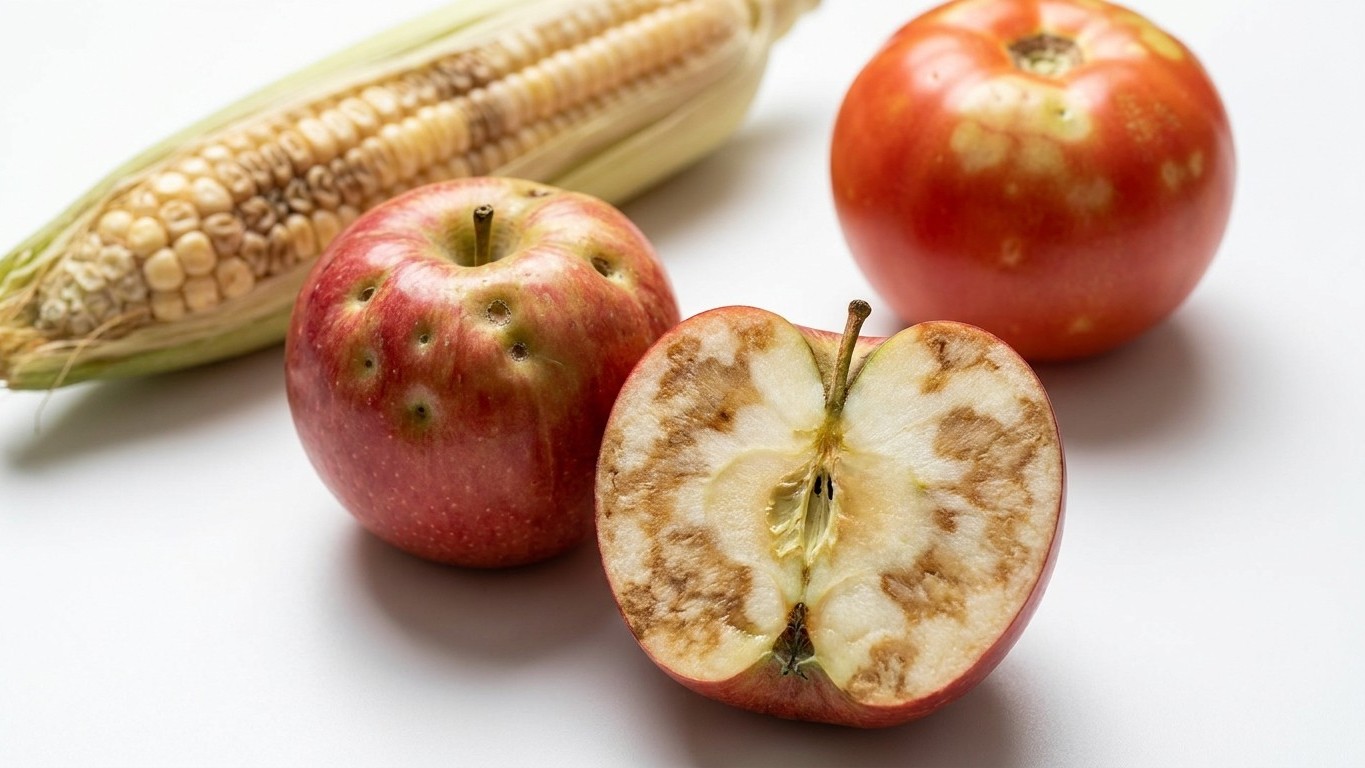

Brown marmorated stink bug damage shows up as sunken, discolored patches on fruit skin, cloudy or corky flesh underneath, and misshapen pods or kernels on vegetables and field crops. The insect (Halyomorpha halys) doesn’t chew leaves into holes; it pierces fruit and seeds with a needle-like mouthpart and feeds from the inside, so the surface often looks fine at a glance while the tissue underneath has already turned to mush or cork.
What the damage looks like

Stand back from the tree or the vine first, because that’s how most people actually notice something is off. Fruit clusters look dimpled, like they’ve been lightly pressed with a thumb in a dozen random spots. On a tomato plant, you might see fruit that ripens unevenly, with pale or yellow blotches that never turn red even after the rest of the fruit is ripe. On corn, whole sections of the ear can look shrunken or twisted compared to neighboring rows.
Move closer and the picture sharpens. Each feeding site is a small, slightly sunken dimple, often with a pinprick mark at the center where the mouthpart entered. On apples and peaches these dimples cluster near the stem end or the shoulder of the fruit, and the skin around them can pucker or crack slightly as the fruit keeps growing around the damaged spot. On peppers, the exterior might show almost nothing, which is part of what makes this pest frustrating to catch early.
Cut the fruit open and the real damage is obvious. Underneath each dimple there’s a cloudy, cottony, or corky area of dead tissue, sometimes brown, sometimes a dull white that looks nothing like healthy flesh. On stone fruit, this shows up as a dry, mealy pocket. On beans and soybeans, feeding on the pod can abort the seed inside entirely or leave it shriveled and discolored, which is why row-crop growers pay attention to pod feeding more than leaf condition.
The autumn giveaway
One trait sets this species apart from most other fruit and vegetable pests: it comes indoors. As temperatures drop in fall, adults look for cracks around windows, siding, and attic vents to spend the winter, and homeowners often find dozens or hundreds clustered on sunny exterior walls before they ever connect that insect to the pitted fruit from the summer garden. That indoor swarming is usually how people first learn what the bug looks like, which is backwards from how the damage was actually done months earlier in the orchard or garden bed.
What it is confused with
Pitted, corky fruit has more than one possible cause, and guessing wrong sends gardeners toward a fix that does nothing. The most common wrong diagnosis is blaming a fungal disease, since corky internal flesh can resemble certain rots, which leads some growers to spray a fungicide on a problem that no fungicide will touch. Another frequent mix-up is with other true bugs that also pierce fruit, and a third is dismissing the damage as ordinary hail or wind scarring.
| Could be confused with | How to tell them apart | Why the mix-up matters |
|---|---|---|
| Fungal fruit rot | Rot usually spreads from one point outward with a soft, wet margin and often visible mold; stink bug damage is a cluster of separate small dimples, each with a distinct dry, corky core and no fuzzy growth. | Fungicide sprays do nothing for insect feeding and waste a treatment window while the actual pest keeps feeding. |
| Other plant bugs (tarnished plant bug, squash bug) | Look at the insect itself, not just the damage: the marmorated stink bug is shield-shaped, mottled brown-gray, with alternating light and dark bands on the antennae and the edge of the abdomen. Other bugs lack that banded antenna pattern. | Some control timing and biological controls differ by species, so treating for the wrong bug can miss the actual population driving the injury. |
| Hail or wind scarring | Weather scarring tends to follow the exposed side of the fruit facing the storm and looks like scattered scratches or scabs; stink bug dimples appear on any side and each one has that internal corky pocket when cut open. | Growers who assume weather damage skip monitoring entirely and miss a building population that will worsen the following season. |
| Native stink bug species | Several native stink bugs cause similar feeding injury but lack the smooth, rounded shoulders and the black-and-white banded antennae of the marmorated species, and they rarely gather on house exteriors in fall. | Confusing the species doesn’t change the damage type much, but it does affect which natural enemies and regional advisories apply. |
The fall indoor clustering itself gets misread too. Homeowners sometimes assume the insects gathering on siding are a home-invading ant or beetle problem and reach for a general indoor insecticide, when the far more useful step is sealing entry points and identifying the insect correctly first, since that same population is what fed on the garden a few months earlier.
Where to look to confirm
Confirming this pest means checking the fruit itself, not just scanning leaves. Start at the point where fruit clusters or touches another fruit, a leaf, or a branch, since those contact points are where nymphs and adults tend to settle in and feed undisturbed. On tree fruit, check the shoulder and stem end. On tomatoes and peppers, check the side of the fruit that faces inward toward the plant’s canopy, since that’s typically shadier and less disturbed.
Time of day matters for spotting the insect itself, even though the fruit damage is visible any time. Adults and nymphs are most active and easiest to see during the warmer part of the day, especially mid-morning through late afternoon, when they move around the plant to feed. Early morning, while dew is still on the plant, they tend to sit still on the underside of leaves near the fruit, which is actually a good time to walk the row slowly with a flashlight and check leaf undersides one by one.
What stage to expect and when
Depending on the point in the season, you’ll find different life stages near the damage. Clusters of barrel-shaped eggs, laid in tight rows on the underside of a leaf, mean a new generation is about to start feeding nearby. Small, wingless nymphs with rounder bodies and often reddish or black markings tend to stay close to where they hatched, feeding in small groups. Full-grown adults, the mottled brown shield-shaped insect with banded antennae, are more mobile and range across the whole plant and often into neighboring plants.
Exact emergence dates, degree-day thresholds, and action levels for this pest are set state by state by the university extension service, since timing shifts with regional climate and crop calendar. Rather than relying on a single national number, check the population trend on your own plants over several visits a week or two apart, and use your state’s extension guidance to decide whether what you’re seeing warrants a response.
What to do once you are sure
Once the damage and the insect match up, the next useful step depends on where that population sits in its yearly cycle, which is exactly what this site’s life-cycle page for the brown marmorated stink bug lays out season by season, from egg-laying through the fall move indoors. Timing a response to the wrong stage, spraying adults after they’ve already fed and moved on, for instance, wastes effort that would matter more a few weeks earlier or later.
Biological control is worth understanding here because it genuinely changes outcomes for this species. The samurai wasp (Trissolcus japonicus), a tiny parasitoid that lays its own eggs inside stink bug egg masses, has established in a number of regions and can meaningfully reduce populations over a season without any spraying at all. Preserving that benefit means avoiding broad-spectrum insecticide applications right when egg masses are present, since those sprays kill the parasitoid along with the pest it targets. Birds and some general predators, including certain spiders and predatory stink bugs, also take a share of nymphs, though the samurai wasp is the natural enemy most closely tied to actually suppressing this specific species.
For the practical side of control, timing sprays, physical exclusion for the fall indoor invasion, and trap options, the control page in this cluster covers what actually works and what doesn’t. And because emergence dates, degree-day thresholds, and legal product options are set at the state level, the most useful next click is this site’s page for your own territory, where the relevant state extension service is named directly so you’re working from guidance calibrated to your actual growing season rather than a generic national timeline.
Common questions
Does brown marmorated stink bug damage always come with visible insects on the plant?
Not necessarily. Adults and nymphs feed and move on, so you’ll often find the pitted fruit without an insect nearby. Checking leaf undersides near damaged fruit and looking at different times of day improves the odds of catching them in the act.
Can damaged fruit still be eaten?
The corky feeding sites are unappetizing and can be cut away, and the damage itself isn’t a food-safety hazard in the way rot or mold can be. Fruit with heavy internal corking is generally not worth saving for fresh eating, but affected areas can simply be trimmed off.
Why do I only notice this pest in the fall, even though the fruit damage happened in summer?
Because that’s when adults move from feeding sites into structures looking for winter shelter. The population that clusters on your siding in October is the same one that pierced your tomatoes and peppers in July and August.
Is a single dimpled fruit a sign of a serious infestation?
Not on its own. A few scattered dimples can reflect light, incidental feeding. What matters more is the trend across repeated checks over a couple of weeks, which is why extension services base action levels on monitoring over time rather than a one-time count.