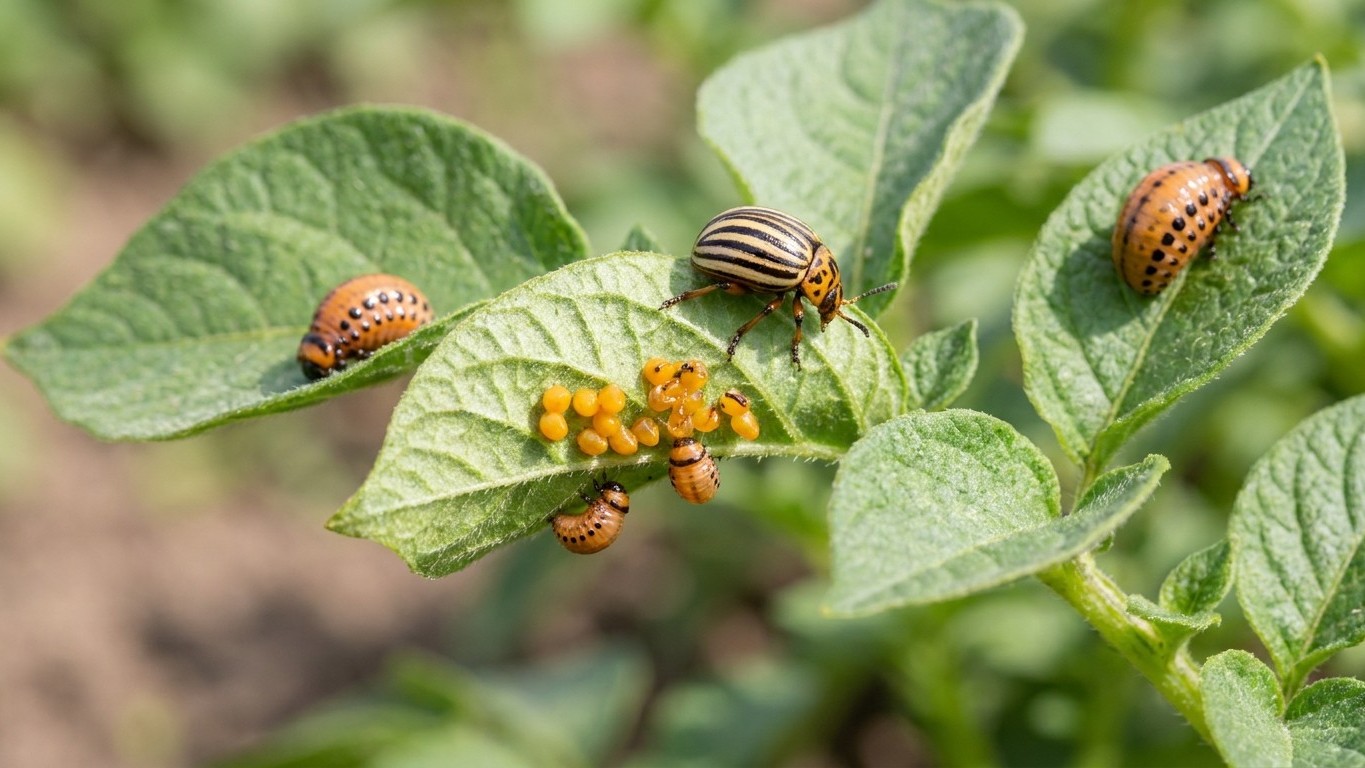

Colorado potato beetle control works when three things happen together: the intervention hits the right life stage, the surrounding habitat still holds natural enemies, and any product used targets small larvae rather than tough adults. Skip any one of those, and even a well-timed spray or a season of hand-picking falls short, because Leptinotarsa decemlineata survives by outlasting mismatched tactics, not by being unusually hardy against a correctly aimed one.
Timing beats product

Here’s what most advice leaves out: with Colorado potato beetle, the calendar matters more than the method. Overwintered adults crawl out of the soil in spring, feed for a stretch, then lay clusters of bright orange-yellow eggs on the undersides of leaves. Those eggs hatch into larvae that molt through four instars, growing from a speck to a fat, humpbacked grub that does most of the season’s real damage. Because generations overlap, a single plant can carry adults, eggs, and larvae of different sizes at the same time by midsummer.
That overlap is exactly why timing decides whether an intervention does anything at all. A treatment aimed at adults does little against eggs already laid. A method built for small larvae is wasted once those larvae have molted into the large, leathery fourth instar that shrugs off far more than young ones do. And hand-picking adults in early spring, before egg-laying peaks, prevents a wave of damage that no amount of later effort fully undoes.
This is also the pest most famous in the entomology world for outlasting insecticides. Populations in various parts of its range have developed resistance to multiple chemical classes over the decades, not because the insect is invincible, but because repeated, poorly timed applications selected for survivors generation after generation. Treating at the wrong stage doesn’t just waste a trip to the garden. It can accelerate that resistance by killing off the susceptible individuals while leaving tougher ones to breed.
None of this can be scheduled from a national calendar. Emergence dates, the length of each instar, and the number of generations in a season depend on local temperature and soil conditions, and they shift from year to year. Before choosing any tactic below, check the Colorado potato beetle life-cycle page for what each stage looks like and roughly when it shows up, because everything that follows in this article only works if it’s aimed at the right moment.
What works without a product
Several tactics control Colorado potato beetle without a single label to read, but each one only works if it’s applied at a specific window, and a few demand real labor.
- Row covers and physical barriers: effective only if installed before overwintered adults emerge and colonize the planting. Once beetles are already on the plants or in the soil beneath the cover, the barrier traps the problem rather than blocking it. Covers need to come off before flowering if the crop needs pollinators.
- Hand removal: the most laborious option, and the most effective one at small scale. Checking undersides of leaves for the orange egg clusters and crushing them, then picking off newly hatched larvae and adults every few days through spring, keeps populations from ever building. It has to be consistent, not occasional, to matter.
- Trap crops: an early-planted strip of potatoes or a related solanaceous plant draws emerging adults away from the main planting. This only pays off if the trap crop goes in ahead of the main crop and if beetles concentrated on it are then physically removed or destroyed, otherwise it simply breeds more beetles in one spot.
- Planting timing: delaying planting until after the peak of adult emergence can reduce the number of beetles that find the crop early, though it trades off against the growing season available to the plant.
- Fall and spring cleanup: removing crop debris and volunteer potato plants after harvest eliminates shelter where adults burrow in for winter. This has to happen at the end of the season, not the following spring, to make a difference.
None of these require identifying a product or a rate, and none of them are dramatic on their own. Stacked together, and timed against the life cycle rather than the calendar on the wall, they routinely keep small plantings under control without a single application.
The allies you already have
Colorado potato beetle has real natural enemies, and a garden or field that still has them rarely needs much else. The spined soldier bug, a predatory stink bug, feeds on larvae. Lady beetles and lacewing larvae take eggs and small first-instar larvae, the same tiny stage that’s most vulnerable to everything. A ground beetle species, Lebia grandis, specifically hunts both eggs and young larvae of this pest and is one of its more consistent predators where populations are allowed to persist. Two parasitoids also matter: the tiny wasp Edovum puttleri lays its own eggs inside beetle eggs, and the tachinid fly Myiopharus doryphorae parasitizes larvae and adults, eventually killing its host.
What keeps these allies around is mostly what you don’t do. Undisturbed ground cover, reduced tillage in field margins, and flowering plants nearby that feed adult parasitoids and predatory insects all help these populations build up season over season. None of them show up overnight. A garden that had none of these predators last year likely won’t have a strong population this year either, which is part of why cultural methods and patience matter early in a new planting.
Here’s the part gardeners often miss: a broad-spectrum insecticide applied against Colorado potato beetle doesn’t only kill the beetle. It kills the spined soldier bugs, the lady beetles, the ground beetles, and the parasitoid wasps in the same pass. Beetles that survive the spray, or that move in from beyond the treated area, then face none of the predation pressure that used to keep them in check. That’s how one spray this month turns into a worse infestation next month, not because the product failed outright, but because it took out the biological control that was quietly doing part of the job. Protecting these allies isn’t a soft add-on to control. For this particular pest, it’s one of the more effective tools available, and it’s free.
When a product is the answer
There’s an honest case for using a targeted product against Colorado potato beetle, and it usually arrives when cultural methods and natural enemies together aren’t holding the population below the point where the crop takes real damage. That’s a judgment call based on how much foliage is being lost and how many plants are affected, not a fixed number that applies everywhere.
The stage matters as much here as it did for every other tactic in this article. Small, early-instar larvae are consistently the most vulnerable point in the life cycle, far more so than hardened adults or the largest fourth-instar larvae. A product applied against a population dominated by big larvae or adults tends to underperform regardless of what’s in it, which is another reason the timing question from the first section of this article comes before any product question, not after.
What can legally be used, and at what rate, is not something this article can responsibly answer in general terms. Permitted active ingredients for Colorado potato beetle differ by state, by crop, and by year, and they change as resistance patterns shift and as products are added or withdrawn from use. A recommendation that’s accurate for one state can be outdated or simply illegal in another. This is also where resistance history matters most: because this insect has developed resistance to multiple product classes in various regions over time, rotating between different modes of action, guided by current local advice, is part of using any product responsibly rather than repeating the same one season after season.
The right source for what’s currently permitted and effective in your area is your state’s Cooperative Extension Service, which tracks local resistance patterns, current action thresholds, and legally registered options. This site carries a dedicated page for finding the guidance specific to your territory, and it links directly to the extension resource that names what’s currently recommended where you live.
Common questions
Does neem oil work on Colorado potato beetle?
It can reduce feeding and interfere with development in young larvae, but it’s inconsistent against later instars and adults, and coverage of the underside of leaves, where beetles feed and eggs are laid, matters more than the product itself.
Can Colorado potato beetle fly?
Yes. Adults are capable fliers and use flight to disperse to new host plants, particularly in spring and when a food source is declining, which is part of why isolated barriers or trap crops need to be paired with removal rather than relied on alone.
What plants deter Colorado potato beetle?
No planting reliably repels it outright, since it’s specifically adapted to potato and related solanaceous plants like tomato and eggplant. Diversifying plantings and avoiding large solid blocks of host crops can slow how quickly beetles locate and concentrate on a planting, but it’s a reduction in pressure, not a barrier.
How many generations does Colorado potato beetle have per year?
More than one is common across much of its range, with generations overlapping as the season progresses, though the exact number and timing depend heavily on local temperatures and season length. Your state extension service tracks this locally and is the most reliable source for what to expect in a given year.