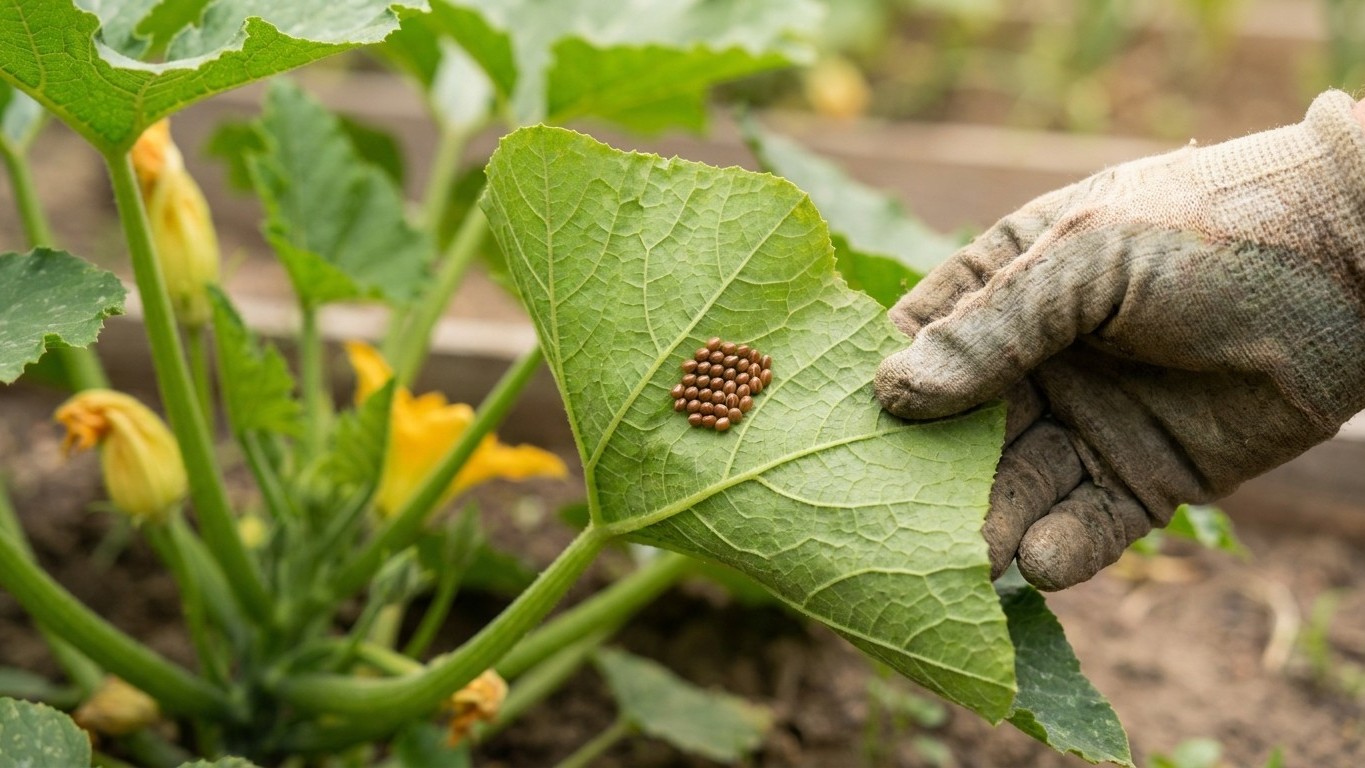

Squash bug control works when it matches the insect’s stage: crushing egg clusters before they hatch, pulling nymphs off leaf undersides while they’re still clumped, and using barriers early enough that adults never find the plant. A single broad spray after wilting starts rarely helps, because by then the damage inside the stem is already done. The fixes that actually move the needle are timing-based, not product-based.
Timing beats product
Here’s what most quick-tip lists skip: Anasa tristis has a life cycle with distinct windows, and missing them means any control effort, chemical or not, lands too late to matter. Adults overwinter in plant debris, mulch, or garden structures, then emerge in spring to mate and lay those distinctive bronze-copper egg clusters on the undersides of squash and pumpkin leaves. Nymphs hatch, feed in groups, and molt through several stages before becoming the flat, shield-shaped adults gardeners usually recognize too late.
This is also where confusion costs people time. Squash bugs get mistaken for stink bugs constantly, and the two aren’t interchangeable targets. Stink bugs are rounder, more mottled, and often feed on a wider range of crops with different piercing patterns; squash bug damage shows up specifically as wilting vines, a symptom sometimes called “anasa wilt,” caused by toxins injected while feeding on stems and leaf veins. Treating for stink bugs when squash bugs are the actual problem wastes effort and lets the real population keep laying eggs.
Before doing anything else, it’s worth checking the squash bug life-cycle page to line up what’s on the plant right now with the calendar stage it represents. Egg clusters that are still bronze and firm haven’t hatched. Ones that look darkened or collapsed already have, and nymphs are likely feeding nearby, out of sight under the leaves.
Why does this matter more than which product someone reaches for? Because egg-stage and early-nymph-stage interventions (removal, crushing, barriers) work with almost no cost and no timing risk. Once nymphs disperse and start hardening into adults, they become harder to kill by any method, and adults are the stage most resistant to contact treatments. A gardener who checks leaf undersides twice a week during egg-laying season will outperform one who sprays reactively after noticing wilted vines, regardless of what’s in the sprayer. The stage you’re looking at determines whether an action does anything at all.
What works without a product
Several tactics control squash bug populations without ever reaching for a pesticide, though none of them are effortless.
- Row covers work best when installed at planting, before adults arrive to lay eggs, and must come off once flowers open so pollinators can reach the blossoms. Left on too late, they trap adults already inside.
- Hand removal means checking the undersides of leaves for egg clusters and scraping them into soapy water, ideally every few days during the laying window. It’s tedious on a large planting, but on a backyard scale it’s often the single most effective habit.
- Trap crops, usually a sacrificial squash or pumpkin variety planted slightly earlier at the garden’s edge, pull egg-laying adults away from the main crop. This only works if the trap planting goes in early enough to be more attractive than the main crop when adults first emerge.
- Staggered or delayed planting can shift a crop’s most vulnerable seedling stage past the peak emergence window, though the timing varies by region and season, which is another reason local extension guidance matters more than a generic calendar date.
- Fall cleanup, removing vines, mulch, and garden debris after harvest, eliminates the overwintering sites adults use to survive winter. Skipping this step is one of the most common reasons a garden sees a worse infestation the following year.
None of these require a label, a mixing ratio, or a re-entry interval. What they require is consistency. Hand removal and cleanup in particular only pay off if they’re repeated rather than done once and forgotten.
The allies you already have
Squash bug populations don’t exist in isolation, and at least one natural enemy is specific enough to this pest that it’s worth knowing by name: the tachinid fly, Trichopoda pennipes. This parasitic fly lays a small white egg on the body of an adult squash bug; the larva then develops inside the host, eventually killing it. Gardeners who look closely at adult squash bugs in midsummer sometimes spot these tiny white eggs attached near the thorax, a sign that biological control is already underway without any intervention.
Beyond that specialist, general predators help keep nymph numbers down. Assassin bugs and various spiders will feed on squash bug nymphs when they find them clustered on leaf undersides, and ground beetles pick off individuals that fall or wander onto soil. None of these predators eliminate an infestation on their own, but they reduce the number of nymphs that survive to become egg-laying adults.
This is exactly where a broad-spectrum insecticide application creates a problem it was meant to solve. A spray that kills squash bug nymphs on contact also kills the tachinid flies, the assassin bugs, and the spiders working the same patch. Those natural enemies have slower reproduction rates than the pest they’re controlling, so when a spray wipes out both sides, the squash bugs typically rebound faster than their predators do. That’s the mechanism behind a familiar garden complaint: someone sprays in June, and by August the infestation looks worse than before they treated anything. It isn’t bad luck. It’s an emptied field with one side reloading faster than the other.
Preserving these allies mostly means restraint: skipping preventive blanket sprays, treating only confirmed active infestations, and choosing the most targeted option available when treatment is genuinely needed. A garden that supports a visible population of assassin bugs or has tachinid flies present most seasons has a built-in check that a heavily sprayed garden simply doesn’t.
When a product is the answer
There’s a legitimate case for a labeled treatment, and it usually shows up when non-chemical methods have already fallen behind: a heavy egg-laying event was missed, nymphs are numerous and still clustered, or a susceptible variety is showing early wilt symptoms on multiple vines. In that situation, timing still governs whether treatment does anything useful. Products aimed at squash bugs work best against young nymphs, while adults are tolerant, which is another reason waiting until adults dominate the population usually means a disappointing result no matter what’s applied.
What can’t be answered generically here is which product, at what concentration, and on what schedule. Permitted active ingredients for home garden use differ by state, get re-evaluated periodically, and sometimes get restricted or pulled entirely in specific territories. A product cleared for use in one state’s extension guidance may carry different restrictions, or none at all, a few states over. Application timing tied to degree-days or local emergence dates also varies by climate zone, so a date that works in one region can be weeks off in another.
This is exactly the gap a state-level extension service is built to fill. These services track regional pest pressure, test which treatments perform under local conditions, and publish current, legally accurate guidance on what’s permitted where a specific gardener lives. Because that guidance changes between seasons as products are reviewed or reformulated, checking it fresh each year, rather than relying on last year’s label or a neighbor’s leftover bottle, is the only way to be sure a treatment is both effective and currently allowed.
The territory-specific squash bug page on this site links directly to the relevant state extension service, so the step from “I need a product” to “here’s what’s actually approved and current where I garden” takes one click instead of a search through outdated forum advice.
Common questions
How do I tell squash bug eggs from other insect eggs on my plants?
Squash bug eggs are laid in tight clusters on the underside of leaves, usually in the angles between leaf veins. They start out a distinctive bronze or copper color and darken as they near hatching. Few other common garden pests lay eggs in that specific color and pattern on cucurbit leaves, which makes them fairly easy to identify once you know to check leaf undersides.
Why does my squash still wilt even after I removed visible bugs?
Wilting from squash bug feeding is caused by toxins injected into the stem and vascular tissue while nymphs and adults feed, not just by the physical presence of insects. Damage already done to the plant’s vascular system doesn’t reverse once the insects are removed, so a vine can keep wilting for days even after the population causing it is gone.
Do squash bugs affect all types of squash and pumpkins equally?
No. Susceptibility varies by variety, and some cucurbits tolerate feeding damage better than others. This is one of several reasons a trap crop strategy can work: planting a more attractive variety nearby draws egg-laying adults away from a less preferred main crop.
Is it too late to do anything once I see adult squash bugs on my plants?
It’s not too late, but the options narrow. Adults are more tolerant of contact treatments and harder to remove by hand since they move quickly and hide at the base of plants. At that stage, checking for new egg clusters becomes the priority, since stopping the next generation matters more than trying to eliminate the adults already present.