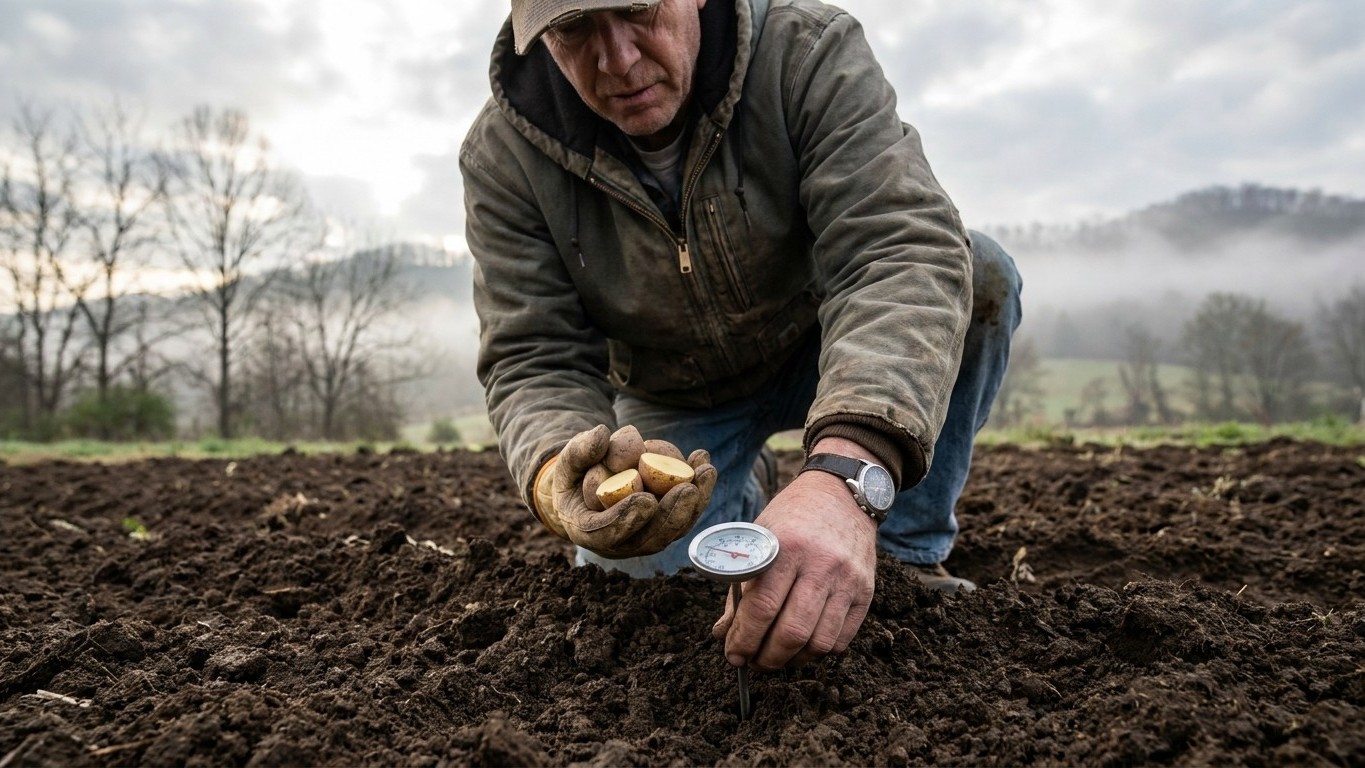

For gardeners near Louisville, the math starts with a single climate figure: NOAA puts the last spring frost date there, at 32°F, somewhere between March 24 and April 4, based on the 1991-2020 Climate Normals. Potatoes go into the ground 14 to 21 days before that date, not on it, because a seed piece needs warm soil, not warm air, to sprout. That places the planting window in the Louisville area roughly across the first three weeks of March, and earlier still for gardens outside the city.
The short answer
Run the arithmetic and the window tightens fast. Subtract 21 days from March 24 and you land on March 3. Subtract 14 days from April 4 and you land on March 21. So for a garden that matches the Louisville reference station, seed potatoes go in somewhere between March 3 and March 21, with the exact day decided by what the soil is doing that particular season, not by which square the calendar lands on.
That station, identified by NOAA as USW00093821, sits at Louisville. It is a real place with a real frost history, but it is not Kentucky’s frost history. The National Weather Service office in Louisville has said plainly that this urban station reports frost dates that run later in spring and earlier in fall than the rural parts of the surrounding county. A garden a few miles outside the city, especially one sitting low or away from pavement and building heat, should plan for a tighter, earlier window than the March 24 to April 4 range suggests.
The wider state stretches that variation even further. Western Kentucky’s river bottomlands along the Ohio and Mississippi tend to shed cold faster than the mountain hollows of the eastern part of the state, where cold air settles and lingers. None of that changes the mechanism, only the date it lands on. Whatever the calendar suggests, the decision to plant still comes down to one number: whether the soil itself has reached 50°F, since that is the temperature that actually wakes a seed potato up.
So the short answer is a range, not a date: 14 to 21 days ahead of your local last frost, checked against the Louisville figure of March 24 to April 4 if that is the closest match to your conditions, adjusted earlier for rural and low-lying ground. Everything past that point is confirmation, done with a thermometer in the dirt rather than a finger in the air.
What actually decides it
Soil temperature, not the calendar
A frost date on a chart is a probability, built from decades of weather records, not a promise about this particular spring. What decides when a seed potato actually starts growing is the temperature of the soil it sits in. University of Maine Cooperative Extension and Utah State University Extension both describe the same trigger: potatoes are planted once soil reaches 50°F, and that point tends to arrive 14 to 21 days before the last frost date because soil warms ahead of the air holding steady above freezing. A cold, wet spring can push that 50°F mark later than the count-back math predicts. A dry, sunny stretch can pull it earlier. The calendar gives you a planning window; the soil gives you the actual go signal.
The 90°F ceiling that shuts tuber growth down
The other end of the season matters just as much, and it’s the part most guides skip. Both Utah State and University of Maine describe a heat ceiling: once soil temperatures climb above 90°F, tuber set and fill are inhibited. The plant doesn’t just slow down, it stops building the crop underground, and extra water at that point does not undo the damage. In a Kentucky summer, soil under full sun can cross that threshold well before the calendar says summer is over, especially in exposed beds without mulch. That single fact reframes the whole planting decision: the goal in most of Kentucky isn’t to keep a potato plant alive as long as possible, it’s to get the tubers set and filled before the soil crosses 90°F. That favors planting as early as the 50°F soil signal allows, and choosing a season class, early or mid-season rather than late, that finishes its bulking before the hottest weeks arrive. A reader gardening somewhere this page never mentions, a rocky hillside plot or a raised bed in full afternoon sun, can apply the same two thresholds: watch for 50°F to start, and count on 90°F to end the growing window, regardless of what the frost chart says in between.
How to do it
- Buy certified seed potatoes rather than grocery-store tubers or saved bin stock. Uncertified seed can carry virus that doesn’t show up as obvious disease but quietly cuts yield year after year.
- Pick a season class, early, mid-season, or late, based on how much cool soil time your site has before summer heat is likely to push soil past 90°F. Shorter cool windows favor early or mid-season stock.
- Track soil temperature at the planting site with a soil thermometer rather than relying on the air temperature or the date on the calendar.
- Once the soil holds at 50°F, or once you’re 14 to 21 days out from your local last frost date and the ground confirms it, cut seed potatoes so each piece carries at least one healthy eye.
- Let the cut surfaces dry and callus over before planting, since fresh cuts are more likely to rot in soil that’s still cool and damp.
- Plant the seed pieces cut side down, eye up, then hill soil around the stems as the plants emerge and grow, which keeps developing tubers covered and shielded from early light and heat.
- Watch the soil temperature trend through the season. If it looks headed past 90°F before the crop finishes bulking, plan to dig it as a spring crop rather than let it stand through the hottest stretch of summer.
What goes wrong
- Planting uncertified seed. Bin potatoes or grocery-store tubers can carry virus invisibly, and yields decline season after season without an obvious cause. Buy certified seed potatoes each planting.
- Going by the calendar date alone. A frost chart gives probabilities, not a guarantee that the soil has actually reached 50°F. Check soil temperature directly before committing seed to the ground.
- Using the Louisville frost date for a rural garden without adjusting. NWS Louisville has said its urban station runs later in spring than the surrounding rural county. A gardener outside the city who plants strictly by the Louisville range risks starting later than the local soil actually allows, pushing the crop closer to the summer heat ceiling.
- Choosing a late-season variety in a hot-summer spot. Late-season potatoes need more time to bulk, and in soil that crosses 90°F early, they may stall before finishing. Match the season class to how much cool soil time the site realistically offers, leaning early or mid-season where summers turn hot fast.
- Trying to nurse a heat-stalled crop with extra water. Once soil passes 90°F, tuber set and fill are inhibited, and irrigation doesn’t reverse that. The fix is timing, not troubleshooting: get the crop planted early enough to finish bulking before the soil gets that hot, and dig it rather than wait it out.
Common questions
What is the last frost date for Kentucky?
There isn’t one figure for the whole state. NOAA’s 1991-2020 Climate Normals put the last spring 32°F frost at the Louisville station between March 24 and April 4. That date is specific to Louisville; rural Jefferson County and other parts of the state, especially the cooler eastern mountains or the earlier-warming western river bottoms, will differ.
Can I plant potatoes before the last frost date?
Yes, and that’s the standard approach. Seed potatoes go in 14 to 21 days ahead of the last frost date, once soil reaches 50°F, according to Utah State University Extension and University of Maine Cooperative Extension. The seed piece sits underground developing roots and sprouts before tender growth reaches the surface near frost-safe timing.
What happens if the soil gets too hot for potatoes?
Both Utah State and University of Maine note that soil above 90°F inhibits tuber set and fill. The plant stops building the underground crop, and watering doesn’t correct it. That’s why early planting matters more in Kentucky than a precise frost date does.
Should I plant early-season or late-season potato varieties in Kentucky?
Neither source publishes a days-to-maturity figure for varieties, but both describe season classes: early, mid-season, and late. Where summer soil heat arrives quickly, an early or mid-season class has a better chance of finishing tuber bulking before soil crosses the 90°F ceiling, compared with a late-season class planted in the same conditions.