
Yes, in most cases, provided the ground drains. The Crider soil that represents Kentucky is well drained by nature, and asparagus asks for almost nothing else: a spot that sheds water rather than holding it, for the ten to fifteen years a bed stays productive. The catch isn’t the state soil. It’s whether your particular patch of yard matches it, or whether a low corner, a compacted lawn strip, or fill dirt from a driveway project tells a different story.
The short answer
Fifteen years is a long commitment for a vegetable bed. Most things in a garden get replanted, amended, or moved if they don’t work out. Asparagus doesn’t give you that option once the crowns are down and the plants mature. That’s why the single soil requirement Utah State University Extension attaches to this crop matters more here than it would for tomatoes or lettuce: the ground has to drain. Not fertile, not a particular pH, not a specific texture. Just drained.
Kentucky’s official state soil, the Crider series, checks that box. Sampled across 255 mapped components by the USDA’s Soil Survey Geographic Database, the surface horizon comes back well drained, with a texture that runs 5 percent sand, 19 percent clay, and 76 percent silt, a loam-to-silt profile with organic matter around 3.0 percent and a surface pH near 6.2. That’s a soil built on old loess deposits over limestone, and it moves water through rather than pooling it, which is exactly what a fifteen-year asparagus crown wants underneath it.
Here’s the caveat worth sitting with: the Crider series is a representative soil, not a survey of your backyard. Kentucky holds hundreds of mapped soil series, and the ground under a bottomland garden near a creek behaves nothing like a ridge-top field, which behaves nothing like a suburban lot where a builder scraped the topsoil and brought in fill. A state soil tells you what the region tends toward. It doesn’t tell you what’s under your grass.
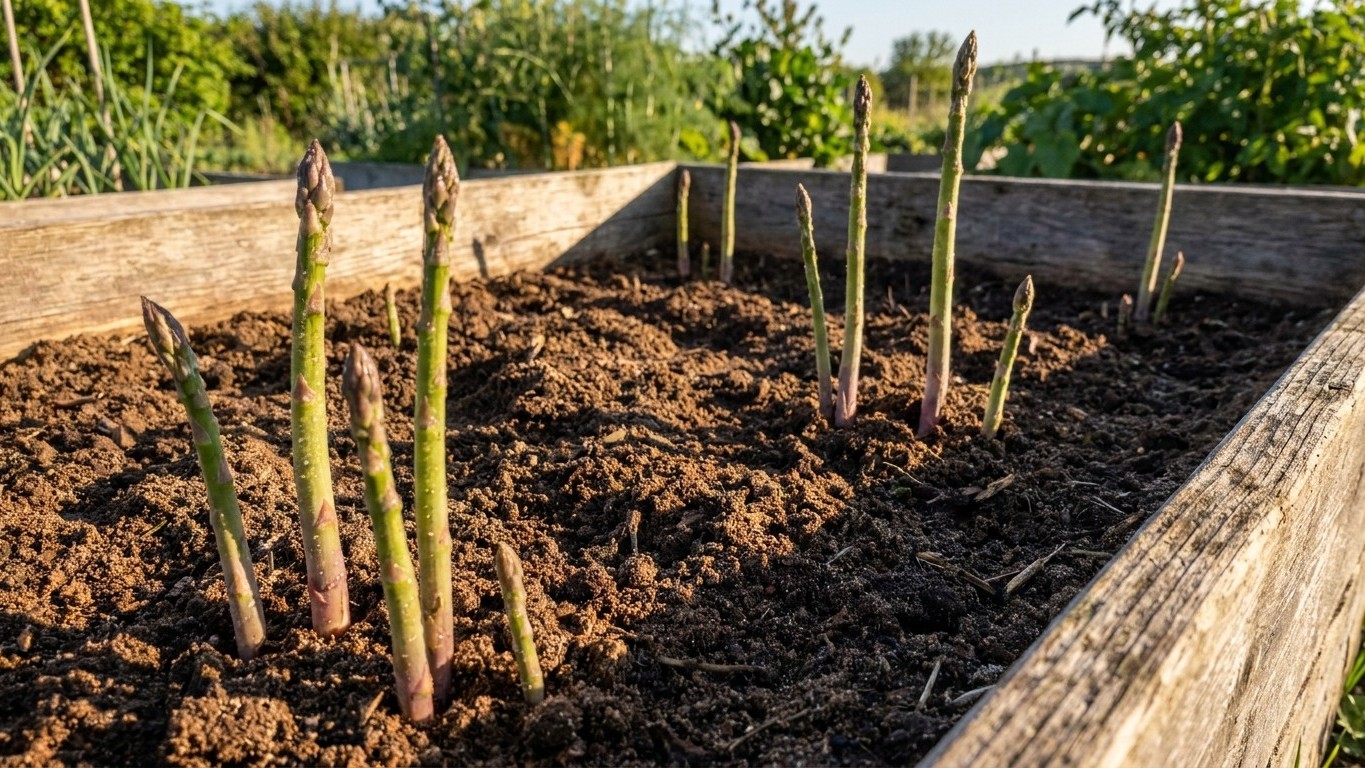
So the practical move, before any crowns go in the ground, is a straightforward drainage check: dig a hole about a foot deep, fill it with water, and see how long it takes to disappear. If it’s gone within a few hours, you’re likely fine. If water is still sitting there the next morning, that spot will drown a crown long before it ever reaches its tenth year. The fix isn’t complicated but it’s not optional either. A raised bed, built up eight inches or more above grade with soil brought in or amended, sidesteps the drainage problem entirely and lets the roots do what they need to do without ever touching standing water. Given that asparagus won’t even give you a harvest until its third year, testing drainage in year zero is cheap insurance against a decade of disappointment.
Will the summer here water it for you?
an Asparagus Bed has a watering rhythm that shifts as it ages: roughly 1 to 2 inches every other week through the first two seasons while roots establish, then easing back to about that same amount every three weeks once the planting matures. Set that against what a Kentucky summer actually delivers, using the 1991-2020 normals from station USW00093821.
- June averages 4.27 inches, the wettest of the three summer months, which comfortably covers even the demanding first-two-years schedule if it falls evenly across the month.
- July comes in close behind at 4.05 inches, still generally enough on paper, but July also carries more heat, and heat pulls moisture back out of the ground faster than a spring rain does.
- August is the tight month, at 3.71 inches, the driest of the summer and the one where a young bed is most likely to run short between storms.
- Add it up and summer delivers about 12.0 inches over June, July, and August combined, against a full-year normal of 48.3 inches, which puts the total in the same range asparagus asks for over a mature planting.
- The gap isn’t in the total, it’s in the delivery. Rain that falls as one heavy afternoon thunderstorm mostly runs off a silt-heavy surface rather than soaking in the way a slow, scheduled watering does, so the on-paper math looks better than what actually reaches the crown roots.
The practical read: a Kentucky summer gets a young bed most of the way there, but it doesn’t get it there reliably, especially in August or during any week that skips a storm. A rain gauge staked in the actual bed, not a general sense of “it rained this week,” is what tells a gardener whether to drag out a hose. On the well-drained Crider-type soils this region tends toward, water that does soak in also moves through fairly quickly, which cuts both ways: less risk of a soggy crown, but also less of a reserve to draw on during a dry stretch.
When to put the crowns in
Crowns go into the ground in early spring, planted about 8 inches deep in a furrow, according to Utah State University Extension. Kentucky’s last spring frost, based on the 1991-2020 freeze probability normals for station USW00093821, falls in a window around March 24 to April 4. That’s an average across three decades, not a promise for any single year, and it’s worth noting that this particular station is an urban one. The National Weather Service office covering Louisville has flagged that this site tends to run later in spring and earlier in fall than the surrounding rural parts of Jefferson County, so a garden outside the city should expect that window to close a little sooner than the station data suggests.
Early spring, in practice, means planting once the ground has thawed and can be worked, but while there’s still enough cool weather ahead for the crowns to settle in before the heat of early summer arrives. Gardeners who’d rather start from seed can do that instead, though it adds a year to the front end of the process since seedlings need to grow to transplant size before they go into the permanent bed. Crowns skip that step, which is why most home plantings start there.
The furrow itself isn’t filled in all at once. It’s backfilled gradually, about 2 inches of soil added roughly every other month across the first year, rather than burying the crown completely on planting day. That staged approach lets the emerging spears keep reaching daylight as the furrow fills rather than getting buried under a foot of soil in one go.
Patience matters more with this crop than almost any other vegetable in a home garden. There’s no harvest at all in the first two years. In year three, the bed can be cut for about 4 weeks. The following year, that stretches to about 6 weeks, and the year after, to about 8 weeks. After that, the harvest window is judged by the plant itself rather than the calendar: cutting stops for the season once most of the spears coming up are thinner than a pencil, a sign the crown’s energy reserves need to go back into growing fern rather than spears.
On variety, Utah State University Extension names four: Jersey Giant and Jersey Knight, both all-male hybrids, and UC 157 F1 and Purple Passion, both male-and-female types. The source doesn’t publish flavor comparisons, yield differences, or a recommendation for one over another, so there’s no published reason here to prefer one over the rest. No nursery source is specified either. Choosing among them comes down to what’s locally available, not a documented performance edge.
Common questions
Does Kentucky’s soil pH need adjusting for asparagus?
The source used for this article’s watering and planting guidance is silent on soil pH requirements for asparagus. The state soil’s surface pH runs around 6.2, slightly acid, but that figure describes the mapped Crider series, not a guaranteed reading for any individual garden. A soil test is the only way to know your own number.
Does an Asparagus Bed need winter chilling to produce well?
That figure isn’t published in the sources used here. It’s tempting to estimate one from a hardiness zone, but that would be a guess dressed up as a fact, not something documented for this crop.
Can I plant asparagus in a raised bed instead of testing my yard’s drainage?
Yes. A raised bed sidesteps a poorly drained spot entirely, since the only firm requirement is drainage, not any particular native soil texture or fertility level.
Why is there no harvest for the first two years?
The crowns need that time to build root reserves. Cutting spears too early pulls energy the plant needs to establish itself, which is why the schedule holds at zero for two years before easing into a 4-week harvest in year three.