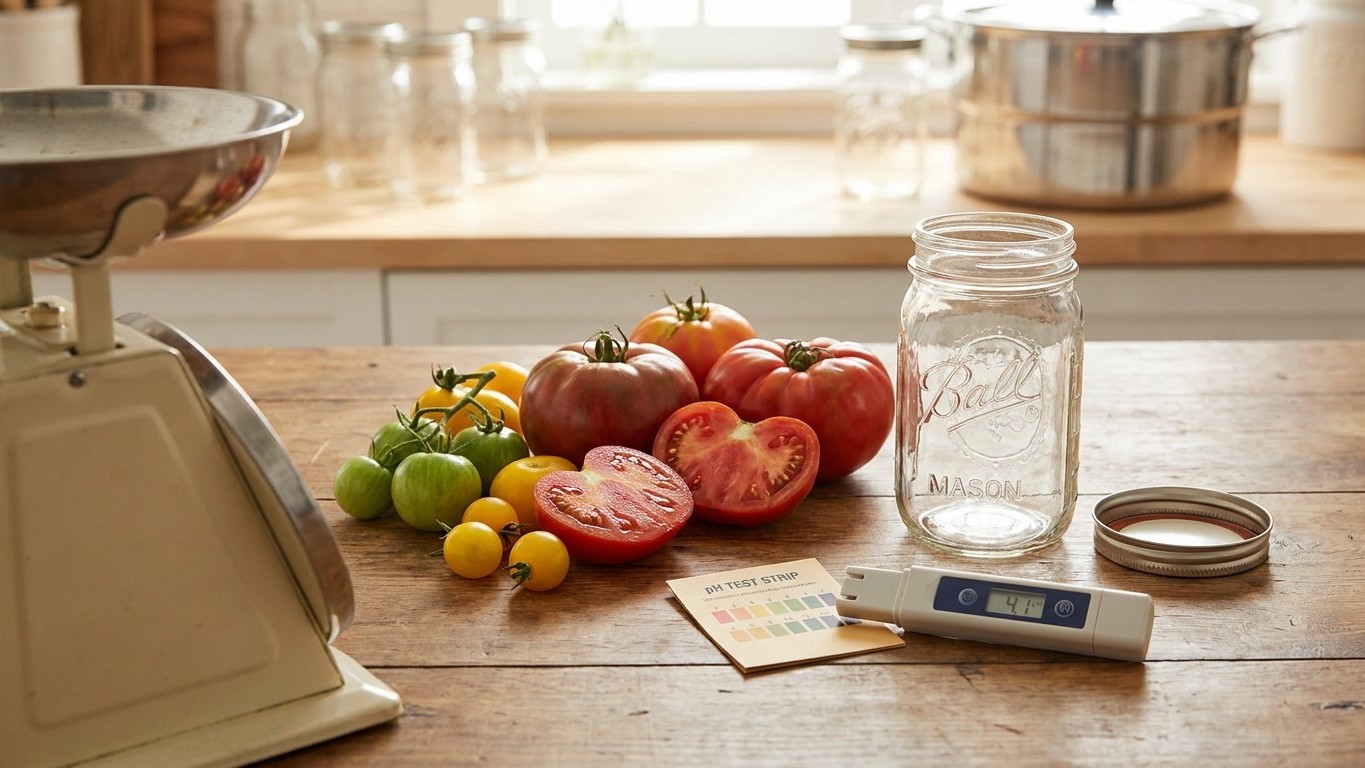

Tomatoes sit almost exactly on the pH 4.6 line that separates acid foods from low-acid foods, and some varieties tip over it. That single fact is why the National Center for Home Food Preservation treats tomatoes as a food that must be acidified before it goes into a boiling-water canner. Skip that step, or trust the tomato’s tartness alone, and you’ve built a jar that behaves like a low-acid food without looking like one.
The short answer
Every canning decision starts with one number: pH 4.6. Above it, a food is classified low-acid and needs a pressure canner running at 240 to 250 F to reach a temperature that destroys Clostridium botulinum spores. At or below 4.6, a food is acid, and a boiling-water canner at 212 F (sea level) does the job, because that environment doesn’t let the organism grow in the first place. The National Center for Home Food Preservation at the University of Georgia, in its guidance Ensuring Safe Canned Foods, draws this line explicitly and sorts foods on either side of it.
Red meats, seafood, poultry, milk, and almost every fresh vegetable land in the low-acid category. Fruits, pickles, sauerkraut, jams, jellies, marmalades, and fruit butters land in the acid category. That sorting looks tidy until you get to the tomato, which the NCHFP names directly as an exception: some tomato varieties are now known to have pH values slightly above 4.6. Figs share the same problem. Both crops sit close enough to the boundary that a batch grown in your backyard, picked a little underripe or a little overripe, can drift to either side without any visible change.
That’s why a tomato is never canned on faith. It’s canned as an acidified acid food, with a measured amount of acid added to every jar so the finished product sits reliably below 4.6 regardless of what the raw tomato’s own chemistry happened to be that season. Once acidified, tomatoes are processed in a boiling-water canner. Left unacidified, they don’t belong in one.
If you grew the crop yourself, the acidity question doesn’t announce itself at harvest. It shows up only in a lab test or in a canning failure, which is precisely why the rule exists as a blanket instruction rather than a judgment call made jar by jar.
Why it falls where it does
Acidity isn’t a flavor note here, it’s a barrier. A pH at or below 4.6 creates an environment where Clostridium botulinum can’t multiply or produce its toxin, no matter how long the jar sits on a shelf. That’s the entire reason boiling water, at a temperature far below what’s needed to kill the organism’s spores outright, is still enough for acid foods. The acid does the heavy lifting; the heat just handles yeasts, molds, and other spoilage organisms that acid alone won’t stop.
Low-acid foods don’t have that built-in barrier, so the only way to make them shelf-stable is to physically destroy the spores with sustained high heat under pressure. That’s a different job than boiling water can do, which is why the two canner types aren’t interchangeable and why the classification of a food determines the entire process before you’ve touched a single ingredient.
Botulinum spores are common in soil and on the surface of many foods, including vegetables pulled straight from a home garden. On their own, they’re not dangerous. The organism only becomes a threat when three separate conditions line up together in the sealed environment of a canning jar.
- A moist, low-acid food, which acidification removes by pushing the food’s pH at or below 4.6, a condition the spores can’t grow in.
- A temperature between 40 and 120 F, which correct canning removes by either processing the sealed jar hot enough to destroy the spores (pressure canning) or by keeping the food’s chemistry inhospitable to growth even at that temperature range (acidification for boiling-water canning).
- Less than 2 percent oxygen, which is exactly what a properly sealed canning jar creates, and which can’t be removed once the lid seals, so the other two conditions are the only ones a canner actually controls.
Take away any one of those three and the organism can’t establish itself. A properly acidified, properly sealed tomato jar removes the first condition permanently, which is what allows it to sit at room temperature for months without the heat levels a pressure canner requires.
What that means at the stove
The order of operations matters as much as the ingredients. This is the sequence, without the specific quantities, which belong to a tested recipe rather than a general explanation.
- Select tomatoes that are ripe but not overripe, and discard any with soft spots, mold, or damage, since spoilage organisms already present multiply the risk.
- Wash the tomatoes thoroughly under running water to remove soil, which is where botulinum spores naturally live.
- Peel the tomatoes if the recipe calls for it, typically by blanching briefly and slipping the skins off, since skins can trap air pockets and affect texture.
- Add the acidifying agent to each jar before adding the tomatoes, using bottled lemon juice or citric acid rather than fresh-squeezed juice, whose acidity varies from lemon to lemon and season to season.
- Pack the acidified tomatoes into clean, hot jars, following the fill line specified by the tested recipe.
- Remove air bubbles from the jar and wipe the rim clean, since any residue on the sealing surface can prevent a proper seal.
- Apply the lid and band according to the manufacturer’s instructions for that lid type.
- Process the jars in a boiling-water canner, since properly acidified tomatoes qualify as an acid food, for the length of time specified in the tested recipe for your jar size and altitude.
- Remove the jars once processing finishes, let them cool undisturbed, and check each lid for a proper seal before storing.
If you’re growing your own crop for this purpose, the tomato growing guide covers variety selection and harvest timing; nothing in that guide changes the acidification step that comes next.
What goes wrong
- Skipping acidification because the tomato tastes tart enough already. Taste has no relationship to pH in the range that matters here. The fix is to add the measured acid to every jar, every time, regardless of variety, ripeness, or how sharp the tomato tastes raw.
- Using fresh lemon juice instead of bottled. Fresh lemon juice varies in acidity from fruit to fruit, which defeats the entire purpose of a measured addition. Bottled lemon juice has a standardized, tested acidity level, and it’s what tested recipes are built around.
- Adding low-acid ingredients, like onions, peppers, or garlic, to a tomato recipe without following a tested formulation. These additions can shift the overall mixture’s pH high enough to require pressure canning, even though the base ingredient is a tomato. The remedy is to follow a tested recipe’s exact ratios rather than improvising with garden extras.
- Relying on smell or taste to judge whether a jar is safe. Botulinum toxin has no taste and no smell, so a jar can look, smell, and taste completely normal and still be dangerous. There’s no sensory shortcut here; a jar that shows any sign of spoilage, or wasn’t processed correctly in the first place, gets discarded rather than tasted.
- Assuming one tomato variety is inherently safer than another. The NCHFP notes some varieties run above pH 4.6, but there’s no reliable home method to tell which ones without lab testing. Acidifying every batch, regardless of variety, removes the guesswork entirely.
Where the exact figures come from
A processing time, an acid quantity, or a headspace measurement depends on your jar size, your tomato preparation (whole, crushed, or juiced), and your altitude, and getting any of them wrong can mean a jar that looks sealed but isn’t safe. The National Center for Home Food Preservation publishes tomato-specific instructions with the tested acid amounts and processing times for each preparation method, and that’s the source to use directly rather than a number remembered from elsewhere.
An untested figure, even one that sounds close to correct, hasn’t been verified against actual bacterial destruction in a lab. Since the consequence of being wrong is a toxin with no detectable taste or smell, there’s no margin for approximation once acidity and heat are the only two variables standing between a shelf-stable jar and a dangerous one.
Common questions
Can I skip acidifying if I only grow low-acid tomato varieties?
There’s no reliable home test to confirm which side of pH 4.6 your tomatoes fall on, and the NCHFP notes some varieties run higher than expected. Acidifying every batch removes that uncertainty entirely.
Does cooking the tomatoes first lower their acidity risk?
Cooking affects texture and flavor, not the pH level that determines which canner method is safe. Acidification, not heat from cooking, is what pushes the food below 4.6.
Can I use vinegar instead of lemon juice or citric acid?
Tested tomato recipes specify particular acidifying agents and amounts for a reason; substituting an untested acid source means the finished pH is unverified, which defeats the purpose of acidifying at all.
Is a pressure canner ever wrong to use for tomatoes?
No, a pressure canner works safely for acidified tomatoes too, since it exceeds the temperature boiling water reaches. The boiling-water method is simply the minimum sufficient approach once acidification has been done correctly.