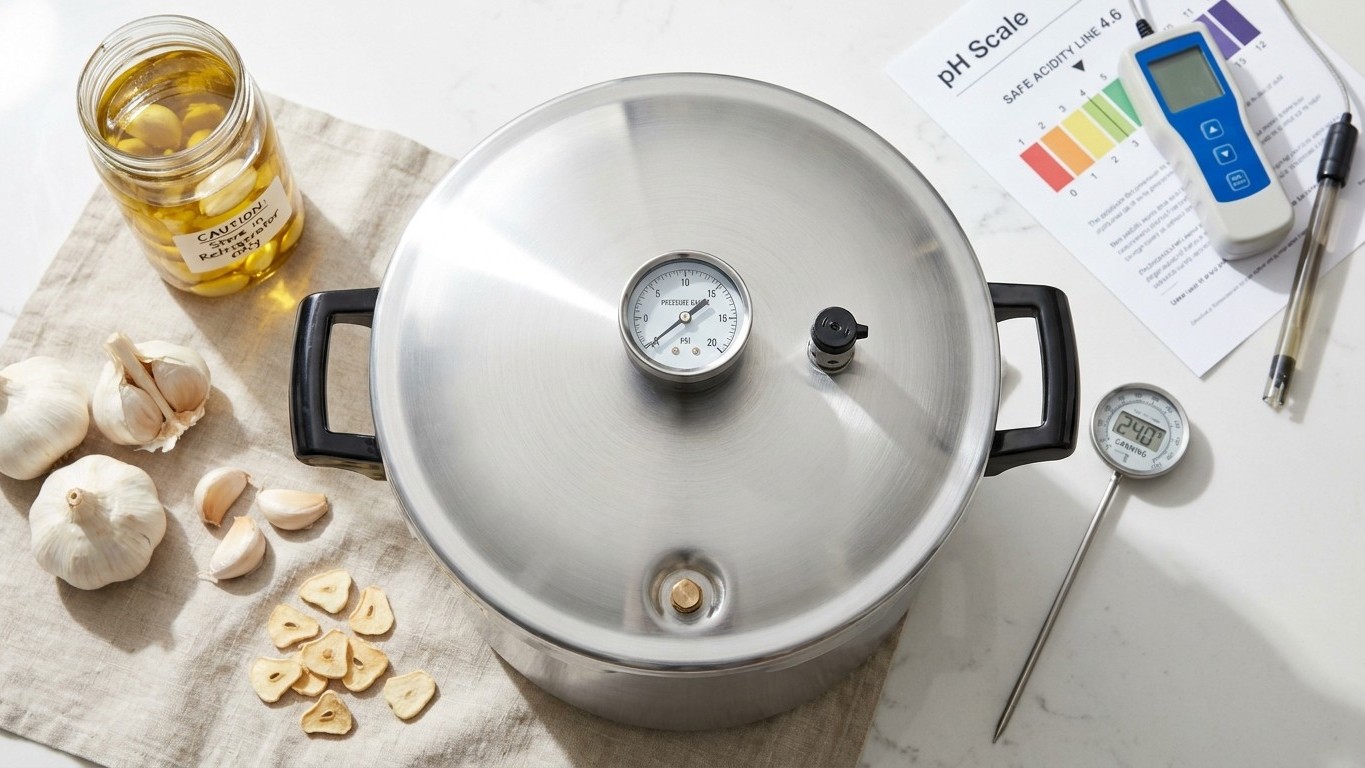

Garlic sits above pH 4.6, which makes it a low-acid food in the eyes of every canning authority. The National Center for Home Food Preservation classifies it that way because it’s a fresh vegetable, and that single fact rules out a boiling-water bath. Garlic needs a pressure canner. It also explains why garlic-in-oil, a favorite kitchen shortcut, turns into one of the more dangerous combinations a home cook can put together.
The short answer
Pressure canning is the only method the National Center for Home Food Preservation (University of Georgia) recognizes as safe for garlic. That’s not a matter of taste or texture, it’s chemistry. The dividing line the entire home canning world works from is pH 4.6. Above that number, a food is low-acid and needs a pressure canner running at 240 to 250 F. At or below 4.6, a food is acid enough that a boiling-water canner, which tops out at 212 F at sea level, does the job. Garlic falls squarely on the low-acid side of that line, in the same category as red meats, seafood, poultry, milk, and nearly every fresh vegetable you’d pull out of a garden. Fruits, pickles, sauerkraut, jams, jellies, marmalades, and fruit butters live on the other side, acid enough for the gentler bath method.
If you grew your own bulbs this season using a growing guide, the plant’s low-acid nature doesn’t change once it’s harvested and cured. Garlic cloves, whether fresh, dried, or chopped, stay in the low-acid category through storage and into the jar. There’s no home test, no vinegar splash, no amount of cooking that shifts garlic’s chemistry into acid territory. Only a controlled process, at temperatures a boiling pot can’t reach, gets rid of the specific hazard low-acid foods carry.
That hazard has a name: Clostridium botulinum, a bacterium that thrives precisely in the conditions a jar of low-acid food can create. Pressure canning solves it by reaching temperatures above boiling, something only a sealed pressure vessel can sustain. Boiling water alone, no matter how long you leave the jars in it, never gets hot enough to destroy the spores that matter here.
This is also where the oil question comes in, and it deserves its own warning. Garlic packed into oil isn’t a canning recipe at all in the traditional sense, and treating it like one, or skipping processing altogether because “people have always done it this way,” creates a textbook set of dangerous conditions. The next sections walk through why, using the same framework the National Center for Home Food Preservation applies to every low-acid food.
Why it falls where it does
Acidity does one specific job in food preservation: it makes the environment hostile to the growth of Clostridium botulinum and to the production of its toxin. High-acid foods, sitting at or below pH 4.6, don’t offer the bacterium a livable environment even if a spore is present. Low-acid foods do. That’s the entire reason the pH 4.6 line exists as the dividing point between the two canning methods, and it’s why garlic, a fresh vegetable with no natural acidity to speak of, can’t be treated the same way as a jar of pickled cucumbers or a batch of jam.
Clostridium botulinum doesn’t cause problems just because it’s present. It needs three specific conditions, and it needs all three at the same time. Take away any one of them and the danger doesn’t develop, no matter how long the jar sits on a shelf.
- A moist, low-acid food. This is what garlic itself provides, unless the environment is altered by an approved process, since the clove carries both moisture and a pH well above 4.6.
- A temperature between 40 and 120 F. A pressure canner removes this condition by driving the contents of the jar to 240 to 250 F during processing, a range no botulinum spore survives.
- Less than 2 percent oxygen. Ironically, this is the condition most home preservers create by accident, whenever they seal a low-acid food away from air without also applying heat sufficient to destroy the spores.
Garlic in oil satisfies all three conditions simultaneously, which is precisely what makes it a recurring subject of home food safety warnings. The clove supplies the moist, low-acid substrate. The oil coating excludes oxygen far more effectively than water or brine would. And a kitchen counter, or even most refrigerator temperatures if held too long, sits inside that 40 to 120 F window at some point. None of this requires spoilage you can see or smell. The toxin itself has no taste and no smell, so a jar that looks and tastes completely normal can still be unsafe. That single fact is why guessing, tasting, or relying on appearance has no place in this decision.
What that means at the stove
Once garlic’s low-acid classification is settled, the process follows a set order. None of the steps below include a specific time, pressure, or ratio, because those figures depend on jar size, altitude, and the exact form the garlic takes, and they belong only in a tested, published procedure.
- Select a canning method appropriate to low-acid vegetables, which means a pressure canner rather than a boiling-water bath, following the National Center for Home Food Preservation’s specific instructions for garlic.
- Prepare the cloves as the tested procedure specifies, since raw preparation steps affect how heat penetrates the jar during processing.
- Pack the jars using the headspace and jar size called for in that same tested procedure, not an estimate or a figure carried over from a different recipe.
- Process the jars in the pressure canner at the pressure and for the duration specified for your altitude in the published NCHFP procedure, since both figures shift with elevation.
- Vent the canner as instructed before pressurizing, a step that matters for even heat distribution throughout the load.
- Let pressure return to zero naturally before opening the canner, rather than releasing it manually.
- Check seals after cooling, and treat any jar that didn’t seal properly as a jar to refrigerate and use promptly, not one to reprocess casually.
If your goal is garlic-infused oil rather than plain canned garlic, the sequence changes entirely, and the National Center for Home Food Preservation maintains a separate, dedicated page for infused oils specifically because the oxygen-exclusion problem makes this category riskier than most home cooks assume.
What goes wrong
Most garlic preservation failures trace back to a handful of predictable mistakes, and each one has a clear fix.
- Treating garlic like a pickle or a jam. Because garlic is often paired with vinegar in recipes, some cooks assume a boiling-water bath is enough. It isn’t, since plain garlic itself carries no acidity of its own; only a tested, sufficiently acidified recipe changes that equation, and even then it should follow a published NCHFP or USDA procedure rather than a guess.
- Making garlic-infused oil for long-term storage at room temperature. This recreates all three of botulinum’s required conditions in one jar. The fix is to consult the National Center for Home Food Preservation’s page on infused oils for a method that manages the risk, rather than improvising a shelf-stable version.
- Judging safety by smell, taste, or appearance. Botulinum toxin produces none of the usual spoilage cues. A jar can look, smell, and taste completely fine and still be dangerous. The only real safeguard is following a tested process, not a sensory check.
- Reusing headspace or timing figures from a different recipe. Garlic’s density and the way it’s packed affect how heat moves through the jar. Borrowing numbers from a tomato or bean recipe, even one from the same source, bypasses the testing that makes those figures safe in the first place.
- Cooling jars quickly or releasing pressure manually to save time. Doing so can affect seal integrity and, in some cases, the heat exposure the contents actually received. Letting pressure drop naturally is part of the tested procedure, not an optional step.
Where the exact figures come from
Garlic’s low-acid status means the exact figures depend on the specific product (whole cloves, minced garlic, garlic combined with other ingredients) and on your altitude, and those variables have to be matched to a procedure that’s actually been tested in a lab, not assembled from general canning knowledge.
The National Center for Home Food Preservation publishes tested procedures for canning garlic and a separate page specifically on infused oils, and the USDA Complete Guide to Home Canning covers the same low-acid category in more general terms. An untested figure, even one that sounds reasonable, might not raise the jar’s contents to a temperature high enough or hold it there long enough to eliminate botulinum spores, and because the resulting toxin has no taste and no smell, there’s no way to catch the failure afterward by inspection.
Common questions
Can I can garlic in a boiling-water bath if I add enough vinegar?
Garlic itself is a low-acid vegetable, so plain garlic always requires a pressure canner. Some tested recipes combine garlic with sufficient acid and specific proportions to shift the overall product into safe boiling-water territory, but that only works when the exact tested procedure is followed, not when vinegar is added by guesswork.
Is garlic-infused oil ever safe to store at room temperature?
Room-temperature storage of garlic in oil recreates the moisture, low acidity, oxygen exclusion, and warm temperature that botulinum needs all at once. The National Center for Home Food Preservation’s page on infused oils addresses how this risk is managed; it isn’t something to improvise.
Does refrigerating garlic-in-oil make it safe indefinitely?
Refrigeration slows bacterial activity but the 40 to 120 F danger range still overlaps with typical refrigerator and counter temperatures depending on how the jar is handled, so refrigeration alone isn’t treated as a substitute for a tested process or a defined storage limit.
How can I tell if a jar of preserved garlic has gone bad?
You generally can’t tell by looking, smelling, or tasting. Botulinum toxin produces no reliable warning signs, which is exactly why following a tested procedure from the National Center for Home Food Preservation or the USDA Complete Guide to Home Canning matters more than any sensory check.