
Mississippi gardeners get the best results from early and mid-season potato types planted as soon as the soil warms to 50°F, roughly two to three weeks ahead of the last spring frost. Season class matters more than any variety name: both Utah State University Extension and the University of Maine Cooperative Extension point to early digging as the strategy that beats summer heat before it ever becomes a problem for the crop.
The short answer
In Jackson, the last spring frost typically falls somewhere between March 6 and March 22, based on NOAA NCEI’s 1991-2020 Climate Normals for the airport weather station there. That window is the anchor point for the whole planting calendar, and it’s the number every Mississippi gardener should start from, then adjust for their own county, since suburban and rural gardens away from the airport often see frost linger a week or two longer.
Work backward from that date and the answer becomes clear. Potatoes go into the ground once soil temperature reaches 50°F, which lands 14 to 21 days before the last frost, according to University of Maine Cooperative Extension. In a Jackson-area garden with a mid-March frost date, that pushes planting into late February or the first days of March, sometimes while a light frost is still a real possibility. Potatoes tolerate a touch of cold better than they tolerate a hot summer, so gardeners accept that risk on purpose.
The reason for the rush is the heat ceiling. Utah State University Extension is specific on this point: soil temperatures above 90°F stop tuber set and fill outright. No amount of watering reverses it once it happens. Mississippi’s summer soil crosses that line early and stays there for weeks, which is exactly the stretch of time a late-season potato would need to keep sizing up. That’s why the practical answer for this state leans hard toward early and mid-season types, the ones that Utah State and Maine describe as reaching harvest readiness before the hottest stretch of the year even arrives. Late-season types aren’t off the table everywhere, but in a Mississippi garden they’re racing a clock they usually lose.
What this looks like in practice: a gardener plants early or mid-season seed potatoes in late winter, lets them bulk up through the mild weeks of spring, and pulls the crop before the soil bakes. It’s a spring crop, dug early, not a summer-long project. Anyone treating Mississippi potatoes like a Midwest planting calendar, going into the ground in April or May, is setting the tubers up to hit that 90°F ceiling right when they should be filling out.
What actually decides it
Two thresholds run this entire crop, and neither one cares about the calendar date on its own. Soil temperature is the trigger for both ends of the season.
The 50°F planting threshold
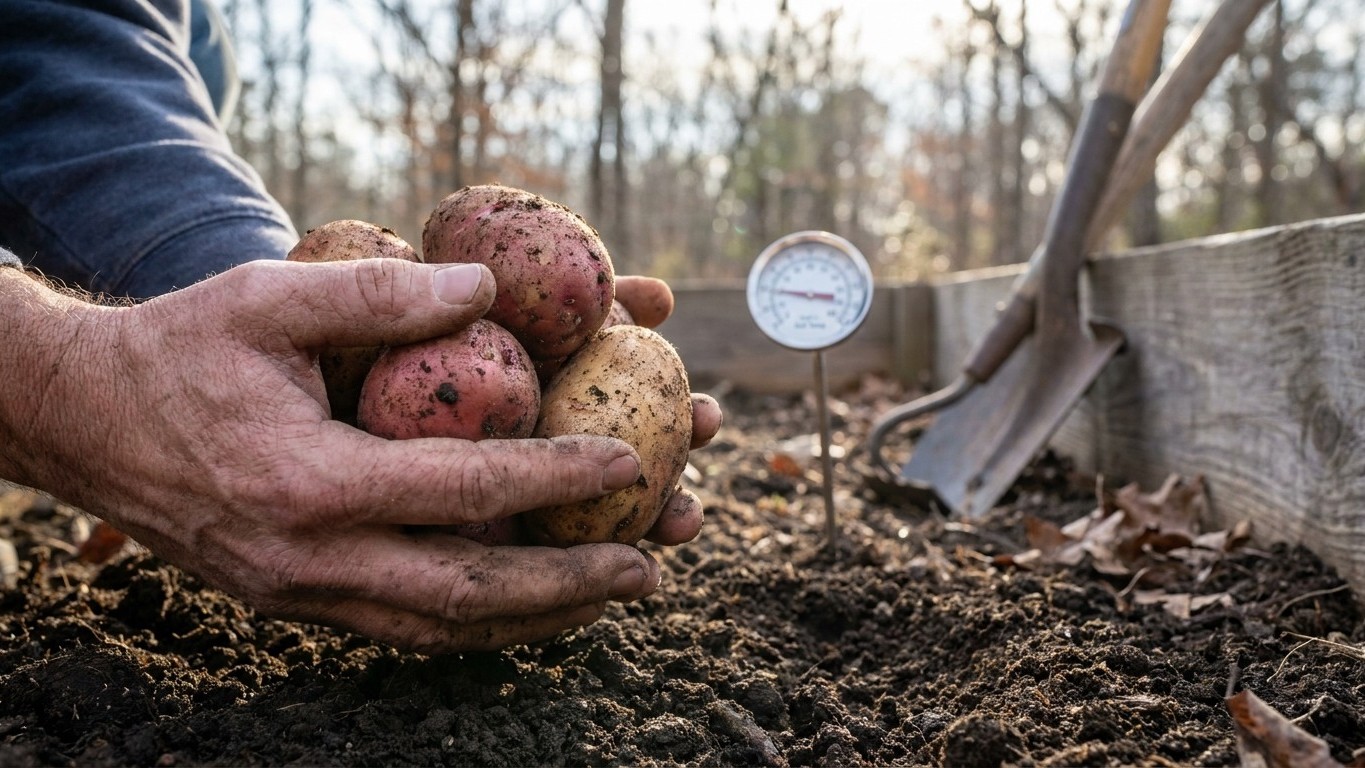
Potatoes go in the ground once soil reaches 50°F, not on a fixed date. University of Maine Cooperative Extension frames it this way because soil warms at different rates depending on soil type, mulch, raised beds versus in-ground rows, and how much sun a particular spot gets. A raised bed in full sun might hit 50°F a full week before a shaded, heavy-clay row a few yards away. That’s the mechanism a gardener needs to reason with on any plot this page never covers: check the soil itself with a simple soil thermometer rather than trusting a printed date, because the printed date (14 to 21 days before last frost) is only a planning estimate built around that temperature.
The 90°F ceiling that ends the window
Tuber set and fill shut down once soil crosses 90°F, per Utah State University Extension. This is a soil temperature, not an air temperature, though the two move together closely enough in Mississippi’s summer that the distinction rarely matters by June. Once that ceiling is crossed, the tubers already in the ground stop sizing. They don’t shrink, but they don’t grow either, and extending the watering schedule doesn’t reopen the window. This is the mechanism that explains why season class outranks variety choice here: an early type finishes its bulking before the ceiling arrives, while a late type is often still trying to size up when the soil crosses 90°F and locks the crop in place.
Frost date as a regional reference, not a guarantee
The March 6 to March 22 window is measured at one airport weather station. A garden thirty miles away, at slightly higher elevation or further from the city’s heat, can see frost linger later into March. That shifts the whole planting window later too, which then narrows the gap before the 90°F ceiling shows up in early summer. This is the trade-off every Mississippi gardener is actually managing: push planting earlier to beat the heat, but not so early that a hard frost damages emerging shoots.
How to do it
- Starting in late winter, check the soil temperature directly at planting depth using a soil thermometer, rather than relying on the calendar alone, since sun exposure and soil type shift the date from one part of a yard to another.
- Buy certified seed potatoes rather than saving tubers from a previous harvest or using grocery-store potatoes; uncertified seed carries virus that can undercut the whole crop before it starts.
- Choose early or mid-season season class seed, since these are the types that reach harvest readiness before Mississippi’s soil climbs past the 90°F ceiling in early summer.
- Plant once soil reaches 50°F, which generally falls 14 to 21 days before the local last frost date, according to University of Maine Cooperative Extension; in the Jackson area that points to late February or very early March, adjusted for how the specific garden’s frost timing compares to the airport’s March 6 to March 22 window.
- Track soil temperature again through late spring and into early summer as the season warms, watching for the approach of the 90°F threshold that halts tuber set and fill.
- Dig the crop before soil temperature holds consistently above that ceiling, since tubers already in the ground stop sizing once it’s crossed and won’t resume no matter how long they’re left in place.
What goes wrong
- Planting on a fixed calendar date instead of soil temperature. A gardener who plants “in April because that’s when the neighbor did” may hit ground that’s already well past 50°F, or in a cooler pocket, still too cold. Check soil temperature directly at planting depth instead of trusting a date on a seed packet.
- Choosing a late-season type out of habit. Late types need a longer stretch of mild soil to finish bulking, and Mississippi’s summer heat arrives before that stretch is complete. Stick with early or mid-season types, which both Utah State and Maine describe as suited to a shorter window before hot weather sets in.
- Using saved or grocery-store tubers as seed. These frequently carry virus that isn’t visible at planting time but shows up as a weak, underperforming crop later. Certified seed potatoes cost more but remove that risk from the start.
- Assuming watering can fix a heat-stalled crop. Once soil crosses 90°F, tuber set and fill are inhibited regardless of moisture, per Utah State University Extension. The remedy isn’t more irrigation, it’s timing: get the crop planted early enough that harvest happens before the ceiling is reached.
- Trusting the airport frost date as gospel for a specific yard. A garden away from Jackson’s airport, especially at higher elevation or in a low-lying frost pocket, can see last frost land later than the March 6 to March 22 window. Watch local conditions and adjust the planting date accordingly rather than planting to the exact printed date.
Common questions
What’s the single most important factor for growing potatoes in Mississippi?
Timing against the heat. Utah State University Extension identifies soil above 90°F as the point where tuber set and fill stop, and Mississippi reaches that threshold early in the year, which makes early planting and early digging the deciding factor over any other single choice a gardener makes.
Should I plant early-season or late-season potatoes in Mississippi?
Early and mid-season types are the practical choice. They reach harvest readiness before the soil crosses the 90°F ceiling described by Utah State University Extension, while late-season types often need more time in mild soil than a Mississippi spring provides before summer heat arrives.
Can I use potatoes from the grocery store as seed potatoes?
It isn’t recommended. Uncertified seed, including grocery-store tubers, can carry virus that isn’t visible when planted but reduces yield and vigor later in the season. Certified seed potatoes remove that risk.
How do I know when my soil has reached 50°F for planting?
Use a soil thermometer at planting depth rather than relying on a calendar date. University of Maine Cooperative Extension ties planting to that 50°F soil temperature specifically because it varies by soil type, sun exposure, and bed setup, even within the same yard.