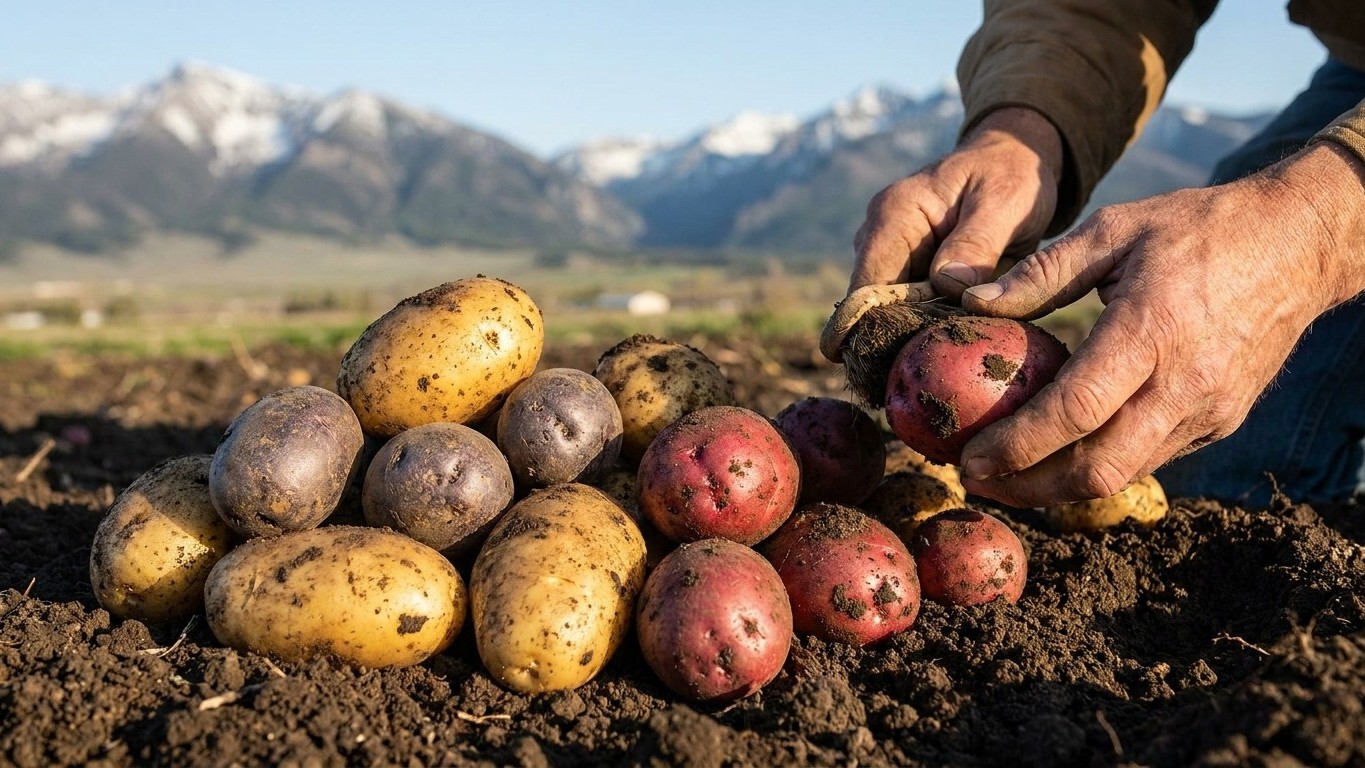

Montana’s growing season runs short and its soil warms fast once summer heat arrives, so the varieties that do well are early to mid-season types that size up before soil temperatures climb into the danger zone. In Billings, the reference point for state climate data, the last spring frost falls between April 29 and May 10, according to NOAA’s 1991-2020 Climate Normals. That narrow window, not the variety label on a seed bag, is what actually shapes the answer.
The short answer
Plant early and mid-season potatoes, and get them in the ground before the frost window closes rather than after. NOAA’s National Centers for Environmental Information puts Billings’ 32°F freeze probability window at April 29 to May 10, based on the 1991-2020 Climate Normals recorded at station USW00024033. That’s the anchor date for the whole state, though it comes with a real caveat: Billings sits in one of Montana’s milder valleys. Higher mountain valleys, and much of the western and central parts of the state, can see frost in any month of the year. So the Billings window is a starting reference, not a promise.
Utah State University Extension and the University of Maine Cooperative Extension, the two sources this page relies on for growing mechanics, don’t rank varieties by state. What they do publish is season class: early, mid-season, and late. For a state where the frost-free stretch is tight and where soil can overheat by midsummer, early and mid-season classes are the practical fit. Late-season types need more time in the ground after tuber set, and in a lot of Montana counties that extra time runs straight into either a return frost in fall or a stretch of soil too hot for the plant to keep sizing tubers in the middle of summer.
Neither Utah State nor Maine Extension publishes a days-to-maturity number for any variety, and this page won’t invent one. That’s not an oversight. Days-to-maturity numbers shift depending on soil temperature, moisture, and elevation, so a number printed on a seed catalog for a valley in Idaho or Maine doesn’t transfer cleanly to a garden at 4,500 feet outside Bozeman. What does transfer is the season class, because it describes how the plant’s own clock works relative to planting date, not a fixed calendar count.
The same caution applies to texture. This page won’t call a potato waxy or floury, because that word isn’t used in the two extension sources behind this article. What is published, and what matters more for a home cook anyway, is end use: some varieties are bred and recommended for baking, others for boiling and general kitchen use. Choosing by end use also happens to align with what grows reliably in a short season, since most early and mid-season types documented by these extensions are general-purpose or boiling types rather than the long-season baking russets that need the most time in the ground.
What actually decides it
Two mechanisms run the whole show for a Montana potato patch: the frost window at the start of the season, and the soil heat ceiling in the middle of it. Everything else, spacing, hilling, watering, is management around those two facts.
The frost window sets the planting date, not the harvest date
Potatoes go into the ground while there’s still a real chance of frost, because the tuber itself is planted below the frost line and the plant doesn’t emerge until soil warms. Utah State University Extension and University of Maine Extension both describe the same target: soil at 50°F, reached roughly 14 to 21 days before the last frost date. In the Billings reference window of April 29 to May 10, that means planting sometime in mid-to-late April, while frost is still statistically likely in the air above the soil surface. This feels backwards to a lot of new gardeners, who wait for frost risk to pass before they touch a shovel. But the tuber under a few inches of soil is buffered from the light frosts that would kill an emerged seedling, and by the time the sprout breaks the surface, the worst of the frost risk has usually passed.
The 90°F soil ceiling ends tuber growth, and it isn’t a watering problem
This is the mechanism that decides the whole crop, and it’s the one gardeners tend not to guess at until it’s too late. Once soil temperature climbs above 90°F, tuber set and tuber fill are inhibited, according to Utah State University Extension. That’s a hard biological ceiling, not a stress symptom that irrigation can undo. A gardener who sees a plant stall in July and responds by watering more is treating the wrong problem; the tubers underground have effectively stopped sizing regardless of moisture, because the heat itself is the limiting factor. This is why the planting date matters so much more than any other single decision. A potato planted early enough to bulk its tubers before the hottest weeks of summer will have most of its growth already banked by the time soil temperature crosses that ceiling. A potato planted late is racing a clock it can’t win.
Put those two mechanisms together and the logic for county-by-county decisions writes itself, even for a spot this page never names. Count the days between when your local soil hits 50°F in spring and when your local soil regularly tops 90°F in summer. That span, not the calendar page, is the growing window an early or mid-season variety has to work with. Wider span, more flexibility. Narrow span, and the case for planting as a spring crop rather than nursing plants through peak summer heat gets stronger.
How to do it
- Check soil temperature with a soil thermometer at a 4-inch depth rather than guessing from air temperature; wait until it reads 50°F.
- Count back from your area’s expected last frost date and confirm that 50°F soil arrives 14 to 21 days before that date, per Utah State University Extension and University of Maine Cooperative Extension guidance; if it doesn’t, planting timing needs adjusting rather than the variety.
- Buy certified seed potatoes rather than saving tubers from a grocery store or a prior home crop. Uncertified seed carries virus that reduces yield and spreads to future plantings, and certification is the only safeguard against it.
- Choose an early or mid-season variety suited to your intended use, baking or boiling, since neither extension source ranks varieties by drought tolerance or cold hardiness beyond season class.
- Cut larger seed potatoes into pieces with at least one eye each, and let cut pieces heal over for a day or two before planting to reduce rot risk.
- Plant seed pieces in the still-cool soil of the pre-frost window, several inches deep, so the tuber is insulated from any late frost above the surface.
- Hill soil around the emerging plants as they grow, which protects developing tubers from sun exposure and helps regulate the soil temperature around them.
- Track local soil temperature through summer and expect tuber growth to taper once it holds above 90°F, regardless of watering; plan harvest timing around that ceiling rather than around a maturity number.
What goes wrong
- Planting after the frost window closes, not before it. Waiting for all frost risk to pass before planting pushes tuber set into the hottest weeks of summer, right when the 90°F soil ceiling shuts growth down. The fix is planting while soil hits 50°F, even with frost still statistically possible in the air above.
- Choosing a late-season variety for a short window. A late type needs more time between tuber set and harvest than an early or mid-season type, and in much of Montana that extra time runs into either a fall frost or a summer heat ceiling. Utah State and Maine Extension’s season-class system exists precisely so a gardener can match a variety’s timing to a local window instead of guessing from a catalog days-to-maturity figure that neither authority actually publishes.
- Treating a summer stall as a watering problem. Once soil crosses 90°F, more irrigation doesn’t restart tuber fill, because heat itself is the limiting factor, not moisture. The fix is accepting the stall as a signal that the growing window has closed for the season, and adjusting next year’s planting date earlier rather than watering harder this year.
- Planting uncertified seed to save money. Seed saved from a prior harvest, or tubers bought at a grocery store, can carry virus invisibly. The fix is buying certified seed potatoes every season, which is the one safeguard extension services consistently point to for avoiding a slow, hard-to-diagnose yield decline.
- Assuming Billings’ frost dates apply everywhere in the state. The April 29 to May 10 window is specific to Billings, one of Montana’s milder valleys, per NOAA’s 1991-2020 Climate Normals. Higher mountain valleys elsewhere in the state can frost in any month, so a gardener in a colder pocket needs a local soil-temperature reading rather than borrowing the Billings date directly.
Common questions
What potato variety grows fastest in Montana?
Neither Utah State University Extension nor University of Maine Cooperative Extension publishes a days-to-maturity figure for any variety, so “fastest” isn’t something this page can answer with a number. What both sources do publish is season class, and early-season types reach tuber set and fill soonest after planting, which is the closest verified equivalent to “fastest” for a short Montana season.
Can I plant potatoes before the last frost in Montana?
Yes, and the extension guidance behind this page recommends it. Tubers are planted once soil reaches 50°F, which falls 14 to 21 days before the last frost date. In the Billings reference window of April 29 to May 10, that puts planting in mid-to-late April, before frost risk in the air has fully passed.
Why did my potato plants stop growing in midsummer?
Soil temperature above 90°F inhibits tuber set and fill, according to Utah State University Extension. That’s a heat ceiling, not a drought symptom, so extra watering won’t restart growth. The plants have effectively banked whatever tuber size they reached before the soil crossed that threshold.
Is it worth buying certified seed potatoes instead of saving my own?
Yes. Uncertified seed, including tubers saved from a home garden or bought at a grocery store, can carry virus that reduces yield and passes into future crops. Certified seed is the standard safeguard extension services point to, and it matters more in a short-season state like Montana where there’s little margin to recover from a weak start.