
New Brunswick gardeners work backward from one number: May 23, the average last spring frost recorded at the Moncton station in Environment and Climate Change Canada’s Canadian Climate Normals. Potatoes go into ground once soil hits 50°F, a mark that typically falls 14 to 21 days ahead of that frost date. Count back from May 23 and most Moncton-area plots land their earliest planting window between roughly May 2 and May 9. That’s a starting point, not a province-wide rule, and the mean frost date itself carries more risk than the round number suggests.
The short answer
The figure driving this whole calculation, May 23, comes from Environment and Climate Change Canada’s Canadian Climate Normals for 1981-2010, tied specifically to the Moncton station (climate ID 8103100). Utah State University Extension’s fact sheet Potatoes in the Garden and the University of Maine Cooperative Extension’s Bulletin #2077 both point to the same trigger for planting day: soil temperature at 50°F, reached 14 to 21 days before a location’s last frost. Run the subtraction against Moncton’s mean and the window opens in the first week or two of May.
Here’s where the number gets misread. A mean last-frost date isn’t a safety line. Half the years on record at that station saw frost arrive after May 23, not before. Treat it as the middle of a spread, not a green light. A grower who plants tender crops the moment the calendar hits that date is gambling on the better half of a coin flip, not following a guarantee.
Moncton is also just one point on the map. New Brunswick runs from coastal lowlands to interior uplands and northern districts where cold air pools longer into spring. A station reading from one city describes that city’s climate, not the province’s. A garden in a low frost pocket, or well north of Moncton, should expect its own last frost to land later, sometimes by weeks, and should count back from a local record rather than borrowing this one wholesale.
One more wrinkle worth flagging for anyone comparing this page against US planting guides on this site: Canadian normals here cover 1981-2010, while the American figures elsewhere in this series are drawn from the 1991-2020 period. The two windows aren’t measuring the same three decades, so a side-by-side comparison between a New Brunswick date and a US state’s date is comparing two different climate baselines, not just two different places.
What actually decides it
The frost date is a proxy. What actually controls the planting calendar is soil temperature, and a second, less obvious ceiling that governs the whole growing season once the crop is up.
Soil temperature, not air temperature, starts the clock
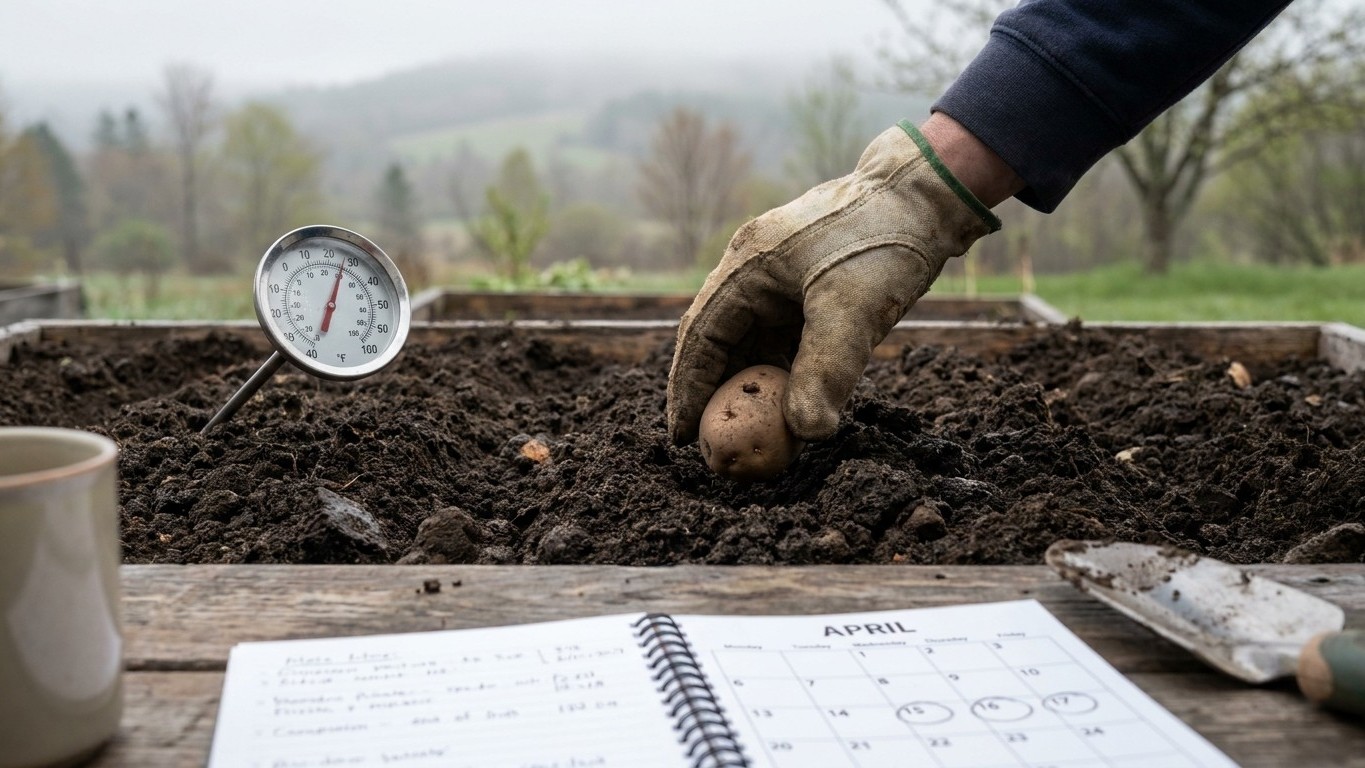
Air can feel like spring days before the ground agrees. Potato seed pieces set into cold, wet soil rot before they sprout, or sprout weakly into disease. Both Utah State and the University of Maine point to the same threshold: soil at 50°F is the signal to plant, not a date on the wall. The 14-to-21-day gap ahead of the mean frost date is an approximation built around how quickly soil in a typical spring warms relative to air. A gardener with a raised bed, sandy soil, or a south-facing slope may hit 50°F well ahead of that window. Heavy clay soil, low ground, or a shaded plot may lag behind it. The frost-date math gets you in the neighborhood; a soil thermometer pushed a few inches down tells you the actual moment.
The heat ceiling that governs the other end of the season
The planting date matters because of what happens months later. Both extension sources describe the same mechanism from the opposite direction: once soil temperatures climb above 90°F, tuber set and tuber fill shut down. Watering more doesn’t reverse it. This is the reasoning tool that carries beyond New Brunswick: in any region, the question isn’t just “when is it safe to plant” but “how many days of workable soil temperature sit between the spring 50°F mark and the point where summer soil crosses 90°F.” Where that window is short, planting early and harvesting a spring crop before the heat arrives matters more than any calendar date. Where summers stay cooler, as much of New Brunswick does, that ceiling binds less often, but a warm, exposed, or sandy plot can still cross it in a hot stretch.
How to do it
- Find the last-frost figure for the station nearest your own garden, not just the Moncton average, since northern and upland districts run behind it.
- Count back 14 to 21 days from that local date to mark the earliest planting window, following the Utah State and University of Maine guidance.
- Push a soil thermometer a few inches into the bed and track it directly instead of trusting the calendar alone; wait until it holds at 50°F rather than spiking there for a single warm afternoon.
- Buy certified seed potatoes rather than saving grocery-store tubers or last year’s leftovers, since uncertified stock carries virus into the row before the season even starts.
- Pick a season class, early, mid-season, or late, based on how much of the summer heat window you want the crop to avoid, rather than chasing a specific days-to-maturity number no extension source publishes.
- Cut and prepare seed pieces once the soil has crossed 50°F and the ground is workable, not waterlogged from spring melt.
- If your plot runs warmer than average, watch soil temperature through the season; once it nears 90°F, recognize that irrigation won’t restart tuber sizing, and plan harvest timing around that ceiling instead.
What goes wrong
- Planting strictly by the calendar date, ignoring the ground itself. A mild spring can push the mean frost date’s usefulness aside entirely if the soil is still cold and wet. Remedy: confirm 50°F with a soil thermometer before planting, regardless of what the date says.
- Treating the mean frost date as a safe date. Because it’s an average, frost lands after it in roughly half the years on record. Remedy: keep row cover or extra mulch on hand through the following couple of weeks rather than assuming the risk is over.
- Borrowing Moncton’s figure for a garden far from Moncton. A single station describes a single location’s climate. Remedy: pull the last-frost record for the station closest to the actual garden, especially in northern or upland parts of the province where spring runs later.
- Using saved or store-bought potatoes as seed. Uncertified seed potatoes carry virus into the soil, and that problem doesn’t announce itself until yields disappoint later in the season. Remedy: start with certified seed potatoes every time, no exceptions for convenience.
- Watering harder once the crop stalls in a hot stretch. Once soil crosses 90°F, tuber set and fill are inhibited by the heat itself, not by lack of moisture. Remedy: recognize the ceiling for what it is, and lean on an early planting date and a spring harvest window instead of trying to push a crop through peak summer heat.
Common questions
What if I don’t know the last-frost date for my exact town?
This page’s figure is specific to the Moncton station. A different community, especially one further north or at higher elevation, should look up its own nearest station’s normals rather than applying Moncton’s May 23 mean, since the gap between locations in the same province can run to weeks.
Can I plant before the average last-frost date on purpose?
Growers routinely do, which is exactly why the 14-to-21-day, soil-temperature-based rule from Utah State and the University of Maine exists separately from the frost date itself. The soil temperature reading, not the date on the wall, is what determines whether seed pieces will rot or sprout.
Does the variety I choose change when I should plant?
The season class, early, mid-season, or late, affects how long the crop needs and how it lines up against the summer heat ceiling, but it doesn’t change the 50°F soil trigger for planting day itself. Neither Utah State nor the University of Maine publishes a days-to-maturity figure for specific varieties, so plan around season class rather than a fixed day count.
Is it really a problem to plant uncertified seed potatoes from the grocery store?
Yes. Uncertified tubers can carry virus that certified seed programs are specifically designed to screen out, and that risk sits invisibly in the seed piece until the plants underperform later in the season. It’s a one-time decision at planting that shapes the whole crop’s health.