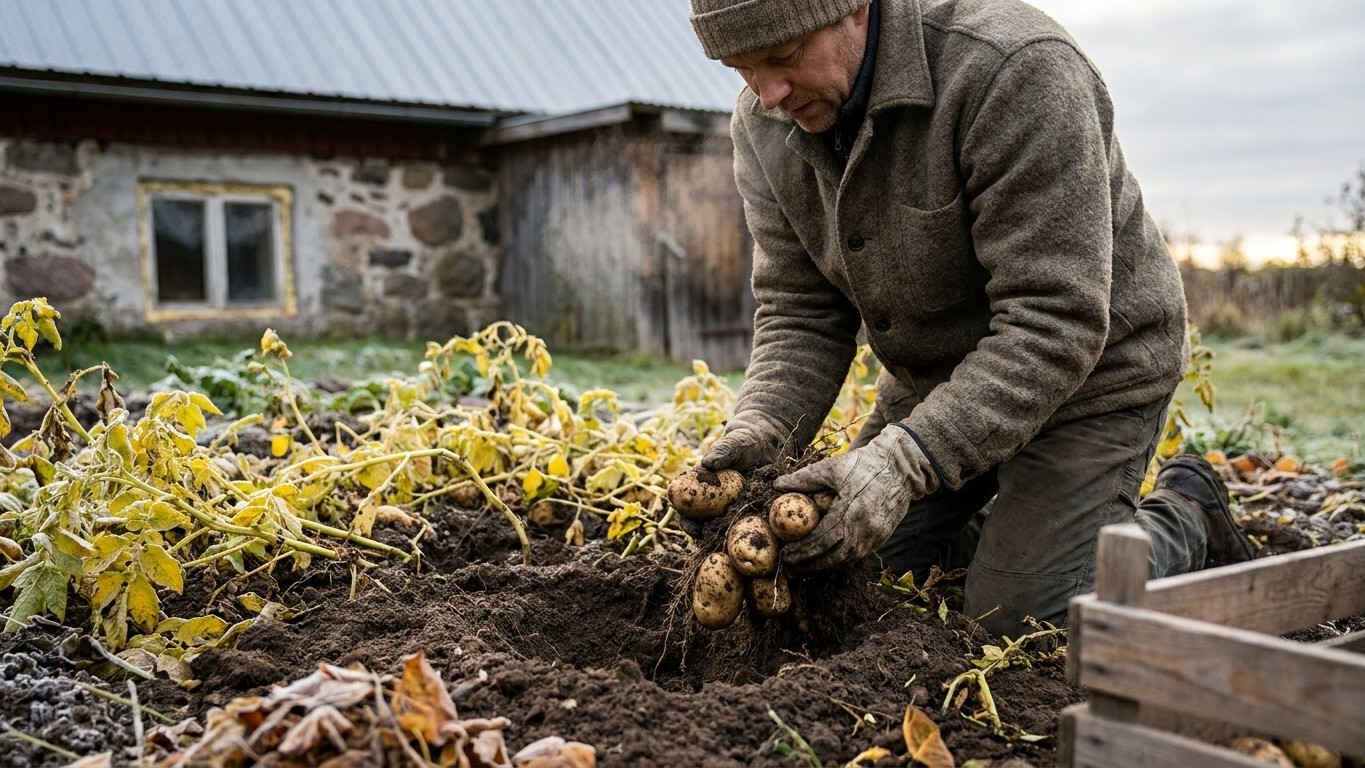

Potatoes need to come out of Northwest Territories ground before the region’s cold truly sets in, and they need a storage spot that never sees the -20 F depths of a Yellowknife January. An unheated shed or garage will not hold the 40-45 F range potatoes need, only a heated basement, an insulated root cellar with supplemental heat, or something similar works here. Curing before storage needs a mild, humid spot for two to three weeks, and that spot is harder to find in this climate than it sounds.
The short answer
Two figures set the calendar for potato growers around Yellowknife and across the Northwest Territories. Environment and Climate Change Canada’s Canadian Climate Normals, drawn from 1981-2010 records at the Yellowknife A station, put the average first fall frost at September 18. The same normals put the mean daily minimum temperature of the coldest month at -21.1 F.
That frost date is a midpoint, not a promise. In roughly half the years on record, the first frost at that station actually arrived later than September 18, some years earlier, some later. It’s also a single-station figure. The Northwest Territories is a vast territory, and communities north of Yellowknife or at higher elevation can expect frost weeks ahead of that date, not weeks behind it. Treat September 18 as the center of a window, and dig with margin on either side of it.
In practice, that means most tubers should be out of the ground by mid-September, once the vines have yellowed and started to die back naturally. Waiting for a hard freeze to kill the tops is not a safe strategy here, a killing frost and a frozen crop can arrive on the same night. Growers who track the weather closely and pull the crop a few days ahead of a forecast cold snap fare better than those who wait for the calendar to tell them it’s time.
The second figure answers the storage question before it’s even asked. A mean daily minimum of -21.1 F for the coldest month means an unheated structure here isn’t flirting with frost on the odd cold night, it’s sitting well below freezing for weeks on end, night after night, as an average condition. No unheated garage, porch, or shed in this climate will hold anywhere near the 40-45 F that stored potatoes require. Anything left in one without supplemental heat will freeze solid, and there’s no recovering a frozen potato. Storage here has to happen inside a heated building, or in a space engineered with insulation and a heat source strong enough to counter that -21.1 F baseline.
Curing, and where
Curing is the step between the field and the storage room, and skipping it or doing it in the wrong conditions is one of the fastest ways to lose a crop to rot over the winter. Utah State University Extension recommends curing at 55-60 F with high humidity for two to three weeks before potatoes go into long-term storage. That window lets cut and bruised skin heal over, which matters more in a climate where every tuber gets handled roughly digging out of cold, often heavy soil.
Finding 55-60 F outdoors in the Northwest Territories at harvest time is close to impossible. Harvest lines up with the approach of that September 18 average frost date, which means ambient outdoor temperatures are already trending down, not holding steady in the mid-50s. A shaded porch, which might work farther south, isn’t a realistic curing spot here, by the time the crop is out of the ground, outdoor air is too unpredictable and too often too cold. An unheated garage carries the same problem; it will track outdoor temperatures closely and can drop below curing range within days of harvest.
The one space that reliably holds curing conditions in this climate is inside a heated home, typically a basement room, a spare closet near interior walls, or any interior space that a household already keeps warm through the shoulder season. That’s the practical answer for most growers here: cure indoors, not outdoors.
Curing steps for this climate
- Dig on a dry day, as close to the historical September 18 frost average as the weather allows, and earlier if a hard freeze is forecast.
- Brush off loose soil by hand rather than washing the tubers, since wet skin cures poorly and invites rot.
- Move the crop indoors immediately, into a heated basement room or interior space that can be held near 55-60 F, not left in an unheated garage or shed.
- Spread tubers in a single layer and cover loosely with damp burlap or cardboard to keep humidity high without trapping condensation directly on the skins.
- Hold at that temperature and humidity for two to three weeks, checking periodically and pulling out any tuber that shows soft spots or breaks down.
- Once skins have set and healed, move the cured potatoes to their winter storage location.
Storing through this winter
Once cured, potatoes want darkness and a steady 40-45 F, according to Utah State University Extension. The University of Maine Cooperative Extension gives a tighter target for longer holding: 38 F at 95 percent humidity. Both figures assume a space that can be controlled, and that’s the catch in a territory where the coldest month averages -21.1 F for its daily minimum.
A root cellar dug into open ground works well in milder climates because soil several feet down stays close to a constant temperature year-round. That principle gets complicated across much of the Northwest Territories, where permafrost sits close to the surface in many areas and ground conditions don’t behave the way they do farther south. A cellar that isn’t attached to a heated structure, or that isn’t built with real insulation and a backup heat source, will follow the outdoor cold rather than buffer against it, and at -21.1 F average lows, that means freezing, not the 38-45 F range potatoes need.
The workable options in this climate are spaces tied to a heated building: a corner of a heated basement that stays cooler than the living space above it, an insulated room built into or against a heated structure, or a purpose-built storage unit with its own thermostatically controlled heat. The goal is to land somewhere between the University of Maine’s 38 F and Utah State’s 40-45 F, in the dark, with humidity high enough to keep skins from shriveling but not so wet that rot takes hold. A thermometer left in the storage space through the coldest weeks is the only reliable way to know which side of that line a given spot actually sits on, guessing based on how a room feels isn’t precise enough when the outdoor baseline is this severe.
What goes wrong here
- Frost catches the crop before harvest. Because September 18 is only an average, waiting for that exact date to start digging can mean losing tubers to an earlier freeze. Watch the forecast in early September and dig ahead of any cold snap rather than by the calendar alone.
- Curing happens in a space that’s already too cold. A porch or unheated garage cools fast once harvest season arrives, and skins never properly set at temperatures well below Utah State University Extension’s 55-60 F range. Move the crop indoors to a heated room instead.
- Storage relies on an unheated outbuilding. A shed or detached garage will track the region’s -21.1 F mean coldest-month minimum, freezing stored potatoes solid. Store inside a heated structure, or add real insulation plus a heat source strong enough to hold 38-45 F.
- Storage sits too close to a furnace or heat duct. The opposite failure also happens: a basement corner near a heating source climbs well above 45 F, and potatoes sprout early. Choose the coolest interior spot in a heated home, away from ductwork and appliances that generate warmth.
- Humidity runs too low in a heated space. Indoor heated air in winter is often dry, and potatoes stored in it shrivel even if the temperature is correct. Covering bins loosely with damp burlap helps hold humidity closer to the University of Maine’s 95 percent target.
Common questions
Is September 18 a safe date to plan around for harvest in the Northwest Territories?
It’s an average from Yellowknife A station records covering 1981-2010, not a safe date. Frost arrives later than that in roughly half of all years, and earlier in the other half, so treat it as the center of a window and watch local forecasts as harvest time approaches.
Can a root cellar work at all in this climate?
Only if it’s attached to a heated structure or built with substantial insulation and a supplemental heat source. A freestanding cellar relying on ground insulation alone runs into the region’s shallow permafrost and the -21.1 F mean minimum of the coldest month, both of which push against the stable, moderate temperatures a traditional cellar depends on.
What temperature should stored potatoes actually be held at?
Utah State University Extension recommends 40-45 F in the dark, while the University of Maine Cooperative Extension specifies 38 F at 95 percent humidity for longer-term holding. Either range works; what matters is that the space stays inside that band consistently, which in this climate requires a heated or actively insulated location.
How long does curing take before potatoes go into storage?
Utah State University Extension calls for two to three weeks at 55-60 F with high humidity. In the Northwest Territories, that almost always means curing indoors in a heated home, since outdoor conditions at harvest time rarely hold in that range.