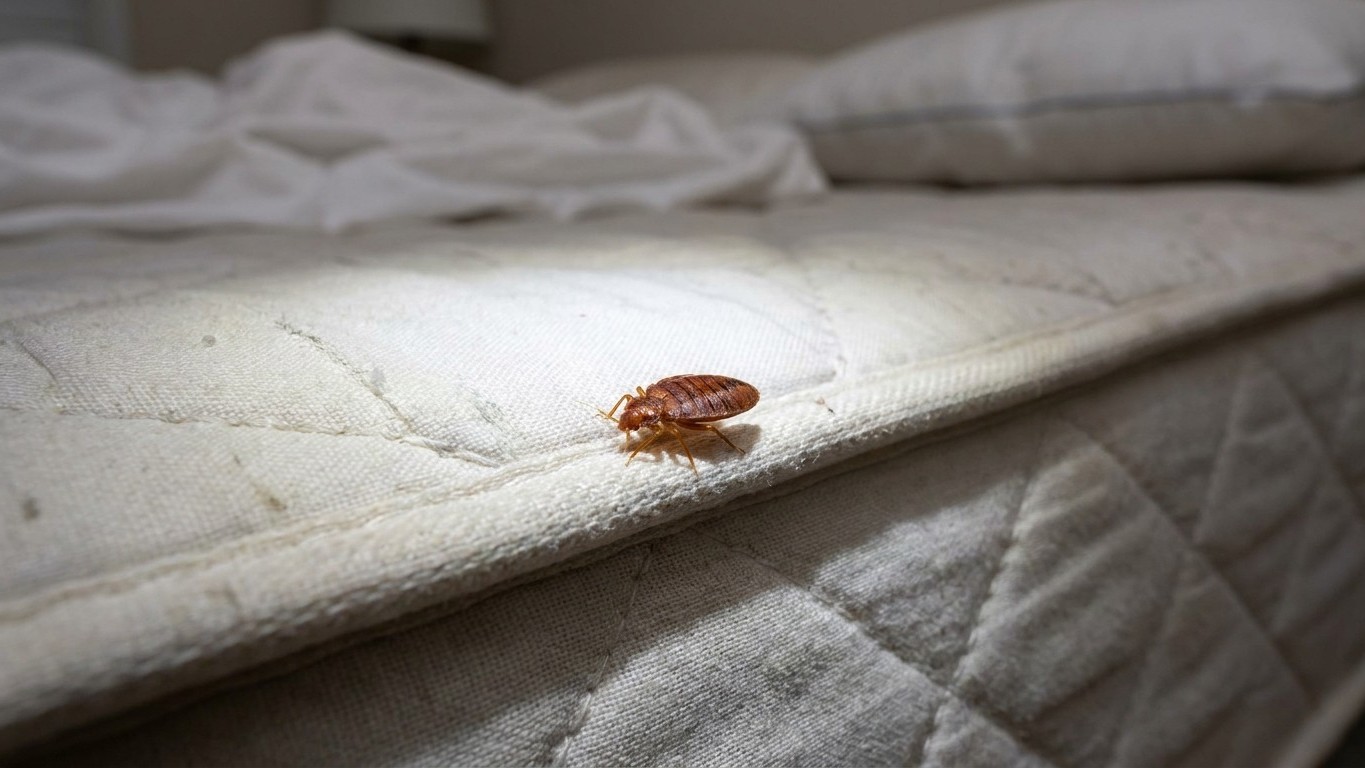

Bed bugs in the house means an infestation problem, not a hygiene failure. A single mated female riding home in a suitcase seam or a secondhand couch is enough to start a colony, and the fix depends on catching it early, confirming the species correctly, and working through pest control in the right order rather than reaching straight for a spray.
What you are dealing with

The insect responsible is Cimex lectularius, a flat, reddish-brown bug about the size of an apple seed that feeds exclusively on blood, usually while a person sleeps. The detail that changes everything about how you respond is this: bed bugs are a transport problem, not a cleanliness one. A spotless house with hardwood floors and nothing under the bed can host an infestation just as easily as a cluttered one, because these insects don’t come for crumbs, standing water, or anything you left out. They come for a blood meal and a dark seam to hide in afterward, full stop.
That’s why the usual advice for ants or roaches, seal the food, dry out the sink, doesn’t translate here. Bed bugs travel on the things people carry: a suitcase pulled from a hotel luggage rack, a used mattress picked up at a yard sale, a work bag set down in a break room that happens to be infested, a moving box that sat in a storage unit next to someone else’s stuff. They ride in on you, not toward you.
Three questions tend to follow once someone suspects bed bugs in the house, and each one deserves more room than a summary can give it. The first is how to tell bites and bug sightings apart from other household pests that get blamed for the same marks. The second is how an infestation actually got started, since knowing the entry point matters for stopping the next one. The third is what an effective response looks like, step by step, without wasting money on treatments that don’t touch the problem.
Why the transport detail matters for control
Because bed bugs don’t depend on food debris or moisture in the home, removing those things won’t discourage them the way it discourages ants or pantry pests. Control has to target the insects directly, in the places they hide, which is a different job than general cleaning.
Recognizing them
The signs that get reported most often are small reddish or rust-colored spots on sheets (crushed insects or fecal marks), tiny pale eggs and shed skins tucked into mattress seams, and bite marks that show up in a line or cluster on skin that was exposed overnight. None of these on their own confirms an infestation, and that’s exactly where confusion sets in. Bite reactions vary enormously from person to person, some people show welts within hours and others show nothing at all even when bites happened, so relying on skin marks alone leads to both false alarms and missed infestations.
Fecal spotting and shed skins get mistaken for other things too: carpet beetle debris, dust mite residue, or plain dirt on a mattress seam. A magnifying glass and a flashlight, checking the piping along a mattress edge and the corners of a box spring, settles more of these cases than people expect. The full breakdown of what counts as reliable evidence, what mimics it, and how to search a bedroom systematically is covered on the signs of bed bugs page, which is the right next stop if you’re trying to confirm or rule out an infestation rather than just react to a few marks on your arm.
Why they are here
Bed bugs don’t need food debris, standing water, or clutter to move in, which is part of why they show up in five-star hotels as readily as in any other building. Their version of “food” is a sleeping host, their shelter is any tight, dark seam close to where that host rests, and water plays essentially no role in drawing them in. That combination is what makes them different from almost every other household pest, and it’s why prevention advice built around sanitation misses the point entirely.
What actually invites them in is contact with an infested item: a piece of used furniture, luggage that sat in an infested room, clothing brought back from a trip without being washed and dried on high heat. Multi-unit housing adds another layer, since bed bugs can travel along shared walls, through electrical outlets, and via hallway carpet between adjoining units, which is why an infestation in one apartment can become a building-wide problem if it isn’t addressed quickly.
The U.S. Environmental Protection Agency frames prevention as the starting point for managing any pest, stating that “as a first line of pest control, IPM programs work to manage the crop, lawn, or indoor space to prevent pests from becoming a threat.” For bed bugs specifically, that means inspecting secondhand items before they enter the home, using protective encasements on mattresses and box springs, and checking luggage and clothing after travel, since prevention here is about intercepting the insect before it ever settles in rather than removing something it was attracted to. The full list of entry points and the situations that raise risk the most, including travel patterns and shared housing, is laid out on the causes of bed bugs page.
What works
The EPA describes Integrated Pest Management as “an effective and environmentally sensitive approach to pest management that relies on a combination of common-sense practices,” and the order it follows matters as much as the individual steps. IPM “first sets an action threshold, a point at which pest populations or environmental conditions indicate that pest control action must be taken,” rather than treating at the first sighting or, worse, treating preemptively with no confirmed activity at all.
After that threshold is met, the next step is identification: IPM programs “work to monitor for pests and identify them accurately, so that appropriate control decisions can be made,” which for bed bugs means confirming the species and mapping where they’re hiding before choosing a response. Only then does the framework move toward action, and even then it starts with the least aggressive options. The EPA notes that “effective, less risky pest controls are chosen first, including highly targeted chemicals, such as pheromones to disrupt pest mating, or mechanical control, such as trapping or weeding,” and that “broadcast spraying of non-specific pesticides is a last resort.” A room-by-room walkthrough of that sequence, adapted to bedrooms, furniture, and travel gear, is the subject of the bed bug control page.
When a professional is the right call
Bed bugs sit in the same category as termites and structural rodent infestations: past a certain point, they are beyond what a householder can reliably resolve alone. Their eggs resist many surface treatments, they hide in places a homeowner won’t think to check (behind baseboards, inside electrical outlets, under wallpaper seams), and an incomplete treatment often just scatters the population into neighboring rooms or units. A licensed pest control professional has access to heat treatment equipment and inspection tools that go well beyond what’s practical to buy or rent for a single infestation. If sightings continue past one or two DIY attempts, or if the infestation spans more than a single room, that’s the point to call one in rather than escalating home treatments further.
Any pesticide used against bed bugs, professional or over the counter, is intended to be toxic to the insect, and the EPA is direct that these products can also be toxic to people when used improperly, with children, older adults, and people with compromised immune systems named as especially vulnerable. Questions about a specific product’s safety or proper use are best directed to the National Pesticide Information Center at 1-800-858-7378 rather than guessed at.
Common questions
Can bed bugs live somewhere other than the bed?
Yes. Despite the name, they hide in couch seams, behind headboards, inside electrical outlets, and along carpet edges near baseboards, anywhere close to a spot where a person sits or sleeps for extended periods.
Do bed bugs mean a house is dirty?
No. Since they’re drawn to a host rather than to food debris or clutter, infestations occur in clean, well-kept homes as often as in cluttered ones. Clutter mainly makes an existing infestation harder to find and treat, not more likely to start.
How long can bed bugs survive without a blood meal?
They can go extended periods between feedings, which is part of why an empty house or a vacant rental unit doesn’t automatically clear an infestation on its own timeline that a homeowner can count on.
Should I throw away infested furniture?
Not always, and encasements or targeted treatment often save a mattress or couch that would otherwise be discarded unnecessarily. If an item is removed, it should be sealed and clearly marked as infested to avoid seeding a new infestation elsewhere, including in someone else’s home if it’s set out for donation or curbside pickup.