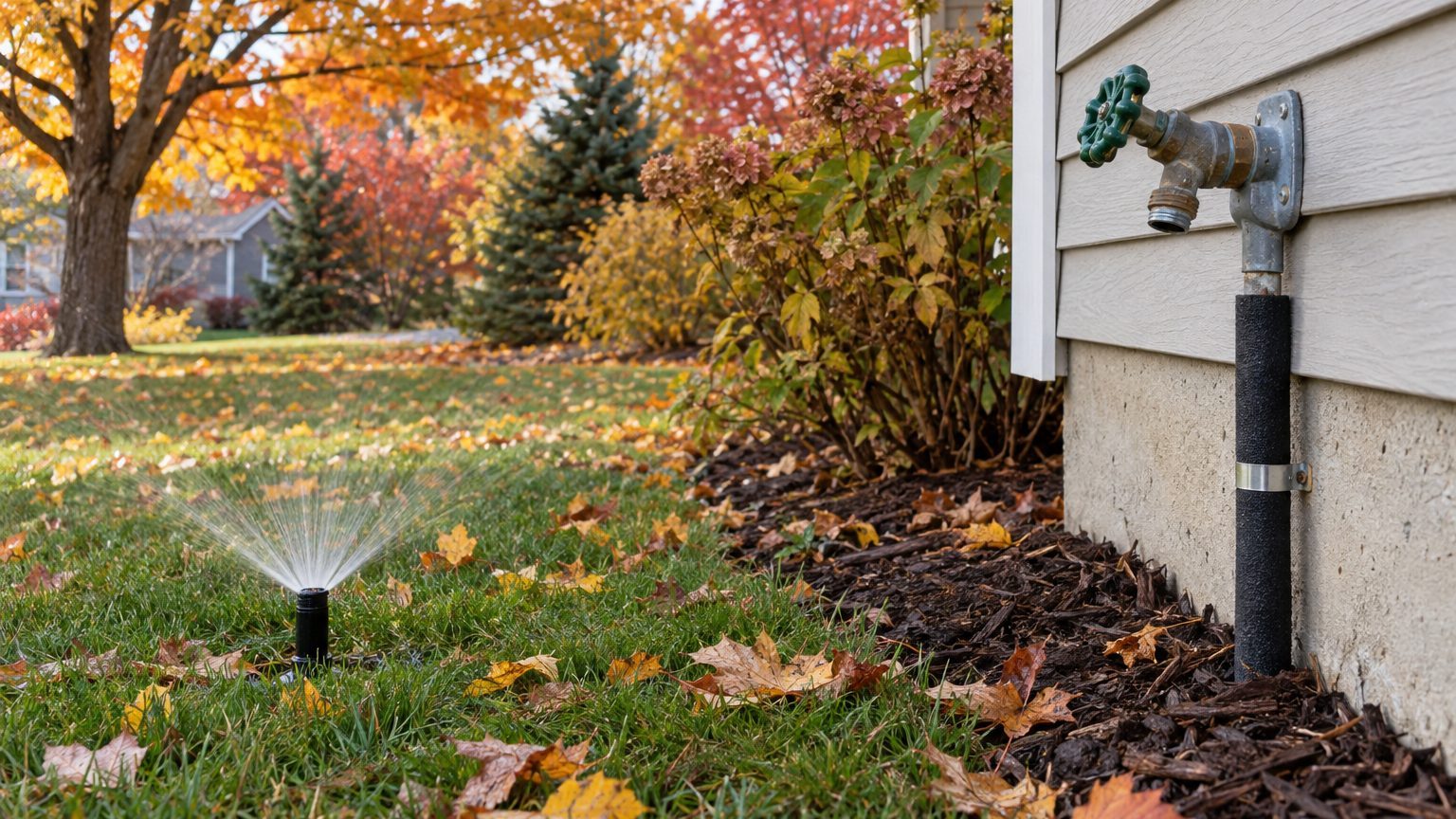

Sprinkler lines and outdoor taps need to be drained before the ground and pipes freeze, and in New York that deadline arrives sooner than most people expect. The first hard freeze often shows up before anyone has taken the first light one seriously. A split pipe stays hidden until the water comes back on in spring. The routine is short: shut off the supply, clear the lines, disconnect the hoses, open the taps. The timing and the right method for this climate take a little more explaining.
When to do it in New York
In New York City, the first fall frost normally arrives between November 14 and November 27, so plan to have sprinklers and outdoor faucets drained before that window opens. The rule is to act before the first hard freeze, not after the first light one.
That range comes from the NOAA NCEI U.S. Climate Normals for 1991-2020, which mark the dates when the odds of a 32°F reading at the Central Park station run between 30 and 70 percent. Finish the shutdown before the November 14 to November 27 window opens, and the job is done well ahead of the first cold night in the forecast. The window starts at 30 percent odds, which means a freezing night before it is far from rare.
Draining the lines is not optional in this climate. NOAA’s 1991-2020 normals put the mean daily minimum of the coldest month at about 28°F for the Central Park station. That is an average of all the nights in that month, so many nights run colder. In mild-winter places where nights stay above freezing, skipping the blowout is a reasonable call. Here, water left sitting in a line will freeze in a typical winter.
How do you tell a light frost from a hard freeze?
A light frost leaves a thin white film on the grass after a night that dips briefly under 32°F. It kills tender annuals, but buried lines and the soil around them hold some warmth, so most plumbing comes through. A hard freeze is a night, or a run of nights, when temperatures stay below freezing for hours. The parts that fail first are the ones sitting in open air: hose bibs, above-ground backflow assemblies, exposed pipe near the house, and valves in shallow boxes.
Watching the forecast helps, but the first light frost is easy to dismiss because nothing bad seems to happen. The first night that does freeze pipes can arrive the same week. Treat a forecast of overnight lows at or below freezing for several hours as a deadline you have already missed.
Does the date shift outside the city?
Yes, and mostly toward earlier dates. Central Park is a dense urban site, where buildings and pavement hold heat. Upstate New York and the Adirondacks frost far earlier in fall, and the colder the spot, whether farther north or higher in elevation, the earlier the first freeze. Anyone there should finish well ahead of the New York City window. Open suburban and rural lots also cool faster than the city core. The county extension office can give you the local frost normals.
The USDA Plant Hardiness Zone Map 2023 spans many zones across the state, from roughly 4a in the Adirondacks to 7b in New York City, based on average annual extreme minimum temperature. That spread is why a single date for the whole state would mislead people. The November 14 to November 27 range describes the city.
Sprinkler lines: drain or blow out
Water expands as it turns to ice, and a closed pipe has nowhere to let that expansion go. The ice pushes against fittings, valve bodies and pipe walls until the weakest point gives. That is usually a threaded joint, the plastic body of a valve, a sprinkler head riser, or the backflow preventer sitting above ground. A long straight run of pipe is less likely to split. The damage stays invisible all winter. In spring, when pressure returns, it shows up as a wet patch, a geyser at a head, or a zone that will not shut off.
Water collects in predictable places: low spots in the lines, the valves, the heads, and the stretch of pipe between the main shutoff and the backflow preventer. Deeper buried pipe is safer than the shallow lateral lines and the above-ground parts. With a coldest-month average minimum of about 28°F at the Central Park station, trapped water has plenty of nights to freeze.
Which method fits: manual drain, automatic drain or blowout?
The three approaches differ in how thoroughly they empty the system.
| Method | How it works | Where it falls short |
|---|---|---|
| Manual drain | Shut the main supply, then open drain valves at the low points so gravity empties the lines | Needs drain valves installed at the right spots; water can stay in heads and in pipe that does not slope |
| Automatic drain | Small valves open on their own when line pressure drops and let water out | Can stick or leave pockets of water; best treated as a backup |
| Compressed-air blowout | Air pushed through each zone forces water out through the heads | Needs a compressor with enough airflow and careful pressure control; carries a safety risk |
Because water left in a line will freeze in an ordinary New York winter, compressed air is the method that matches the climate. Manual and automatic drains still get most of the water out, and they work well on systems installed with the right slope. Air confirms that the heads and the dips are empty. Blow out every zone with compressed air, and treat manual or automatic drains as the backup.
What does a blowout involve?
The details vary by system, so the sprinkler manufacturer’s pressure limits come first. The general sequence looks like this:
- Shut off the water supply to the system and open a drain or test valve to bleed off pressure.
- Set the controller to off or rain mode so no zone starts on its own.
- Connect the compressor at the blowout port, with the regulator set within the manufacturer’s limit.
- Run one zone at a time, starting with the zone farthest from the connection, until the heads stop spitting water and only a faint mist comes out.
- Move through every zone, then leave the drain valves open for the winter.
Keep air from running in a single zone longer than necessary, because dry heads can be damaged. Wear eye protection, since pressurized lines throw debris. Give the lawn one last deep watering before you shut things down, and see Winterizing a Lawn for the rest of the fall routine.
Hiring a professional is the sensible choice in a few situations. One is a system with no blowout port or no clear main shutoff. Another is a small portable compressor that cannot move enough air, which leaves water in the farthest zones. A third is a large system with many zones, or one where nobody knows the pressure ratings. Backflow preventers can also need certified testing, so ask your water supplier what applies to your system.
Outdoor faucets and hoses
Start outside. Disconnect every hose from every tap, along with splitters, nozzles, timers and sprayers. Drain each hose and coil it off the ground. Then go inside and find the interior shutoff valve for that tap, usually in a basement or crawl space near the wall where the faucet sits. Close it. Back outside, open the tap to drain whatever water sits between the valve and the spout, and leave it open for the winter so any trace left has room to expand. Hoses off, interior valve closed, outside tap left open is the sequence to remember.
Turning valves is the whole job. If you cannot find an interior shutoff, if it will not close, or if the tap keeps dripping after you shut it, call a plumber. Anything beyond turning valves is plumbing work, and a mistake behind a wall is expensive to find.
Why does a frost-free faucet still freeze with a hose attached?
A frost-free faucet has a long stem that puts the valve seat well inside the heated part of the house. The pipe barrel around the stem tilts slightly downward, so when the faucet is shut, the water in it runs out. That design only works if the water can leave. A hose left attached, even a short one or one with a closed nozzle, traps water in the barrel. It freezes in the section close to the exterior wall, and the ice can split the pipe, often inside the wall.
Nothing leaks in winter, because the valve seat is closed and holds the water back. The first sign comes in spring, when you turn the tap on and water sprays into the wall cavity. A faucet that was installed without its slight downward tilt can hold water even with no hose on. Frost-Free Outdoor Taps covers how these faucets work and how to check one, and Winterizing Outdoor Faucets Before the First Freeze goes deeper on the full routine for both kinds of tap.
Foam covers slow heat loss around the tap, which helps on a cold night once the tap is drained. They are an extra layer after the real work and never replace it. A conventional tap with no frost-free stem and no interior shutoff is the one most likely to fail, so give it the most attention.
What goes wrong here
What does an early cold snap do to undrained lines?
A common failure is simply being late. The New York City window of November 14 to November 27 begins at 30 percent odds of a 32°F night, so a freeze before the window is a real possibility in the city. In the colder parts of the state it is the normal pattern, because the first freeze comes earlier. In spring, an undrained system shows it with a geyser at a head, a cracked riser, a soggy patch over a buried pipe, or pressure that drops when a zone runs. Schedule the shutdown for the weeks before the November 14 to November 27 window. Upstate, set it earlier still. A reminder on the calendar and a compressor lined up ahead of time beat a scramble on a cold evening.
What happens when a hose is left on a tap?
A forgotten hose is the quiet one. It is usually the hose on the side of the house, behind shrubs, or on a reel in the garage. In spring the sign is water spraying inside the wall when the tap is first opened, a hissing sound, or a stain on a basement ceiling or wall near the faucet. Prevention is a walk around the property with a short checklist: front, back, side, garage, shed, and any tap hidden by plants. If you suspect a tap or pipe has already frozen, Frozen Pipes explains what to do before it thaws.
Why do sprinkler valve boxes flood?
The green box in the lawn that holds the valves sits below grade, so rain and groundwater collect in it. A box full of water freezes solid around the valves and can crack a valve body, a solenoid or the fittings. In spring you may see a zone that will not shut off, a valve that weeps, or a box standing in water. Open the box in fall, clear out leaves and debris, and check that the lid is intact and the box is not sitting in a puddle. Regrade the soil if water runs toward it. Replacing a cracked valve is a job for a sprinkler or plumbing professional.
Common questions
When should I winterize my sprinkler system in New York?
Before the first hard freeze. In New York City, the first fall frost normally comes between November 14 and November 27 according to the NOAA climate normals, so the system should be drained before that window. Upstate New York and the Adirondacks frost far earlier, and the shutdown moves earlier with them. Other seasonal routines for the state are collected in the New York guides.
Can I wait until I see the first frost?
You can, but the margin shrinks. A rainy weekend, a work trip, or a sudden cold night can use it up before the job is done. The first frost on the grass is a warning that the season has turned, and the lines themselves can freeze within days of it. Doing the work before the frost window opens costs one afternoon, and a split pipe costs a spring repair.
Does a frost-free faucet need winterizing?
Yes, but the job is smaller. Remove the hose and every attachment so the barrel can drain. If the tap has an interior shutoff, close it and open the outside tap to let it empty. A frost-free faucet only protects itself when nothing is holding water inside it.
What if a freeze already hit before I drained everything?
Keep the system off and do not run any zone until temperatures have climbed and everything has thawed. Then check the heads, the valve box, the backflow assembly and the walls near each outdoor tap for leaks. If you find a leak, shut the supply valve and call a professional. Finish the draining right away, since more cold is likely. A small crack can stay sealed by ice and only start leaking as it warms, so look again after the thaw and once more when the system first runs in spring.