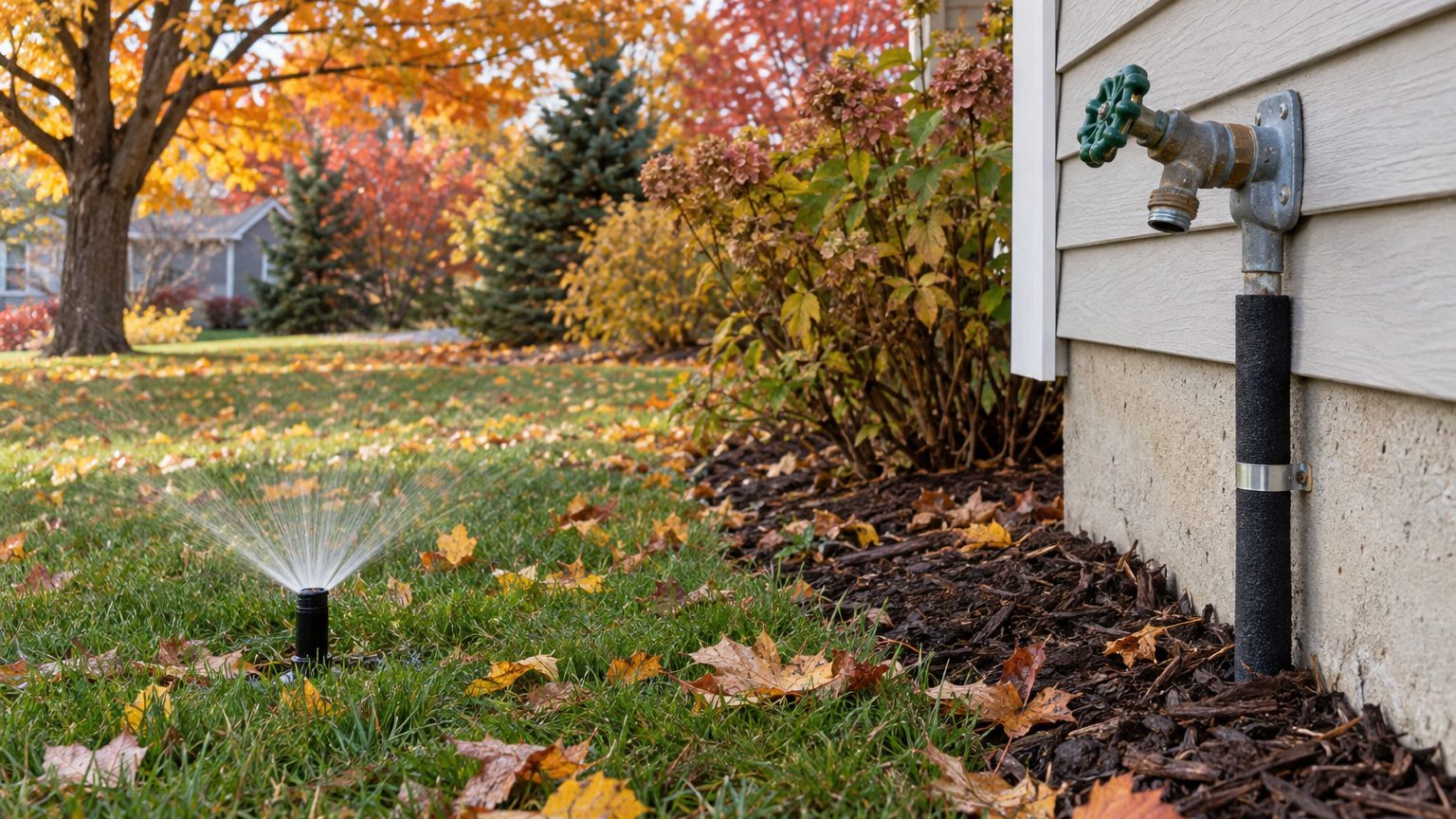

Texas has no single winterizing date, because the first hard freeze can arrive weeks apart in the Panhandle and on the Gulf Coast. Finish before your area’s first freeze, and let the forecast decide the last steps. Along the upper Gulf Coast, the job is lighter than most northern advice suggests. In colder parts of the state, a full sprinkler drain belongs on the early-fall list. Readers elsewhere in the state can find regional timing in the Texas guides.
When to do it in Texas
In the Houston area, the first 32°F freeze typically falls between December 1 and December 19 in the NOAA NCEI 1991-2020 Climate Normals for Houston Intercontinental, so the work belongs in November: before the first hard freeze, not after the first light one. Finish hoses, faucet covers and the sprinkler shutdown in November, ahead of the December 1 to December 19 freeze window.
What does the December 1 to December 19 window actually mean?
That range comes from NOAA’s freeze probabilities. It marks the stretch of dates when the odds of a 32°F reading reach somewhere between 30 and 70 percent. Early in the window a freeze is still less likely than not. By the end, it is more likely than not. A freeze can still come before December 1, because the range describes typical odds and says nothing about any one year.
The window also moves with the map. Houston Hobby airport typically sees its first freeze later than Intercontinental, so a house near the Gulf can sit later in the window than one north of town. Farther north, the first fall freeze comes earlier, and so does the winterizing. The Panhandle freezes much sooner than the Gulf Coast, and North Texas and the Hill Country fall in between. The USDA Plant Hardiness Zone Map 2023 runs from about zone 6 in the northern Panhandle to zone 10 in the far south, which tells you how far apart the two ends are. Anyone outside the Houston area should start in early or mid fall and check the local freeze outlook with the county extension office.
The difference matters because pipes and valve bodies take sustained cold to freeze solid. That is why the forecast overnight low and the length of the cold matter more than a single reading.
Do you need a full blowout on the Gulf Coast?
Often, no. The normal daily minimum of Houston’s coldest month (January) is 43.7°F in the NOAA 1991-2020 normals, well above freezing. Most winters, buried sprinkler lines never see damaging cold. A full compressed-air blowout every fall is usually more than the climate asks for.
The risk comes from the rare hard-freeze night, and it falls mostly on parts above ground. What is worth doing is short: pull hoses off every spigot, cover the outdoor faucets, shut off the water to the irrigation system, and wrap the exposed backflow assembly in an insulated cover. Turn the controller to its off or rain setting so zones do not run in a freeze. Find your main shutoff before you need it. When a hard freeze shows up in the forecast, a few of these steps are all you have time for, so do them in November while the weather is easy.
Sprinkler lines: drain or blow out
Water expands when it freezes. Trapped between closed valves in a sprinkler line, it has nowhere to go, so pressure builds until something gives. Fittings crack, valve bodies split, and the above-ground backflow assembly is among the most exposed parts of the system. The damage stays hidden through winter. It shows up in spring, when the water is turned back on and pressure returns.
Manual drain, automatic drain or compressed air?
A manual drain uses valves at the low points of the system. After the supply is shut off, someone opens them and gravity empties the lines. It works well when the system was built with sloped pipe and drain valves, and it costs nothing but a short trip around the yard. It leaves some water behind in any section that does not slope toward a drain.
Automatic drain valves open on their own when line pressure drops and let the water out at the low points. They suit mild climates well, since the freezes are short and shallow. Grit can hold one open or shut, and each valve only drains the pipe around it. Check them in fall by watching whether water runs out after the system shuts down.
A compressed-air blowout is the most thorough method. Air pushes water out of each zone and through the sprinkler heads, one zone at a time. It is also the one that can hurt the system. Too much pressure damages heads, valves and fittings, and flying debris is a hazard. For that reason the method belongs to people with the right compressor and a procedure for it.
Which one fits depends on where you live. On the upper Gulf Coast, shutting off the supply, draining the backflow device and checking the low-point drains is generally enough. In North Texas, the Hill Country and the Panhandle, where hard freezes arrive earlier and stay longer, a blowout before the first hard freeze makes sense. On the Gulf Coast, shut off the supply and cover the backflow assembly in November, and save the air blowout for the colder parts of the state.
When should you hire a pro to winterize sprinklers?
Call one when the system has no drain valves, when you do not know where the supply shutoff is, or when you live where a blowout is the right method. A multi-zone system on a large lot also justifies it, since a mistake multiplies across every zone. Pros get booked up fast once the first freeze watch hits, so schedule the visit in fall. Ask whether the technician blows out each zone in turn and drains the backflow assembly. The last irrigation cycle of the season often falls around the same weekend as Winterizing a Lawn, so the two jobs can share a calendar.
Outdoor faucets and hoses
One of the quickest winterizing jobs on the property also helps avoid a costly call to a plumber. It takes only valve turns and a few minutes at each spigot.
How do you drain a standard outdoor faucet?
Start by pulling every hose off, along with splitters, timers and spray attachments. A hose left on holds water against the faucet, and a hose lying in the yard can hold water for weeks. Drain each one, coil it and store it in the garage. If your home has a separate interior shutoff valve for the outside tap, close it. Then open the outside tap and let it drain, and leave it open so any leftover water has room to expand. An insulated cover over the spigot adds protection on the nights when it matters. Our walkthrough on Winterizing Outdoor Faucets Before the First Freeze covers the sequence in more detail.
If your house has no interior shutoff for the outdoor line, leave it alone. Adding a shutoff or replacing a faucet is plumber’s work, and the steps above are as far as a homeowner should go.
Why does a frost-free faucet still fail with a hose attached?
A frost-free faucet has a long barrel with the valve seat set deep inside the heated wall. When the tap closes, the water left in the barrel drains out through the spout, because the barrel is angled down toward the outside. That design only works if the spout is open to the air. A hose, especially one with the nozzle closed, keeps the water in the barrel. The water freezes, the barrel splits, and the break often sits inside the wall where nobody can see it until the tap is turned on in spring.
So even with a frost-free tap, remove the hose before a freeze. The details on how these taps work are covered in Frost-Free Outdoor Taps. Pull every hose off before the first hard freeze, and leave the tap closed and drained afterward. That one habit is the difference between a working spigot in March and a wet wall.
What goes wrong here
A common Texas pattern is a mild fall followed by a sudden hard freeze. People are caught between a warm week and a cold front, with no time to do the job they had planned for later.
What happens when an early cold snap arrives before you have drained?
In spring, the signs show when the system is turned on. A zone loses pressure, a patch of lawn stays soggy, a head sprays sideways, or the backflow assembly hisses and leaks. The water meter keeps moving after the sprinklers stop, which can point to a split somewhere underground or in a valve. Prevention is simple: do the November work early, and keep a short list of last-minute steps for the day the forecast turns. If a pipe has frozen already, the steps in Frozen Pipes apply.
What does a forgotten hose do?
A hose left on a spigot through a freeze often shows up as a spray or drip from the wall when the tap is turned on. Inside, a stain on the drywall or the sound of running water behind it is a sign the barrel split. The fix is cheap if you catch it, since the faucet gets replaced, and expensive if the water ran for hours.
What does a flooded valve box look like in spring?
The valve box is the buried plastic box with the lid that holds the zone valves. If it fills with water over winter, the valves can crack. A zone then fails to shut off, a lawn stays wet, or the water bill jumps. Prevention is to shut off the supply, keep the lid on and secure, and check the box in fall for standing water and debris. Check the valve box lid and every spigot when the first freeze watch appears.
Common questions
Do I need to winterize my sprinkler system in Houston?
Usually a light version is enough. The coldest month’s normal daily minimum is 43.7°F in the NOAA 1991-2020 normals, so buried lines rarely freeze. Shut off the supply, cover the backflow assembly and disconnect hoses in November. Save the full drain or blowout for a year when a hard freeze is forecast.
When is it too late to winterize?
Once the forecast shows a hard freeze, the best window has passed. Pipes are already at risk, and pros are often booked up. Houston’s first 32°F freeze typically lands between December 1 and December 19, so the work is easiest in November. In the Panhandle and North Texas, the same deadline comes earlier in the fall.
Can I just cover my outdoor faucets instead of draining them?
A cover slows heat loss and helps on a light-freeze night. It does not empty the barrel or the hose. Disconnect hoses first, then cover the faucet. In colder parts of the state, close the interior shutoff if there is one and open the outside tap to drain.
Who should do a compressed-air blowout?
A professional with the right compressor and a procedure for each zone. Too much pressure damages heads and valves, and the work throws debris. If your system has drain valves and you live on the Gulf Coast, a pro visit may not be needed at all.